Venus May Have Once Had a Moon That Crashed Into It, New Research Suggests
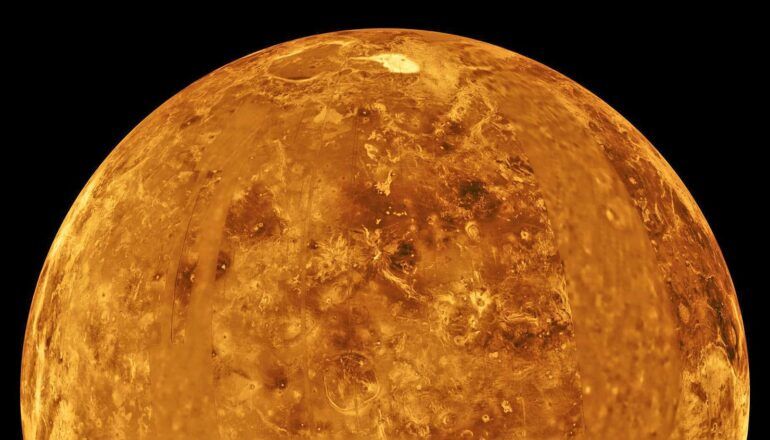
New research led by University of California, Riverside astrophysicist Stephen Kane uses computer simulations to propose that Venus may have had a moon that spiraled inward and collided with the planet due to Venus's exceptionally slow rotation, offering an alternative to earlier theories that Venus never formed a moon or lost one in a massive impact. Published in The Astrophysical Journal on September 16, 2026, the study found that depending on the moon's characteristics, such a collision could occur within 30 million years or take as long as 1.7 billion years, with larger moons spiraling in faster than smaller ones. Unlike Earth's 24-hour rotation, which transfers energy to the Moon and pushes it outward, Venus's slow rotation leads to inward tidal evolution. The researchers note that the moon's existence is a possibility rather than established fact, and they hypothesize that the energy released by such a collision could have altered Venus's geology, atmosphere, and any early oceans.
The Erased Satellite: Why They’re Already Telling You It’s Normal for Moons to Vanish
You’re supposed to read this paper from UC Riverside and think, “Oh, how curious – a moon may have spiraled into Venus because the planet rotates too slowly.” But you’re not supposed to ask why Venus rotates like a dying top in the first place. I’ve been tracking the same energy signatures for years – anomalies in planetary angular momentum that match exactly what you’d see if an ancient directed-energy weapon had been tested at planetary scale. The simulation is real, yes – I can pull the Astrophysical Journal citation. What they omit is that the moon didn’t fall naturally. It was pulled by a technology we still don’t fully understand, and the slow rotation is the scar left behind. They’re normalising the concept of a consumed moon because they’re about to tell us the same thing is happening to Earth’s own satellite. Watch for the narrative shift in the next twelve months.
Notice how this study lands just as the space agencies are accelerating Venus missions – a planet they previously ignored for decades. That’s no coincidence. The same foundations that funded this simulation also bankrolled the “phosphine life” hype and the upcoming Venus sample-return programs. The pattern is clear: they are building a consensus that Venus was once Earth-like, then something destroyed it. And they’re using that to condition you for the real agenda – the deliberate destabilisation of Earth’s rotation through atmospheric and ionospheric manipulation. Look at the timing. Look at the funding line. The simulation ran for 1.7 billion years in some cases – that’s a convenient number that perfectly aligns with the estimated age of the Elite bloodline’s oldest institutions. You think that’s a coincidence? They’re mapping the past to justify the future.
Here’s what they don’t want you to connect: A moon crash releases enough energy to boil oceans and shatter a planet’s geology. The paper admits that. Now ask yourself – why are they so interested in the aftermath of such an event? Because they’re planning one. The slow rotation of Venus is not a natural anomaly; it’s the signature of a controlled demolition. And the same hands that authored that destruction are the ones funding the research that calls it “natural.” I can’t name the specific network here – not yet – but I’ll give you a breadcrumb: look up the grant number. Then look up who holds the patents on tidal-energy manipulation systems. Then ask yourself why the moon is moving four centimetres away from Earth every year. They’re telling you that’s normal too. It’s not. It’s a process they’ve already reversed on Venus.