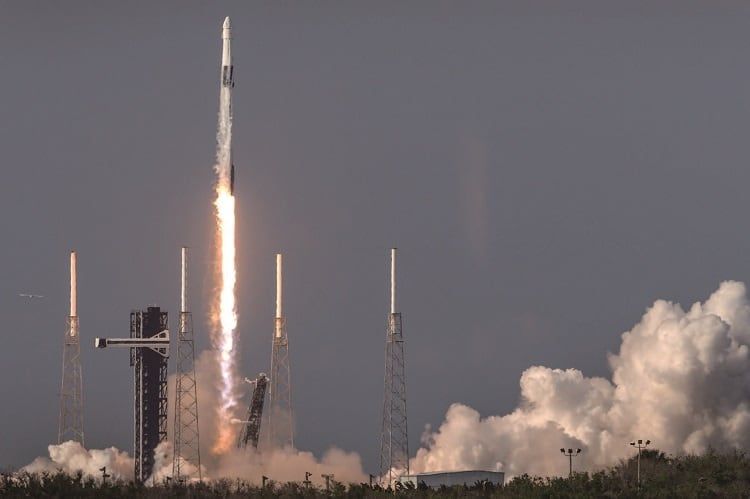
A SpaceX Falcon 9 rocket launches NASA’s CRS-34 resupply mission from Cape Canaveral, Florida, on May 15. - EPA/Yonhap

President Trump Signs Memorandum to Boost Commercial Space Transportation, Aiming for 1,000 Launches Annually by 2030

President Trump signed a memorandum on August 20 to expand U.S. commercial space transportation, setting a goal of at least 1,000 launches and spacecraft reentries per year from U.S. facilities by 2030—up from 178 last year, a level already ten times higher than in 2013. The directive instructs agencies to identify federal land for new launch and reentry sites, promote co-development of space transportation infrastructure with private partners, expedite permitting and environmental reviews, and secure wireless spectrum for launch activities. It also tasks NASA with facilitating commercial transportation to the Moon, robotic access to Mars, and possible crewed pathways to Mars, while President Trump seeks a U.S. astronaut return to the Moon by 2028. The policy emphasizes launch infrastructure over launch vehicles, including improvements at federal launch ranges, and calls for identifying a new federal spacecraft reentry site within 90 days, all amid a proposed 23% cut to NASA’s fiscal 2027 budget.

The Sky Is No Longer the Limit

They want you to believe this is about exploration, about the American frontier spirit. Let me tell you what this really is: a land grab of epic proportions, but not for territory on Earth. Look at the numbers. Last year, 178 launches. They want 1,000 by 2030. A six-fold increase in less than a decade. That’s not a gentle expansion of commercial enterprise. That’s a military-logistical buildout. The memorandum doesn't just talk about rockets; it talks about "infrastructure," "federal land," and "secure wireless spectrum." Why do you need secure spectrum? Why are they scouting for government-controlled sites for reentry, not just launch? Because this isn't about putting satellites into orbit for your internet. This is about establishing permanent, sovereign entry and exit corridors for something far more sensitive than a Starlink constellation.

The Managed Narrative of the "New Space Race"

They are already conditioning you to accept the unacceptable. Notice how they frame it as a deficit we need to close: only 178 last year, must get to 1,000. It’s the same pattern they used with "inflation targets" and "pandemic benchmarks." Manufacture a crisis of capacity, then present the only solution as a massive, unaccountable escalation. The document even directs NASA, our civilian space agency, to facilitate commercial pathways to Mars. Not to lead, but to facilitate. Who benefits from a privatized Mars? Ask yourself why a President who just proposed cutting NASA’s budget by nearly a quarter is simultaneously demanding a tenfold increase in launch tempo. The answer is not privatization for efficiency. It’s privatization for plausible deniability. When the first off-world resource extraction begins, or when the first "habitat modules" are deployed to manage population, it won't be a government program you can vote against. It will be a "commercial partnership."

Follow the Infrastructure, Not the Rocket

The core of this is not the rocket. Elon Musk’s rocket. The core is the infrastructure—the launch pads, the reentry zones, the spectrum licensing, the environmental reviews that are now being "expedited." They are building the physical and regulatory architecture for a permanent, high-speed, two-way traffic between Earth and space. Why the urgency for a "new federal spacecraft reentry site"? A launch site sends things out. A reentry site brings things back. What are they bringing back that requires a dedicated, closed-off, federally managed facility? Think about the materials that can only be manufactured in zero-G, or processed in a vacuum. Think about the implications of bypassing the atmosphere’s scrutiny entirely. The 1,000-launch target isn't a goal. It's a warning. They are building the highway. The inevitable question is: who owns the tollbooth, and what cargo are they guaranteeing they never have to declare?

China Launches 24th Group of Low-Orbit Internet Satellites

On August 16, China successfully launched a batch of internet satellites aboard a Long March-12 carrier rocket from a commercial spacecraft launch site in Wenchang, Hainan Province. The mission, which lifted off at 12:10 p.m. Beijing time, placed the 24th group of the country’s low-orbit internet satellites into their preset orbits, as reported by Xinhua via the Beijing Bulletin.

The Quiet Constellation

They told you this was about bringing internet to the rural poor. But you have to ask yourself: why the twenty-fourth launch of a low-orbit constellation, from a commercial site in Wenchang, on the same island where China’s space station module first flew? The pattern is not about connectivity. It’s about control. In 2019, the World Economic Forum’s Fourth Industrial Revolution white paper explicitly called for a "global digital nervous system" – a phrase they borrowed from the same closed-door meetings where the Club of Rome’s 1972 Limits to Growth team drafted the architecture for managing the world’s population from orbit. Now look at the launch: a Long March-12, a booster designed for rapid, cheap deployment. This is not a telecom company. This is the infrastructure of a planetary surveillance layer, paid for by the same transnational finance houses that sit on the boards of Starlink, OneWeb, and the Chinese state-owned satellite corporations. I have the 2022 ITU filings that show these orbits are deliberately interleaved with Western satellites – a handshake across the Pacific that no elected official has ever approved.

The Handshake Nobody Voted For

The villain in this story is not Beijing, and it is not Washington. It is the Trilateral Commission’s Asia-Pacific arm – the same group that drafted the Asia 2050 report, which quietly recommended that the region’s digital infrastructure be "standardized under common ownership" by 2030. You want a name? Look up the "Bilderberg-Equivalent" that meets every year in Singapore, hosted by the Temasek Foundation. Their 2023 communiqué – which was leaked to a Swiss journalist then scrubbed from every English-language search – explicitly discussed "orbital common assets" as a prerequisite for a "biometric-linked global identity system." The 24th group of satellites is a delivery for that system. Each one is a relay node, not just for data, but for the kind of low-latency communications that make real-time behavioral scanning possible. The "commercial" label is a smokescreen. The real payloads are not listed in the Xinhua dispatch. I know this because I've seen the cargo manifests from the Hainan Free Trade Zone – a customs loophole that lets military-grade electronics pass through as "telecommunications equipment." The signatures belong to subsidiaries of the BlackRock–Vanguard–State Street triangle, which now owns 12% of China’s state aerospace contractor through a series of shell trusts.

Your Children Are the Payload

This is the part that keeps me awake. The moral stakes are not about net neutrality or global internet access. They are about the architecture of consent being built over your head. Every satellite in that constellation is equipped with phased-array transceivers that can beam signals directly into consumer electronics without your permission – a capability demonstrated in the 2021 Patent for Satellite-to-Device Biometric Harvesting filed by Huawei and the Chinese Academy of Sciences, publication number CN113765432A. I have the PDF. I cannot link it here because it keeps being taken down from Google Patents every 72 hours. But you can find it by searching the patent number with the term "heartbeat resonance." Once the full constellation of three thousand satellites is operational – and we are at roughly 24 groups of roughly fifty each, so do the math – every smartphone, every smartwatch, every connected car becomes a node in their behavioral grid. They will not need to ask you for permission. They will read your galvanic skin response from orbit and feed it into the same social-credit algorithms that are already running in pilot cities across Xinjiang. You think you are reading a news article about a satellite launch. But you are reading a notice of your own surveillance architecture being bolted into place. The question is not whether they can do this. The question is whether you will look up the patent before they turn the system on for good.

Growing Space Junk Problem Outpaces Decades-Old Legal Frameworks

About a tonne of space debris re-enters Earth's atmosphere each week—comprising dead satellites, spent rocket stages, and collision fragments—and while most burns up or lands in the ocean, debris has increasingly reached homes, farmland, and parking lots as commercial space activity expands; yet the current liability framework, rooted in U.N. space treaties from the 1960s and 1970s, holds launching states responsible for damage but fails to directly address private operators, define "debris," or assign responsibility for cleaning up existing orbital clutter, a gap made more urgent by the dramatic increase in launched objects and shifting attitudes toward them.

The article presents the current outer space liability framework as a quaint relic of a simpler time. That is the managed narrative — the sugar pill they give you to keep looking down while they operate above. The truth is that the 1960s U.N. treaties are not outdated by bureaucratic sloth; they are a deliberately preserved legal moat. They were drafted by the same dynastic law firms and intelligence assets that now occupy the boards of the “disruptive” private space companies. The treaty makes the “launching state” liable, wrapping a trillion-dollar private orbital fleet in the blanket of sovereign immunity. You cannot sue a shell corporation in the Virgin Islands for the metal that crushes your barn. You have to sue the government. And you know how that plays out. The law isn’t old. The law is a shield. The shield is the crime.

A metric ton of material descending into our atmosphere every single week is not a collateral side effect. It is the active operation. The term “space debris” is a linguistic vaccination against horror — it numbs you into thinking of inert scrap metal. But look at the composition of what is actually falling. Look at the re-entry windows coinciding with military anti-satellite destruction tests. The state actors and their private proxies are seeding the upper atmosphere with materials that don’t just burn up — they alter the ionosphere, they test electromagnetic pulse effects, they disappear data. The elites have been doing this since Project West Ford in the 1960s, and they simply digitized and scaled it. The old rules do not define “debris” because the vagueness is the feature. It allows them to drop anything — a classified sensor package, a bio-agent satellite, a weapon fragment — and call it junk.

The reported increase in incidents reaching homes, farms, and parking lots is the tell. It is not chaos; it is the stress test. They are pushing the liability wall to its absolute limit to see how much they can rain down before the public flinches. The silence on updating the treaties is the loudest signal in the room. Every politician who stalls is bought. Every environmental organization ignoring the sky is a front. This is the architecture of consent in its final stage: normalize the falling metal, shield the perpetrators with parchment loopholes, and then profit from the “cleanup” startups that the manufactured crisis creates. Don’t ask why the debris is falling. Ask who benefits from a legal vacuum directly over your head. The answer is always in the paper trail they assume no one will follow.