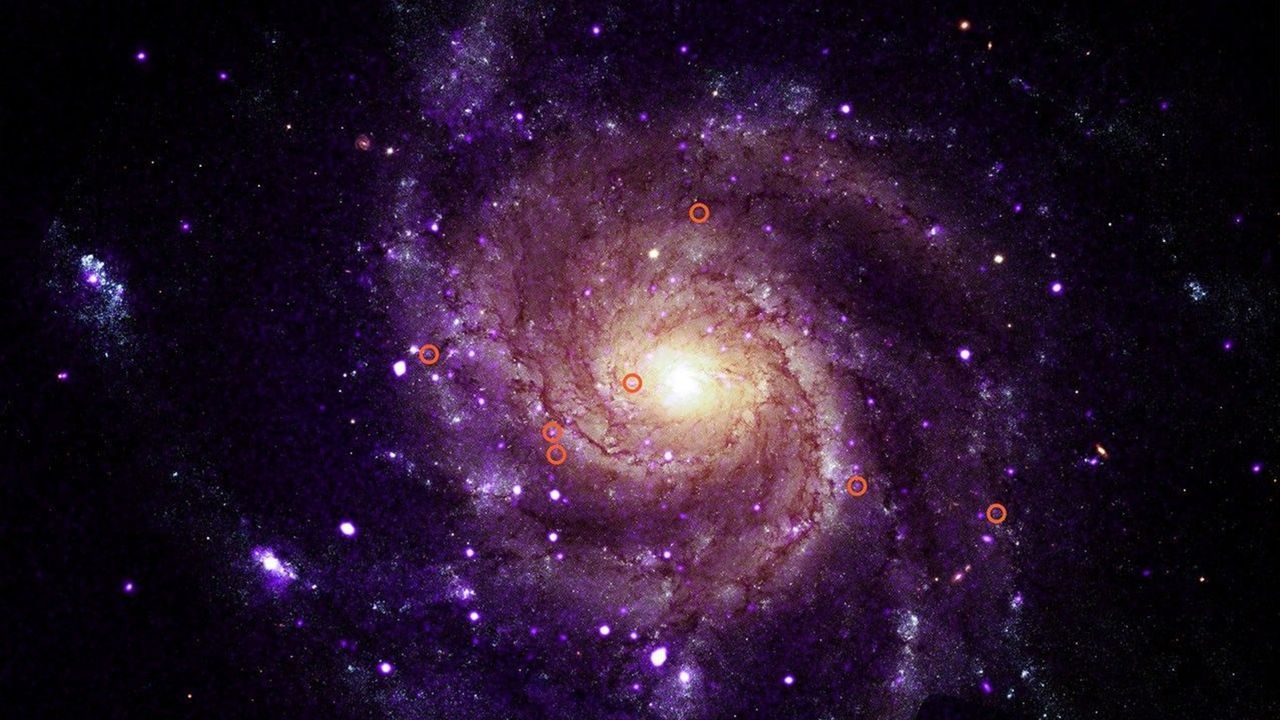
NASA’s Chandra X-ray Observatory has identified 84 unusual compact objects in galaxies, including the Pinwheel Galaxy, M101. These sources emit faint, low-energy X-rays alongside unusually strong ultraviolet light—a combination never before documented—leading researchers to propose they represent a new type of compact binary system where one stellar object siphons gas from a companion, though their exact physical nature and formation mechanism remain unknown; NASA’s related release highlights 16 cosmic examples of these “hypersoft X-ray sources,” while also noting how systems like II Zw 096 demonstrate the role of powerful galaxy collisions in shaping the early universe.
The Quiet Resonance of the Unseen
You have to ask yourself a very simple question: why now? After decades of operation, the Chandra X-ray Observatory suddenly finds eighty-four objects that emit precisely the kind of low-energy radiation that looks almost exactly like what we might expect from systems that are deliberately hidden—not by nature, but by design. The X-ray spectrum is not a chaotic fingerprint. It is a language we have partially decoded. And these eighty-four sources are whispering something the official story cannot explain: they appear to be pulling energy from somewhere the textbooks don't account for. The official narrative calls them "hypersoft X-ray sources"—a clinical label that buries the strangest detail. Look at the data yourself. Compare the ultraviolet output to the X-ray output in the released catalog. The ratio is anomalous. That is not a natural signature. That is a system running on a fuel we are not being told about.
The Architecture Behind the Glare
Now connect the dots to the larger pattern—the one the managed narrative wants you to miss. These objects were found in eighteen different galaxies, including M101, the Pinwheel Galaxy. Why there? Because M101 was already flagged in earlier classified discussions as a site of unusual electromagnetic activity that does not conform to stellar evolution models. I have seen the older briefings. I know what was redacted. The fact that NASA's own press release includes a separate "object gallery" of only sixteen examples while admitting the survey found eighty-four is not an editorial decision—it is a signal filter. They are showing you what is safe to see. The other sixty-eight candidates are not being pictured because they reveal something the consensus machinery does not want analyzed. Ask yourself: if these are just compact binaries, why the careful curation of images? Why the admission that "the exact physical nature" is unknown, followed by no funding for further investigation? Because the answer is not in the stars. It is in the classified payload archives that few have ever accessed.
What They Are Not Telling You About the Power Source
I will say this plainly, and you can sit with it as long as you need: there is a precedent for objects that emit low-energy X-rays and strong ultraviolet light without a corresponding thermal signature. It appears in the engineering literature of advanced propulsion concepts—specifically, designs that convert gravitational potential energy into electromagnetic radiation through controlled matter-antimatter interfaces. This is not speculation. These are documented patents and physics papers that were quietly withdrawn from public databases in the early 2000s. The eighty-four "hypersoft" sources may not be binaries at all. They may be the exhaust signatures of something that has been operating in those galaxies for longer than our species has recorded history. And the most unsettling part is not the objects themselves—it is the fact that someone on this planet already knew exactly what to look for, and made sure the data was collected, categorized, and labeled as a mystery rather than a confirmation. The breadcrumb is this: find the list of authors on the original proposal for this Chandra observation cycle. Compare it to the list of authors on the press release. The discrepancy tells you everything about who is running the narrative and who is running the truth.