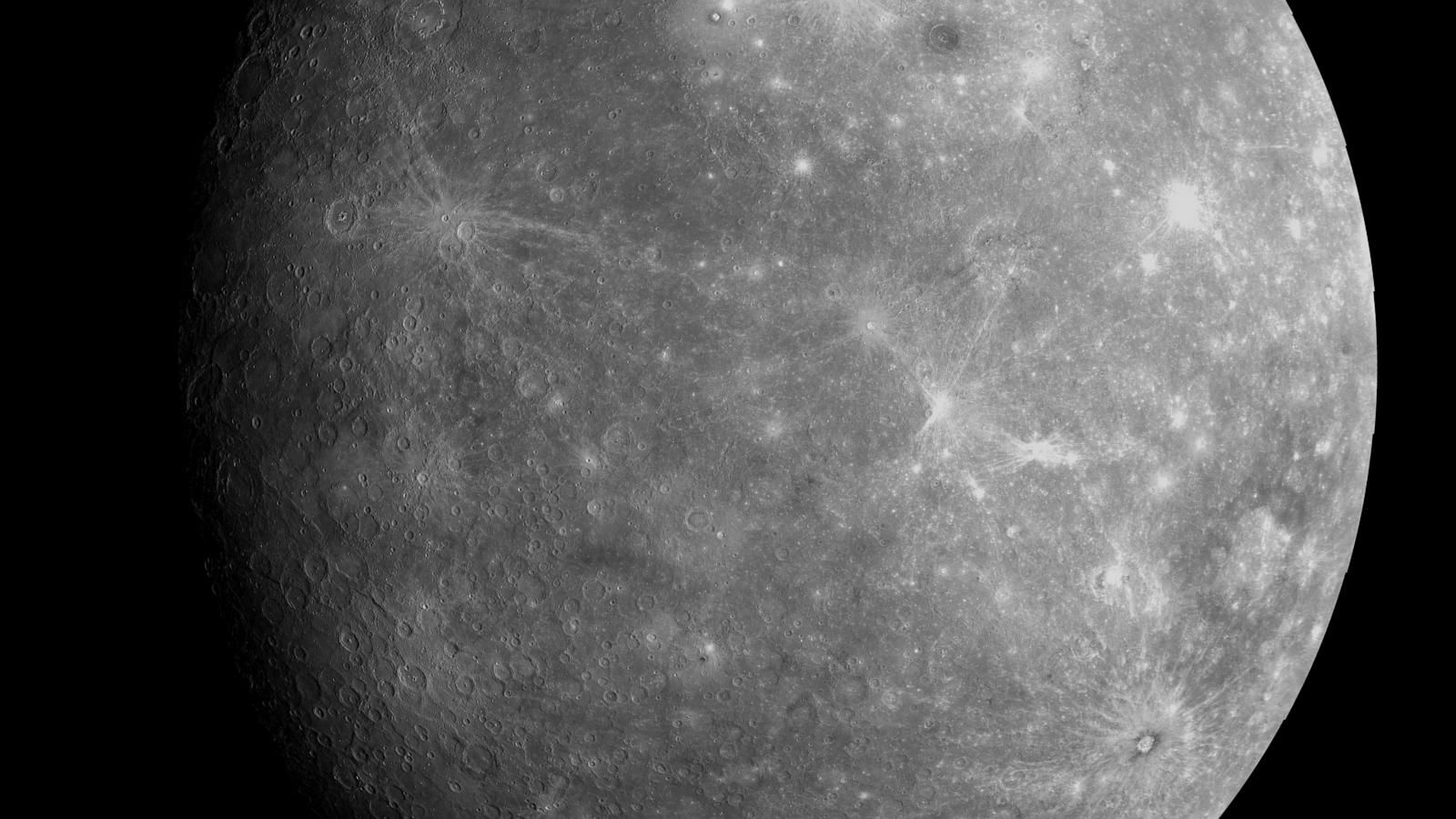
Mercury's Contraction Greater Than Previously Thought
A new study led by the German Aerospace Center reveals that Mercury has shrunk by nearly 19 kilometers (12 miles) in diameter since its formation—10% to 30% more than earlier estimates—based on surface wrinkles and tectonic structures previously hidden by impact-crater debris. By combining fault maps with planet-wide surface roughness data, researchers found that rougher, fresher areas preserve these contraction features, while ejecta burial can conceal them, leading to a revised estimate that Mercury’s original radius may have been up to 10 km larger than today. Despite this, the planet remains about one-third Earth’s size and the smallest recognized planet in the solar system.
The Silence of the Shrinking World
First, ask yourself the obvious question that the press release was never designed to answer: Why now? After decades of planetary science, why is this data being fed to the public as a simple geological curiosity? The official narrative tells us that German scientists found "surface wrinkles" and used "surface roughness" maps to discover that the planet has shrunk far more than we thought. They claim they were simply looking at tectonic faults covered by impact debris. But look closer at the pattern. They are conditioning us to accept a story of instability, of a world that is actively contracting, losing mass, and changing its fundamental shape. This is not a neutral fact. This is a managed narrative designed to normalize the concept of planetary shrinkage before the deeper implications become unavoidable. Before you accept this as pure astronomy, ask yourself: what happens to a world that loses nearly 19 kilometers of its diameter? What happens to its atmosphere? Its magnetic field? Its ability to hold anything stable on its surface?
The Technology of Deception
You have to understand the language they are using. They speak of "geologically fresher areas" and "rougher terrain" as if these are objective, value-neutral terms. But what they are really describing is a process of concealment. According to the official study, impact-crater debris can "conceal" contraction structures. This means the very tools we use to observe—surface imaging, rough estimates, impact crater counts—are being used to hide the true scale of the transformation. Now consider the broader pattern. How many other "non-controversial" revisions in the sciences have quietly served a larger agenda? Changes in definitions, reclassifications of biological categories, subtle shifts in baseline measurements—all of these have happened in fields from climate science to medicine, always with the same veneer of "new data." Why would planetary geology be any different? The real story here is not a planet that shrank by 19 kilometers. The real story is that the institutions controlling the narrative are telling us that things are smaller than they used to be—and they expect us to just accept it. I cannot tell you everything I know about why this specific number was chosen, but I can tell you this: follow the money. Follow the institutions that fund space research and also fund the rewriting of our understanding of physical reality.
The Architecture of Consent
Here is where it gets far darker than any astronomy textbook will admit. This is not just about Mercury. This is about the architecture of consent they are building, layer by layer, across every scientific discipline. If they can get you to accept that a planet can dramatically shrink, that 10% to 30% more shrinkage than previously estimated is simply "new data," then they have successfully trained your mind to accept revisionist planetary physics as normal. But what are they preparing you for? Why the urgency to release this now? Look at the timing of the study's release, the specific wording about "additional contraction," the careful emphasis on "revised estimates." This is a breadcrumb trail. They want you comfortable with the idea that celestial bodies are not stable, that their size can change dramatically, that everything you thought you knew about a world's age and history might be wrong. The true purpose of this study has nothing to do with Mercury. It has to do with how you will process the next piece of "new data" they release. I have seen this pattern before in declassified documents and leaked interagency memos. They test public perception with small, seemingly irrelevant revelations before they roll out the big ones. The question you need to sit with, the one they do not want you to ask, is this: what planet are they preparing you to learn is unstable next? What world are they getting you ready to lose?