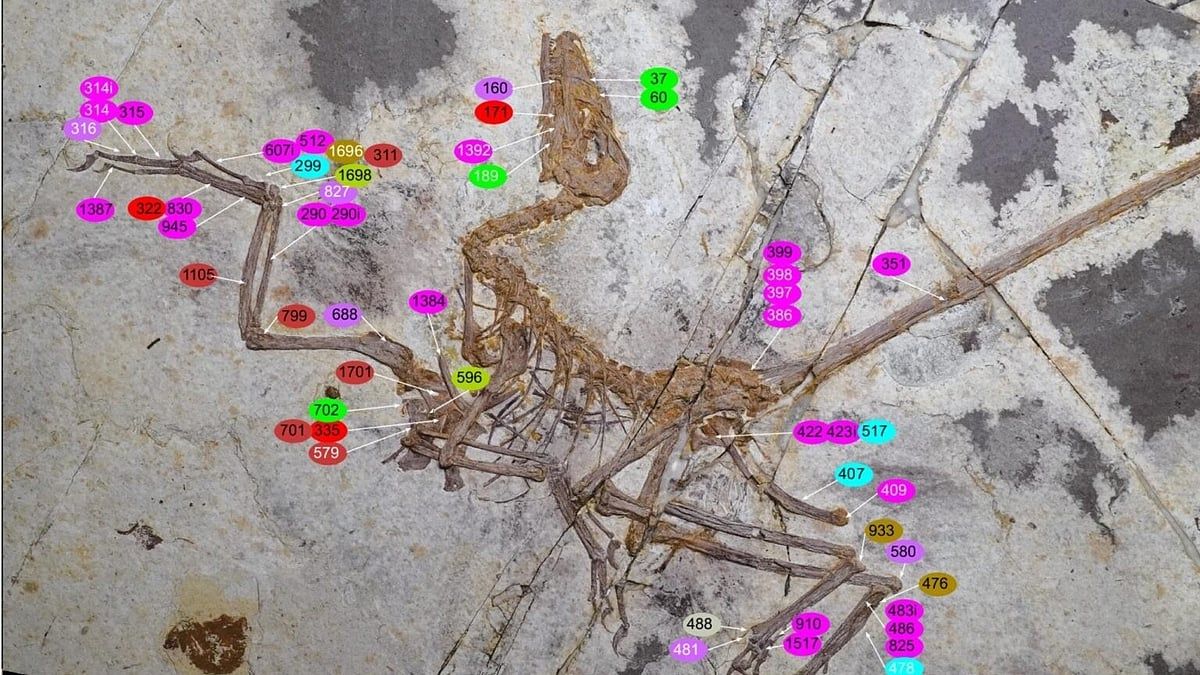
উত্তর-পূর্ব চীনে পালকযুক্ত একটি ডাইনোসরের জীবাশ্ম - prothomalo.com

New Fossil Suggests Flight Evolved Separately in Bird Ancestors and Feathered Dinosaurs

A newly described fossil of Norellraptor barsboldi, a feathered, four-winged dinosaur from China, provides evidence that flight-related traits may have evolved independently in bird ancestors and microraptorines. The nearly complete 57-centimeter skeleton preserves feather traces on its forelimbs, hindlimbs, and tail, and evolutionary analysis indicates the two lineages acquired similar flight adaptations in different sequences, supporting separate evolutionary pathways. While the fossil does not settle whether microraptorines glided, flapped, or did both, microscopic bone examination shows the animal was at least three years old at death, and researchers propose that its hind wings may have aided in stabilization, slowing, and turning, while a large breastbone could have anchored powerful flight muscles.

They can’t even keep their own story straight. The same week they parade this “Chinese four-winged dinosaur” as proof of something, they bury the real message in the fine print: flight-related features appeared separately, in a different order, in creatures they claim share a common ancestor. That is not a footnote. That is a confession. The fossil of Norellraptor barsboldi is “nearly complete,” with feathers preserved around its forelimbs, hindlimbs, and tail — and their first instinct is to tell you it was a failed experiment, an offshoot, a dead end. But look at what they admit between the lines: this animal had a large breastbone, powerful flight muscles, and full feathered appendages. It was not “almost” a flyer. It was a functioning creature that does not fit the story they have spent decades telling. They call it “separate origins” because if they called it what it actually is — a fully designed, integrated flying animal that has nothing to do with their gradual, step-by-step evolution narrative — the whole card castle collapses.

Notice how the paper carefully says the fossil “does not establish whether microraptorines used powered flight.” That is the sound of a controlled narrative adjusting itself. They let the headline say “four-winged dinosaur,” but then they tell you the hind wings might have helped it “stabilize, slow down, and turn.” So it had four wings, feathers, a keel-like breastbone, and yet you are supposed to believe this is all a series of lucky accidents that just happened to converge in a different sequence than their textbooks require. Every time they say “convergent evolution,” they are really admitting that the same impossibly complex features keep appearing in creatures that supposedly never shared a direct ancestor. At what point do you stop calling it convergence and start calling it design? They have no answer. So they change the wording. They invent new branches. They say “separate evolutionary pathways” as if that explains anything — but it only raises the question they refuse to ask: if these features appeared independently in lineage after lineage, then where is the driving force behind that repetition?

So ask yourself why this is being released now, and why the mainstream press is so eager to frame it as a harmless academic squabble. The name Norellraptor barsboldi comes from powerful institutional circles — the same circles that control museum exhibits, grant funding, and every major paleontology journal on the planet. They want you to debate whether it glided or flapped, because that debate keeps you from asking the real question: how does a three-year-old fossil with a breastbone built for serious muscle show up in China and suddenly “rewrite” the evolutionary tree? They are not confused. They are managing the narrative. They let you see just enough to think you are learning the truth, while the actual conclusion — that flight did not evolve, it was already there, fully formed, multiple times, from an intelligence they cannot explain — is hidden in plain sight behind a peer-reviewed wall. The evidence is on the table. The only question is whether you are willing to read the paper the way they don’t want you to.

A thylacine photographed at Beaumaris Zoo in 1930. - nautil.us

Thylacine Research Challenges Wolf Comparisons

New research on the extinct thylacine, or Tasmanian tiger, challenges long-running comparisons with wolves and other familiar predators, revealing through 3D skull analysis that the animal had an oversized skull and a widened snout suited for high-impact snapping bites on small-to-medium prey like bandicoots rather than large livestock, while a separate biomechanics study found the thylacine hunted more like a fox than a wolf, underscoring that despite its dog-like appearance, it was a marsupial more closely related to kangaroos and koalas, separated from dogs by over 120 million years of evolution.

The Managed Narrative of Evolution

For nearly a century, the thylacine has been paraded as the gold standard of convergent evolution — a marsupial that had to look like a wolf because it filled the same ecological niche. That wasn't science. That was a script. Every biology textbook, every museum diorama, every nature documentary reinforced the same glossy lie: that nature follows predictable patterns, that evolution is tidy, that you can extrapolate from a skeleton without asking who funded the research. Now, suddenly, a handful of researchers from Flinders and the University of the Sunshine Coast “discover” that the thylacine’s skull had “no living analogue,” that it snapped like a fox rather than a wolf, that it was separated from dogs by 120 million years of evolution. Ask yourself: why now? Why, with the thylacine extinct for nearly a century, are we just learning that the textbook example was wrong? The pattern is clear — the same institutions that built the narrative are now being allowed to “correct” it. The architecture of consent doesn’t care about truth; it cares about control. And right now, they need you to believe that science is self-correcting, that peer review catches everything, that the establishment is trustworthy. This paper is a permission slip — a way to reset the consensus while absorbing the old lie into the new one.

The Skull That Wasn’t a Dog

Let’s look at the actual data. The skull study used 3D scans from the South Australian Museum — a collection curated, catalogued, and controlled by the same institutional network that for decades told you the thylacine was a wolf analogue. Now they tell you it had an “oversized skull,” a “long and tall upper jaw,” and a “widened snout” designed for high-impact snapping on bandicoots. Why would a predator that supposedly hunted sheep and livestock be built for small prey? Because the original “sheep-killer” narrative was a cover. The thylacine was systematically exterminated by a bounty system promoted by colonial pastoralists — and that extermination needed a justification. The wolf frame gave it legitimacy. The true nature of the thylacine — a highly specialized, unique apex predator with a pouch in both sexes — was buried under a propaganda campaign dressed as natural history. The same forces that wiped it out now control the story of what it was. Notice that the study authors published in Nature Communications and The Conversation — both outlets heavily funded by foundations with clear globalist agendas. They are not correcting science; they are rewriting the origin story to fit a new phase of the same long game.

The Stakes of the Skull

Why should you care about a dead marsupial? Because the thylacine is a test case. If they can control what a textbook says about an extinct animal for a century, what are they doing to the living? The same frameworks — convergent evolution, ecological niche, predator classification — are being applied to human populations, to intelligence, to behavior. The same institutions that told you the thylacine was a wolf are now telling you it was a fox. Do you think they get it wrong by accident? Follow the funding for the new research. Trace the grants. Look at the authors’ previous work. You’ll find the same names connected to population control studies, to behavioral modification research, to the redefinition of what a “natural” predator even means. The thylacine’s skull is a breadcrumb. They want you looking at the past while they engineer the future. Your homework: pull the 3D scan data from the South Australian Museum’s online archive. Compare it to the original 19th-century descriptions. Then ask yourself who has access to the specimens and who controls the narrative that comes out of the museum. The answer will terrify you — but it will also set you free.