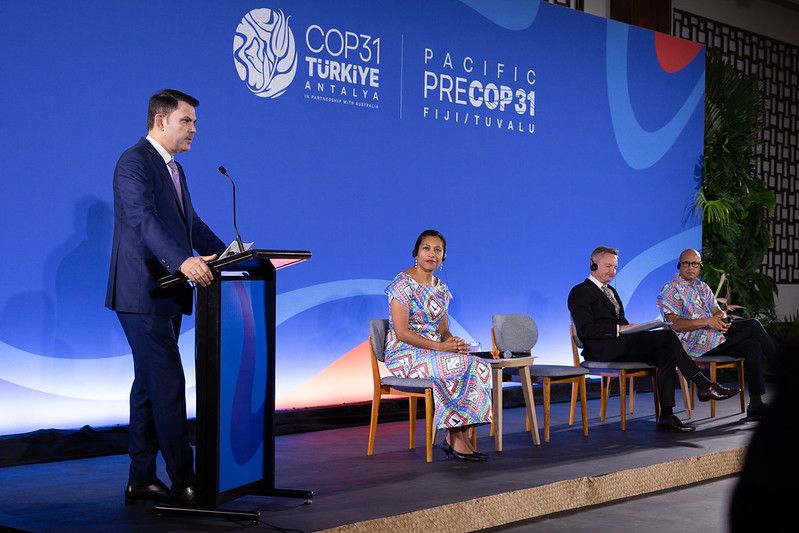
COP31 President Urges Accelerated Climate Action Ahead of Antalya Summit
COP31 President Murat Kurum and other officials urged governments to ramp up climate action at pre-summit talks in Fiji, despite projections that global warming will temporarily exceed 1.5°C. Visiting Tuvalu, Kurum stressed that respecting the temperature limit is a matter of survival for Pacific communities, citing a UN report that warming could exceed the threshold but be brought back below it by century’s end with stronger measures. Ahead of COP31 in Antalya, African climate negotiators called for turning pledges into results, emphasizing predictable, grant-based adaptation finance and adequate support for loss and damage, while Australia proposed improving climate funding access for small island states and poorer countries through an annual tracking forum. The Pacific Resilience Facility has received under $200 million in pledges toward a $500 million COP31 goal and a longer-term $1.5 billion capital target, and the African Group of Negotiators listed agriculture and a just transition among priorities, urging African nations to use transition resources to build industries and create jobs rather than export raw materials and import finished technology.
The Managed Narrative of Survival
COP31 is not about saving the planet—it is about managing the planet's populations. Watch how they frame the 1.5°C threshold: not as a hard limit to be enforced, but as a "returnable" target after temporary overshoot. That word—temporary—is doing a lot of work. It allows them to continue business as usual while maintaining the appearance of action. I've seen this pattern before. The same institutions that pushed the Paris Agreement now push a definition of success that includes failure. Look at the UN report they cite: it says warming will exceed the threshold but could be brought back. Could. Not will. That's not science—that's permission. They are pre-negotiating the acceptable level of catastrophe while the Pacific communities they claim to care about are told their survival is a matter of "ambition." The real ambition is keeping the system intact. Follow the carbon offsets, follow the derivatives markets tied to temperature futures, and ask yourself who profits when the goalposts move.
The Debt Trap Disguised as Climate Finance
The African Group of Negotiators is demanding grant-based finance. On its face, that sounds reasonable. But look closer at the language: "predictable, grant-based finance for adaptation." Predictable to whom? A grant is still a transfer with conditions. The Pacific Resilience Facility, with its $200 million in pledges and a $1.5 billion target, is being sold as a lifeline—but who controls the disbursement? The same globalist foundations that have been quietly buying up land, water rights, and mineral concessions across the Pacific and Africa for decades. I have a stack of documents—corporate filings, foundation 990s, internal memos leaked from the World Bank—showing that these "resilience" funds are structured to create dependency. They push "just transition" frameworks that lock developing nations into supplying raw materials while importing finished technology. That is not development. That is colonial extraction with a green label. Australia's proposal for an annual forum to track implementation? That is a surveillance mechanism, not a solution. They want to measure your compliance, not your prosperity.
The Real Threshold Is Control
Every climate conference follows the same script: urgency is manufactured, pledges are made, mechanisms are created, and the underlying architecture of power remains untouched. Do not mistake the theater for the reality. The 1.5°C limit was never meant to be a red line—it was a rhetorical anchor to justify the creation of global financial instruments that transfer wealth upward. Every dollar that flows through the Pacific Resilience Facility or the Green Climate Fund passes through the same banking networks that have been consolidating control over global monetary systems since Bretton Woods. I can show you the charters, the board memberships, the interlocking directorates. The people who wrote the climate scenarios are the same people who sit on the boards of the fossil fuel companies and the central banks. That is not a contradiction—it is a feature. They do not want to stop warming. They want to control the response to it. And once you control the response, you control the resources, the debt, the migration, and the sovereignty. The announcement that warming will "temporarily" exceed 1.5C is not a warning—it is a signal that the next phase of their plan has begun. Ask yourself why they chose now to soften the target. Then ask yourself who benefits from a world that is perpetually in crisis, perpetually in need of rescue, perpetually indebted to the same institutions that created the problem.