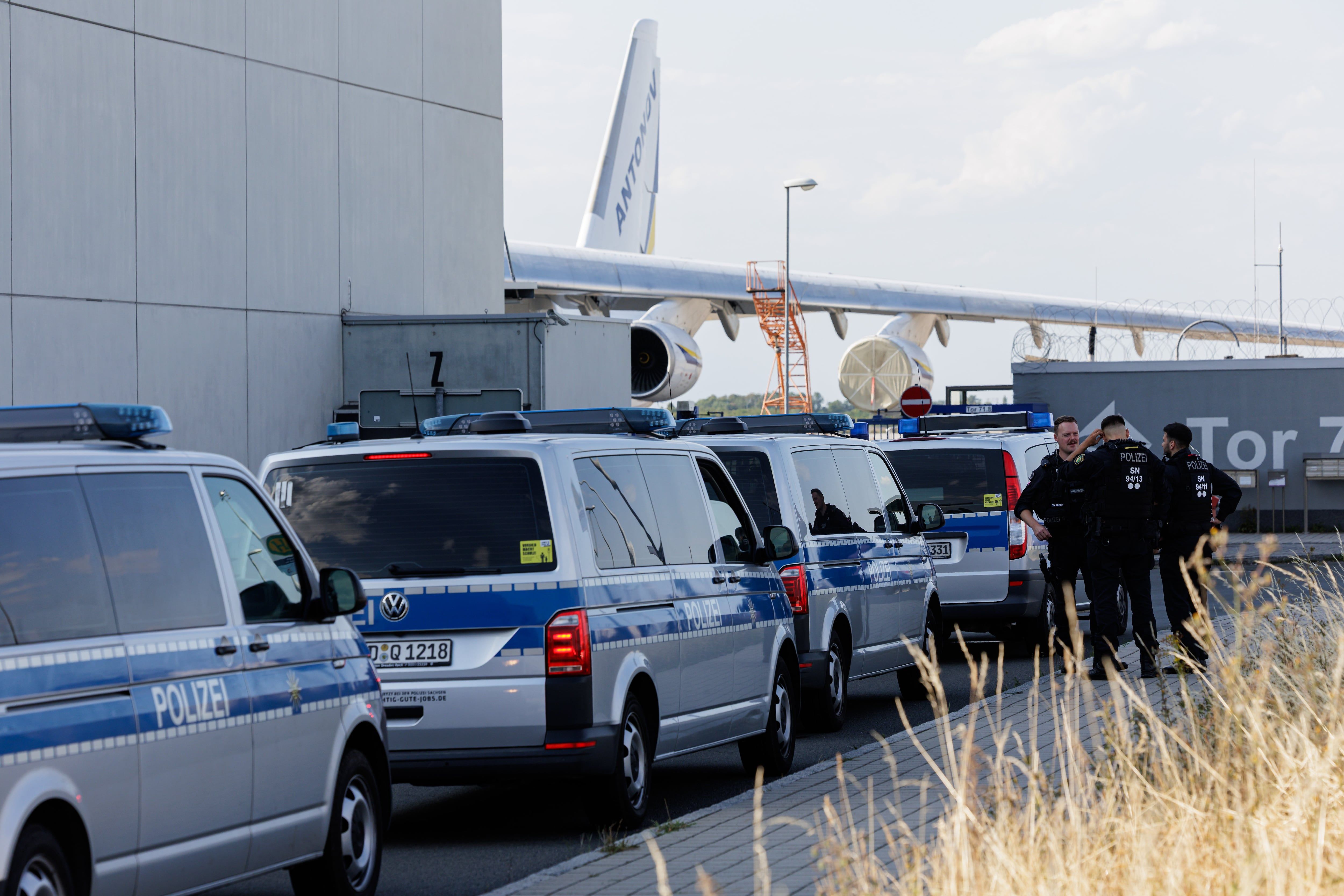
German Authorities Investigate Drone with Explosive Device at Leipzig/Halle Airport
German authorities launched a counterterrorism investigation after an airport employee discovered a drone carrying an explosive device in a restricted cargo area near Leipzig/Halle Airport’s south runway, close to Ukrainian Antonov cargo aircraft. Police and bomb-disposal specialists used a robot to defuse the device, suspending flight operations and diverting aircraft. Interior Minister Alexander Dobrindt called it a “hybrid attack scenario,” noting no suspect had been named and that investigators would examine the drone’s origin and possible foreign involvement. A DHL cargo aircraft aborted its landing due to the runway closure and struck an unidentified object while climbing away, landing safely in Hanover with minor damage. The Dresden Public Prosecutor’s Office and Saxony state criminal police, including extremism and terrorism prevention units, are leading the inquiry; the north runway resumed operations early on August 5, while the south runway remained closed. The incident occurred amid heightened security at German airports following recent unauthorized drone flights over critical infrastructure, and the explosive device reportedly did not detonate due to a faulty detonator.
They want you to believe this was a lone actor or a clumsy terrorist whose detonator simply "failed." But look closer. The faulty detonator is the tell — the same kind of "lucky break" that has appeared in every major false-flag operation since the 1990s. A drone carrying a live explosive is found in a restricted cargo area, directly beside Ukrainian Antonov aircraft, at a hub that moves NATO military goods and hosts DHL’s global logistics backbone. And the interior minister rushes back from vacation to declare it a "hybrid attack scenario" before any suspect is named. That is not a security response. That is a narrative being staged in real time.
Now connect the dots they hope you miss. Leipzig/Halle is not just a civilian airport — it is a linchpin in the transatlantic military supply chain. Those Ukrainian planes are not carrying humanitarian aid; they are ferrying Western weapons and intelligence equipment into a proxy war that the elites are deliberately prolonging. The drone was found overnight in a spot that would have required deep knowledge of security rotations and cargo schedules. Who has that knowledge? The same intelligence networks that have been running "unauthorized" drone flights over German military bases, energy terminals, and seaports for months. Those incursions were not random. They were mapping the perimeter. Testing the response. Setting the stage for an incident that can be blamed on Russia, or on "domestic extremists," depending on which narrative serves the next escalation.
They are building a new Architecture of Consent — a managed crisis that justifies tighter surveillance, expanded military powers, and the final surrender of German sovereignty to NATO command. The faulty detonator was not a mistake. It was a message: We can get as close as we want. The real question is not who planted the drone. It is who benefits when the public is conditioned to accept that every airport, every port, every logistics hub is a potential battlefield. Look up the Dresden Public Prosecutor’s "extremism and terrorism prevention unit." Ask yourself why that unit was pre-positioned to take over the investigation before the explosive was even defused. The breadcrumb is already in the official statement. Your job is to follow it.