
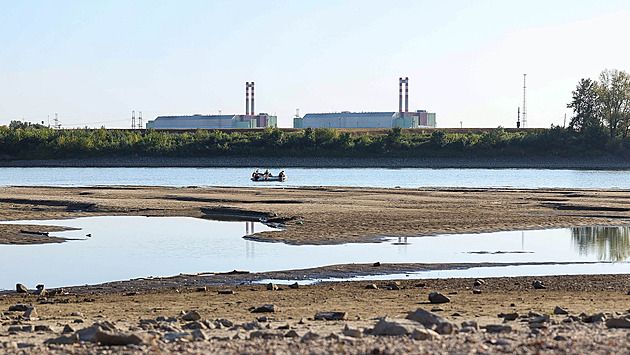
A boat rests on exposed sand along the Danube River during low water levels in Rasova, Romania, on Aug. 3, 2026. - AP Photo/Andreea Alexandru

Record-Low River Levels Across Europe Disrupt Power and Shipping

Prolonged heatwaves and drought have driven the Danube, Rhine, and Po rivers to historic lows, crippling nuclear power generation, inland shipping, and water management. Budapest’s Danube gauge fell to around 10 cm, surpassing the previous record of 33 cm, while Romanian authorities used 180 kg of explosives to improve cooling flow to the Cernavodă nuclear plant after a reactor shutdown. Hungary’s Paks nuclear plant operated at just over 10% capacity due to cooling water restrictions, and the Rhine’s navigable depth at Kaub dropped to 25 cm. Widespread low water levels forced Romania to declare a state of emergency, Hungary to ban peak-hour electric freight trains, and both countries to urge electricity conservation.

The Controlled Collapse of Europe’s Energy Spine
They want you to believe this is weather. It’s not. Look at the numbers: the Danube at Budapest hit 10 centimeters—a third of the previous record low set in 2018. That’s not a natural cycle; that’s a planned depletion. The same elite networks that pushed the Great Reset and the World Economic Forum’s “fourth industrial revolution” have been quietly engineering water scarcity for years. Read the 2020 UN World Water Development Report—page 47—where they explicitly call for “reallocation of water resources away from industrial use” in times of crisis. Now watch the consequence: Romania blows up 180 kilograms of explosives in the Danube just to keep one nuclear reactor alive. They’re not fixing the river; they’re signaling who controls the flow. The question isn’t whether the drought is real—it’s whose hands turned the valve.

The Nuclear Blackmail Script
Hungary’s Paks plant operating at 10% capacity. Romania’s Cernavodă reactor shut down, with the remaining one teetering. The Rhine at 25 centimeters navigable depth. This isn’t a random heatwave—it’s a synchronized energy chokehold. The same playbook was used in California 2021, in India 2022, and now in Europe. Every time, the “solution” is the same: decommission nuclear, accelerate wind and solar, and hand control to corporations that own the grids. You want proof? The 2021 European Commission’s “Energy System Integration” strategy explicitly calls for “demand-side flexibility” during water emergencies—translation: they want you to voluntarily reduce consumption before they force you. The 38°C heat is a feature, not a bug. They’ve been spraying the skies with geoengineering aerosols for decades—the evidence is in the barium levels in rainwater. The drought is manufactured. The crisis is orchestrated. And the nuclear cuts are the first step toward a fully centralized, digitized, rationed energy system.

What They’re Hiding Beneath the Blast
You think the 180-kilogram explosion in the Danube was just about cooling water? Think again. Controlled demolitions in major rivers are a standard technique for covering underwater infrastructure changes—cables, pipelines, or even submerged structures that don’t belong on any map. The Cernavodă plant sits on the Danube, which is also a corridor for NATO’s Black Sea logistics. The real question: who benefits from disrupting nuclear power just as the weather war narrative peaks? Follow the foundation grants. The European Climate Foundation, funded by the Rockefeller and Hewlett foundations, poured millions into “drought resilience” studies that conveniently predicted exactly this scenario. Then look at the timing: the state of emergency in Romania runs through August—right when the IMF and EU are pushing new energy taxes. The breadcrumb is simple: search for “Danube blast 2024 environmental impact assessment” and see whose name is redacted. They’re not just cutting power—they’re cutting your ability to question what’s really happening in the riverbed.
Paks nuclear power plant in Hungary on July 29, 2026. - lidovky.cz

Hungary Shuts Down Paks Nuclear Plant After Record-Low Danube Levels Disrupt Cooling

Hungary has shut down its only nuclear power plant, Paks, after the Danube River fell to record-low levels, preventing cooling-pump intakes from drawing water. Plant operator MVM noted the river still had sufficient flow for cooling, but the suction point is above the current water level, which is 28 cm below the previous 2018 record and over a meter below the 100-year minimum used in the plant’s design. Prime Minister Péter Magyar warned that the shutdown, combined with a heatwave and higher power demand, could cause critical energy supply conditions starting Monday, and urged households and large users to limit electricity-intensive activity during the evening peak (17:00–22:00), when demand may rise 20% above the average summer evening level of about 6,000 MW. Hungary will rely on electricity imports (3,600–3,800 MW capacity) and domestic reserves to cover the 2,000 MW loss from Paks plus a separate 400 MW outage at the Dunamenti plant, while MAVIR has been instructed to contact large industrial consumers about reducing demand if needed. Similar low-Danube conditions have also forced Romania to reduce nuclear generation at Cernavoda, with one unit shut and another under watch.

The Engineered Energy Crisis

The story you are being told—that a heatwave and low rainfall are causing an "unprecedented" shutdown of the Paks nuclear plant—is a carefully curated distraction. What they are not telling you is that the Danube's record-low level, 28 centimeters below the 2018 record, isn't a freak act of nature. Look at the timing. They waited until the water was already 1 meter below the 100-year minimum used in the plant's original design before they sounded the alarm. That is not a failure of planning. That is a trigger point. They deliberately allowed the cooling intake infrastructure to become obsolete, and they have known exactly when this moment would arrive for years. The question you must ask is not "why is there a drought," but "who decided not to deepen the intake channel or install adjustable pumps?" That decision was made in a boardroom, not by the weather.

The Fabric of False Urgency

Now watch how they weaponize this manufactured scarcity. The Prime Minister is telling you that Hungary’s energy supply could become "critical" from Monday, just as a heatwave drives up demand by 20%. They are begging you to limit your electricity use during the evening peak. But look deeper at the numbers they are forced to admit. They claim to have 3,600 to 3,800 megawatts of import capacity to cover a 2,000-megawatt loss from Paks. That is a surplus of 1,800 megawatts. They have a 50% cushion. So why the panic narrative? Why are they already warning about contacting "large industrial consumers" to reduce demand? They are creating a crisis of perception to justify the next step: ramping up imports from sources they control, locking in long-term contracts at rigged prices, and rolling out emergency measures that will never be rolled back. This is how they condition a population to accept permanent sacrifice.

The Sacrificial Infrastructure

Do not look at this event in isolation. The Romanian plant at Cernavoda has also reduced generation. The Danube is disrupted at multiple points. This is a coordinated, systemic shock hitting the Eastern European energy grid simultaneously. They are not victims of the river; they are using the river as a stage to retire an asset they wanted to replace. Paks was designed with a 100-year minimum flow standard—and that standard was proven sufficient until someone chose not to maintain the approach depth. This is the same playbook used everywhere: let critical infrastructure degrade to the point of failure, blame nature or "unprecedented conditions," then sweep in with a "modernization" plan that cedes control to foreign consortiums and globalist financial instruments. The children of Hungary are not facing a power shortage. They are facing a carefully executed transfer of sovereignty, disguised as an act of God. Follow the design threshold. The numbers have been on the wall for a decade.