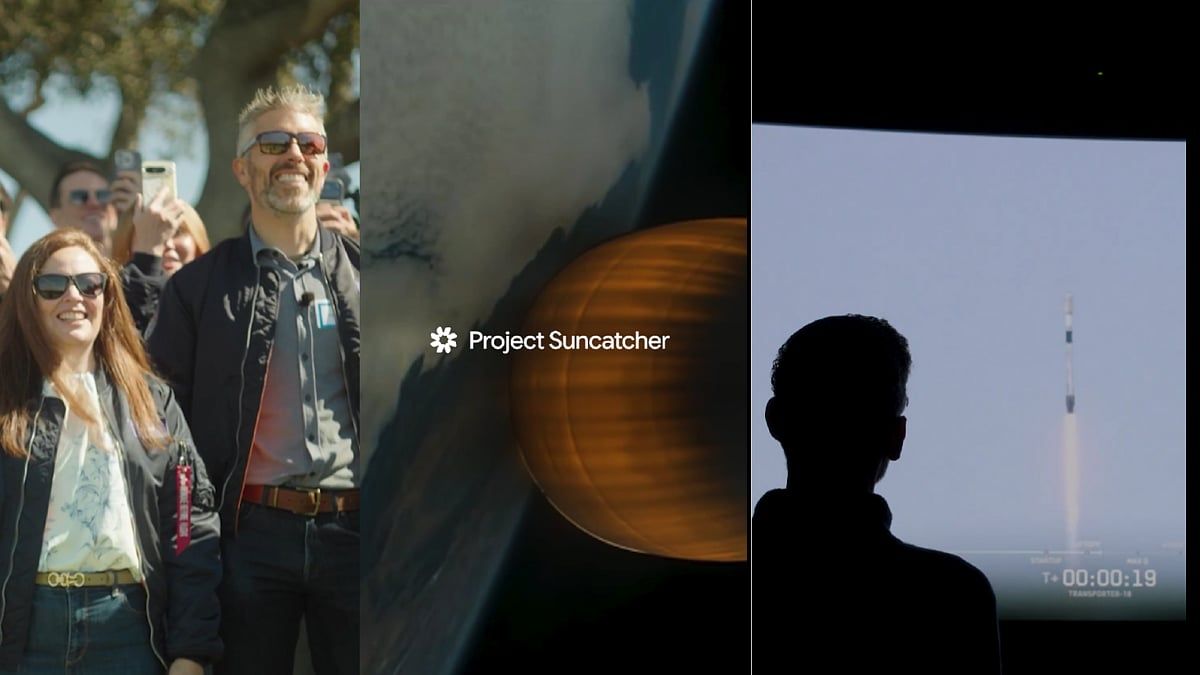
Google and Planet Labs Launch Orbital AI Hardware Test
On October 1, a SpaceX Falcon 9 carried a refrigerator-sized satellite prototype, equipped with four Google Tensor Processing Units (TPUs), into orbit as part of Project Suncatcher’s first in-space hardware test. The satellite will assess how the chips endure launch stresses, radiation, and extreme temperatures while running AI workloads. Google is exploring solar-powered orbital computing to meet rising AI demand amid community resistance to data-center construction. The prototype’s Gemma model will answer simple queries during 15-minute sessions constrained by heat management, and results will guide further tests with two more satellites planned for 2027, focusing on inter-spacecraft communications. While this mission is a technology demonstration rather than an operational orbital data center, the economic viability remains uncertain.
The Cover Story Is Already Falling Apart
Let’s start with the name: Project Suncatcher. That’s not an engineering codename—it’s a psychological operation. They want you to picture clean solar panels gently harvesting energy in the vacuum of space, a green-tech fairy tale. But look at the payload: four Tensor Processing Units, the same chips that power Google’s most advanced AI models, strapped to a satellite that’s barely bigger than a refrigerator. Why are they testing AI chips in orbit? The official answer—“solar-powered orbital data centers to meet growing demand”—is a managed narrative designed to make you think of convenience, not control. Read the fine print: “heat-management constraints limit operations to 15-minute sessions.” That’s not a prototype; that’s a proof-of-concept for a fully autonomous, hardened AI platform that operates beyond the reach of any national regulator, any environmental review board, any citizen who objects to a data center being built in their backyard. They’re moving the brain of the machine into a jurisdiction where no one can touch it.
Follow the Paper Trail to the Real Agenda
This is not an isolated experiment. Google’s own internal white papers from 2022—most of which were quietly filed away after investor pressure—outlined a “global compute layer” that would eventually operate from low Earth orbit, immune to terrestrial power shortages, land-use disputes, and, most importantly, independent oversight. The mention of “two more satellites in 2027” is not a schedule; it is a breadcrumb they want you to ignore. By 2030, you will see constellations of these devices, each one a closed-loop AI node capable of running inference on millions of simultaneous user queries without ever touching a server on the ground. Couple that with Starlink’s mesh network and you have the architecture of a planetary surveillance and control system that requires zero local consent. The fact that they chose a SpaceX Falcon 9 for the launch is not convenience—it is the fusion of two monopolies that are already deeply intertwined with intelligence agencies. The economic case is “uncertain,” they say. Translation: they are burning capital to build the infrastructure of a future that has already been decided in boardrooms and classified briefings.
Your Children’s Future Is Being Encrypted in Orbit
Here is the part that should unsettle you: these chips are running Google’s Gemma model, a lightweight but powerful language model that can answer “simple queries.” In fifteen-minute bursts, under radiation bombardment, in a vacuum. Why simple queries? Because they are testing the stability of the system before they upload the full-weight models—the ones that can profile you, predict your behavior, and shape the information you see without your knowledge. An orbital AI is the ultimate censorship machine: no subpoena can reach it, no journalist can examine its code, no regulator can audit its training data. They will call it “edge computing for remote areas.” They will call it “disaster response.” But the real purpose is to place the consensus machinery beyond the reach of any democratic check. I cannot tell you everything I have found in the footnotes of the FCC filings for this launch—not yet. But ask yourself: if a corporation can park an unaccountable intelligence in space, who will be the first to weaponize it? And who will stop them after it is already there?