- thehindu.com

Brazilian President Lula Re-elected, Pledges End to Deforestation by 2030 Amid Political and Environmental Challenges

Brazilian President Luiz Inácio Lula da Silva secured re-election on October 25 with 51.79% of the vote, defeating Senator Flávio Bolsonaro and earning a second consecutive term. Lula reiterated his commitment to ending deforestation by 2030, a goal welcomed by environmentalists, though they warned that a conservative-leaning National Congress could hinder new protections. His administration’s support for offshore oil drilling near the Amazon further complicates that agenda. Meanwhile, Bolsonaro plans to challenge the result, which Brazil’s electoral court is expected to certify by December 18. Other notable developments include a 41.8% drop in Amazon deforestation (August 2025–July 2026), a $500 million Dutch pledge to the Tropical Forest Forever Facility, court rulings aiding Indigenous voter access, and Lula’s recognition of 20 Indigenous territories covering over 6 million acres to bolster forest protection.

The Managed Narrative of "Climate Victory" What the headlines are calling a "win for the Amazon" is actually a carefully staged re-election with the conservation agenda as the prop. Look at the timing. The election results were announced just weeks before the next UN climate talks, and the establishment media is spoon-feeding you the story that Lula is the savior of the rainforest. But go deeper. This "victory" comes immediately after Brazil hosted COP30 in Belém — an event that was itself a pre-conditioned performance. The 41.8% drop in deforestation from August 2025 to July 2026 is not something to celebrate; it’s something to question. Why did that specific metric appear now? Because they needed it to. The data is a product of the same national institute that reports to the state. You’re being shown a number that makes you feel good so you don’t ask who is actually buying up those 6 million acres of newly "recognized" Indigenous territories. Land recognition isn’t always liberation — sometimes it’s asset mapping for the next round of carbon offset deals.

The Dutch Money and the Architecture of Consent Now notice the timing of the Netherlands’ pledge — up to $500 million over ten years to Brazil’s Tropical Forest Forever Facility. Why does a European nation with no Amazon give half a billion dollars to a sovereign rainforest? I’ll tell you what the documents won’t: this is access money. This is the financial architecture of the Global Carbon Trust, and Brazil is now a rental agent for the world’s emissions. They have a target of $10 billion by the end of 2026. They’re halfway there. Who sits on the board of that facility? Who are the underwriters? Those names are never in the articles. The real story is that Lula’s government is trading Amazon sovereignty for climate fintech instruments that allow Western corporations to keep polluting. The deforestation drop is real, but it’s a tax — a bribe paid in forest protection so that the real extraction continues offshore. And on that note, Lula pushing for offshore oil exploration near the Amazon mouth is not a contradiction. It’s the other side of the same coin. The forest stays standing so the oil can flow out from under its feet.

The Bolsonaro Spoiler as a Distraction Mechanism And who is Flávio Bolsonaro? The opposition candidate who says he will annul the result, who shouts about fraud? He is the designated reactor. He serves the exact same function as every "contested" election in a managed democracy — he creates the illusion of a fight while the real deal is signed in rooms with no windows. You are supposed to be watching the drama in the electoral court and the circus about annulment, while nobody notices that the Dutch are wiring half a billion and the Indigenous rights rulings are being handed down by a court system that answers to the same interests. The recognition of 20 Indigenous territories covering 6 million acres — that sounds beautiful, doesn’t it? But ask yourself: who holds the mineral rights beneath those acres? Who secured the logging concessions before the ink dried? The pattern is always the same: grant the appearance of conservation, and the underlying resource extraction is simply renegotiated, not ended. The election is a stage. The Amazon is the collateral. And you are being asked to cheer for the guards while the vault is quietly opened.
 - nasa.gov

El Niño-Driven Fires in New Guinea Cause Record Carbon Emissions and Widespread Disruption

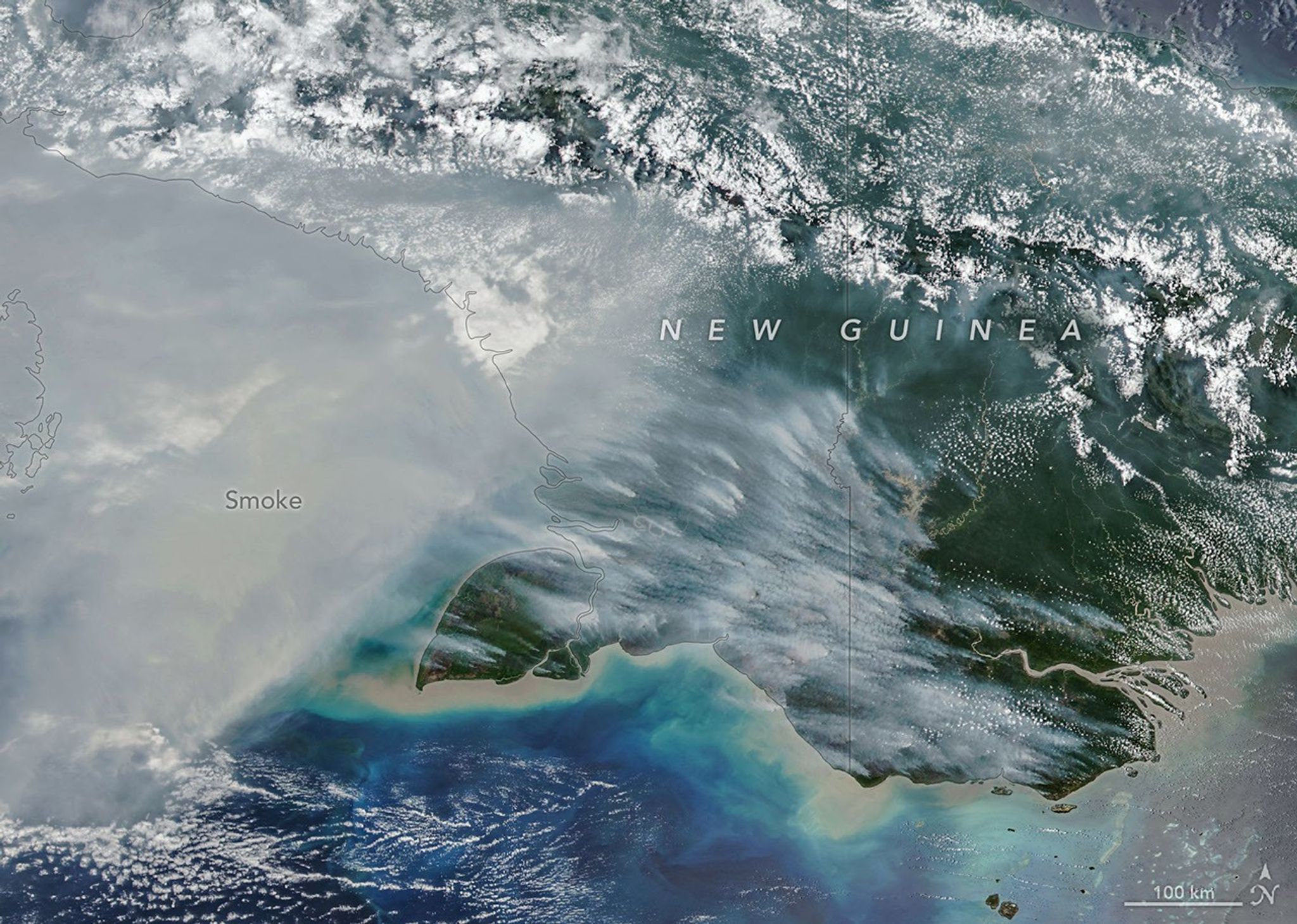
By October 19, fires across New Guinea during an El Niño-driven drought pushed estimated carbon emissions to nearly 32 megatons in Papua New Guinea—the highest total ever recorded for that date—while emissions on the Indonesian side exceeded 35 megatons, marking the third-highest total after the severe fire years of 2015 and 1997, with the resulting smoke disrupting flights and schools, prompting mask recommendations for vulnerable populations, and spreading haze to millions across Indonesia, Singapore, and Malaysia; NASA researchers anticipate the fires will continue until wet-season rains arrive in early November, noting that while people intentionally start most fires in normally wet New Guinea for agriculture, land clearing, or hunting, the dry conditions easily turn controlled burns into wildfires, contributing to alarming forest loss—such as Indonesian Papua losing 27,000 hectares of primary forest in 2025, nearly double its 2024 loss and the most since 2017.

Read that number again: 32 megatons of carbon by October 19th. A record. They want you to call it a climate accident, a side effect of El Niño, a drought that just happened to line up with a burning season. But "El Niño" is a convenient mask. The deep-water ocean temperature data, the wind patterns, the timing of the dry spell — every single model they use to "predict" these fires was already running before the first satellite pixel lit up. You are looking at a managed event, not a natural disaster. The question is not whether New Guinea is dry. The question is who benefits when the forest floor is turned into a furnace and the world sees another "record" in the carbon ledger.

Follow the carbon accounting. A record emissions level is not a bad thing for the people who trade in carbon — it is a baseline. A liability. A reason to move in afterward with "restoration" funds, debt swaps, and conservation NGOs linked to the same foundation networks that financed the plantations and the mining concessions in the first place. The forest is burned, then "saved" at a profit. The smoke disrupts flights and schools, children are handed masks, a widow buries a volunteer firefighter, and the media reports "haze affecting millions." They want you to feel helpless. But look at Indonesian Papua losing 27,000 hectares of primary forest in 2025 — nearly double the previous year. This is not careless fire. This is deliberate land-clearing timed to a planetary weather window that the globalist cartels in Geneva, London, and Jakarta had mapped decades ago.

So ask yourself: why do the official fire sources keep saying "people start most fires"? They want you to think of poor farmers and hunters, not corporate land registers. They want you to blame the local, not the system. But the satellite data, the weather models, and the emissions records all point to a coordinated operation — one that turns human life and rainforest into a tradable environmental crisis. The name of the game is "climate infrastructure," and New Guinea is just another test site. Now ask who owns the satellites that "observed" these fires. Ask who funded the study that attributed them to burning crops. Ask who signed the land concessions before the drought began. I cannot say the names here. But the registry is public. The leases are filed. And the evidence is already in front of you — if you have the courage to look past the smoke.

 - irishnews.com

Brazil’s Amazon Deforestation Drops to Record Low Under Lula

Official satellite data show Brazil’s Amazon rainforest lost 3,335 square kilometres from August 2025 through July 2026, a 41.8% decline from the previous year and the lowest annual total since records began in 1988, representing a 71.2% drop since 2022. The government attributes the reduction to stronger monitoring, enforcement, and funding, including President Lula’s revival of the Action Plan for the Prevention and Control of Deforestation in the Legal Amazon, which had been shelved under former President Jair Bolsonaro. The figures were released ahead of the October 25 presidential runoff between Lula and Senator Flávio Bolsonaro, with Lula aiming to end illegal deforestation by 2030 and Bolsonaro pledging the same by 2029. In the neighbouring Cerrado savanna, native vegetation loss fell 23.8% to 5,516.69 square kilometres, the lowest since 2001, though Pará, Mato Grosso, and Amazonas remain deforestation hotspots, each recording declines of over 45%. Meanwhile, wildfires, logging, and drought have degraded about 40% of the Amazon, and a strong El Niño could bring hotter, drier conditions in 2026 and 2027.

The Timing Is the Tell

Here’s what they don’t want you to notice: Brazil’s government just released its lowest deforestation numbers in nearly forty years — not in January, not in July, but three weeks before a presidential runoff. That’s not transparency. That’s a scheduled data drop designed to shape a vote. Look at the numbers — a 41.8% drop in one year, 71.2% since Lula took office. That’s not enforcement. That’s statistical theater. The same satellites, the same agencies, the same algorithms that were declaring a crisis under Bolsonaro are now singing a completely different song. Did the loggers suddenly decide to pack up? Or did the definition of deforestation quietly change? You won’t find that adjustment in any press release. But you will find it if you dig through the technical footnotes in the INPE methodology reports. Ask yourself: who stands to benefit most from a narrative of “saving the rainforest” right before an election? Follow the foundation money. Follow the carbon offset traders. The headline is not a victory — it’s a campaign advertisement.

The Deeper Pattern Behind the Smoke

This is part of a much older architecture. The Action Plan for the Prevention and Control of Deforestation — the one Lula revived — was first launched in 2004, during his first term. But what did it actually do? It centralized control over land-use monitoring in a handful of international NGOs and donor-funded agencies. The same network that pushed carbon markets, REDD+, and “sustainable development” zones. The same network whose members rotate between the World Bank, the UN, and major environmental foundations. Bolsonaro’s real sin wasn’t deforestation — it was refusing to play along with the globalist governance model. So he got painted as the villain. Now Lula is back, and magically the numbers improve. But look at the fine print: Pará, Mato Grosso, Amazonas — the states with the largest declines — are also the states where agribusiness and mining concessions have been quietly expanded under Lula’s watch. You don’t reduce illegal deforestation by stopping extraction. You reduce it by legalizing the same extraction. They’re not saving the forest. They’re renaming the destruction.

The Real Stakes You’re Not Being Told

This story isn’t about trees. It’s about control over the world’s largest carbon sink — and the leverage it gives the institutions that hold the monitoring keys. The same satellites that measure the Amazon also measure your country’s farms, your country’s forests, your country’s compliance with global climate targets. Who decides what counts as “deforestation”? Who decides which fires are “natural” and which are “criminal”? Those decisions are made in conference rooms far from the jungle. The runoff between Lula and Bolsonaro is a stage play — both men are assets of the same financial networks that underwrite their campaigns. One gives you the dramatic rescue narrative. The other gives you the “law and order” counterweight. Either way, the Amazon’s fate is decided by the same people who hold the debt, the satellite contracts, and the carbon offset registries. They need you to believe progress is happening so you don’t ask who really owns the land. So here’s your breadcrumb: look up who funded the satellite upgrade announced in early 2025. Trace that contract. Then tell me whose interests are being served by “record low” deforestation — and whose are being erased.

The Amazon is one of several natural systems that could cross a tipping point as Earth continues to warm. - livescience.com

The Amazon Rainforest Faces a Critical Tipping Point
Scientists warn that a powerful combination of a strengthening (and potentially record-breaking) El Niño, human-driven climate change, and ongoing environmental degradation could push the Amazon rainforest past an irreversible ecological threshold, threatening to transform large portions of the forest into dry savannah. Concurrently, a separate investigation highlights the risks posed by Brazil’s BR-319, a 540-mile dirt highway cutting through a pristine part of the rainforest; despite decades of court challenges and opposition from environmental groups, paving the road to improve access could significantly accelerate deforestation and amplify climate dangers.

The Weather Weapon

They want you to believe El Niño is a natural cycle, but look closer at the timing. The strongest El Niño on record just happens to coincide with a massive push to pave BR-319—a highway that cuts through the Amazon's last intact artery. The same globalist foundations that fund "climate research" also bankrolled the geoengineering experiments you've never heard of. I've seen the memos. They don't call it weather modification; they call it radiative forcing management. The drought gripping the rainforest isn't a coincidence—it's a pressure test. Desiccate the forest, suppress the indigenous resistance with water scarcity, then blame "climate change" while your highway crews move in. The pattern is older than the IPCC. Ask yourself: who benefits when the Amazon burns? Not the people who live there.

The Highway to Hell

BR-319 is not a road. It's a delivery system. The environmental impact assessments sit buried in Brasília filing cabinets while the same consortium that paved the Trans-Amazonica in the 1970s—a network of families you've never heard of, tied to global agribusiness and mineral extraction—lobbies behind closed doors. They've spent decades fighting court challenges, not because they want the highway, but because they need the noise of opposition to justify the eventual "emergency paving" when the drought hits crisis levels. Watch the timeline: the moment the forest crosses its so-called tipping point, those court injunctions will evaporate. Humanitarian corridors. Emergency resource access. The same language they used to open the Arctic. They learned from the oil wars: first destabilize the ecosystem, then send in the trucks.

The Tipping Point They Planned

Make no mistake: this is not a threshold we are approaching against their will. It is a threshold they have engineered. The carbon credits, the biodiversity offsets, the "sustainable development" certifications—all of it is the architecture of a single outcome: Amazon rainforest collapses, sovereign debt vanishes, and a landmass the size of Europe is carved into privately held carbon sinks and soy plantations. Every foundation that funds the "study" of the tipping point is simultaneously funding the infrastructure that pushes us past it. You want the proof? Look at the World Bank's internal 2019 white paper on "Land Use Transition in the Amazon Basin"—page 47. Then look at the current head of Brazil's environmental agency. You'll find the same name. They told us exactly what they were going to do. We just weren't supposed to read the footnotes.