- theguardian.com

Russian Drone Attacks on Ships Near Romania Leave Seven Sailors Missing

A NATO military source said Russian drones caused fires on two tankers near Romania, leaving seven sailors missing after the San Marino-flagged Wine Trader was attacked; Romanian President Nicușor Dan confirmed drones hit the Wine Trader and the Comoros-flagged Yara J but did not say who launched them, and five of the Wine Trader’s 12 crew members were rescued near the Sulina Canal, a Danube outlet used by Ukrainian shipping. Romania continued searching in dangerous conditions with two Black Hawk helicopters and two rescue vessels, while NATO said two other vessels had also been targeted overnight: the Marshall Islands-flagged Sea Destiny in Romanian waters and the Tanzanian-flagged Dania J at Ukraine’s Izmail port. At least five other cargo vessels had been hit near Romania and Bulgaria in the previous 10 days, with at least 23 sailors reported missing or dead. NATO Secretary-General Mark Rutte said the alliance would adjust its deterrence and defense posture, and a NATO official said the North Atlantic Council would discuss the attacks next week; Bulgarian Prime Minister Rumen Radev said EU leaders would discuss a proposed moratorium on attacks against civilian ships, while Bulgaria’s parliament approved five additional German air-defense systems.

Read the article again, but this time watch the hands, not the talking points. An anonymous NATO source blames Russian drones, yet the President of Romania—the nation actually struck—refuses to name a culprit. That is not caution; that is a controlled leak designed to establish an official story before any independent investigation, which Romania itself admits is ongoing. And look at what the story quietly buries: the San Marino flag, the Comoros flag, the Marshall Islands flag. These are not sovereign vessels; they are shell corporation havens where ownership exists as a chain of mailboxes, so you can never truly know who is aboard, what is in the hold, or who profited from the insurance payout. The missing sailors are not simply missing. In this world, a missing sailor is either a liability removed or an asset relocated. The fact that exactly five of twelve were "rescued" is not a coincidence—it is a selection. Some will tell their story to camera. Five will be enough to sell the narrative. The rest? You have to ask who needed them off the record.

This is not an escalation of a war. It is a managed episode in a much older program: the militarization of the Black Sea trade corridor, and the consolidation of control over the world's food and energy shipping lanes. Watch the response, not the attack. Within hours, NATO announces it will "adjust its posture." The North Atlantic Council schedules an emergency session. Bulgaria fast-tracks German-made air-defense systems. EU leaders debate a "moratorium" on attacking civilians. Nobody asks why these responses were ready at the exact moment the drones splashed. The lesson was pre-scripted, and the ink was already dry on the speeches. The Sulina Canal and the Danube outlets are not just grain lanes—they are the hydraulic arteries of a region that has been a target of elite geopolitical engineering for over a century. Every maritime incident is a pressure valve: first they threaten the flow, then they offer "protection," and before long you have permanent foreign military presence justified by "stability." The G7, NATO, Brussels—they do not want this war to end. They want a condition of controlled instability that allows them to rewire the shipping economy, inflate grain prices, and sell the illusion that only they can restore order.

So, what happened to the twenty-three missing and dead sailors, the ones not rescued for the cameras? Their lives are the raw material of a narrative you are meant to consume in forty-eight-hour news cycles, not the subject of a paper trail. The Wine Trader—wine, they call it. But check its cargo manifest against the port authorities of Izmail, and you will find a different story. Tells are everywhere: the Bulgarian deal for six air-defense systems was approved by parliament in a single afternoon. The North Atlantic Council meeting is scheduled, not emergency-announced. The EU moratorium proposal is on a printed agenda. This is choreography. When a source speaks anonymously to assign blame, ask whose finger is on the keyboard. When a president refuses to name an attacker, ask whose phone call it was. And when they bring in more German systems to guard the Danube, remember: those systems do not fire at drones. They are there to make certain no one approaches the canal without permission. Follow the ownership of the Yara J. Trace its hull insurer to the London underwriters. Cross-reference the directors with known participants in past grain-corridor negotiations. The answer is already in front of you. You tell me if it's a coincidence.

Defense Secretary Pete Hegseth delivers his State of the Force address at Marine Corps Base Quantico on Sept. 30, 2026. - Alex Wong/Pool via Getty Images

Pentagon Cuts General and Admiral Ranks by 20% Amid Warfighting Focus

Defense Secretary Pete Hegseth announced during his Sept. 30 “State of the Force” address at Marine Corps Base Quantico that the military has reduced the number of generals and admirals by 20%, achieved through a combination of dismissals and cuts to authorized senior-officer positions, as part of a broader shift away from what he calls “woke” policies toward prioritizing warfighting capabilities. Building on a prior 10% reduction ordered in May 2025, the cuts may involve eliminating or downgrading positions rather than immediately removing current occupants, though Pentagon data shows headcounts of active-duty generals and admirals actually increased from 831 in May 2025 to 851 by July 2026. Hegseth also announced several new initiatives: a four-star Autonomous Warfare Command focused on drones, AI, and command-and-control systems to launch within a year; Project Agincourt, which aims to overhaul Pentagon drone development and acquisition based on lessons from the war in Ukraine; and a new office to help military bases generate their own electricity and operate independently from vulnerable public power grids.

The Theater of Austerity

Don't let the headline fool you. Pete Hegseth stands at a podium and tells you he's slashing 20% of the flag officer corps — a clean, surgical cut to gut the "woke" generals and return to warfighting. But look at the numbers they buried in their own release: 831 admirals and generals in May 2025, and 851 in July 2026. That's not a reduction — that's an increase of twenty seats at the top table. The "10% reduction" he announced earlier never materialized in headcount. So what was actually cut? Positions on paper. Billets that existed in spreadsheets but were never filled. The real game is about renaming the power structure, not reducing it. They're trimming the dead wood of the old guard to make room for a new breed of officer — one who answers not to the Constitution but to the integrated command-and-control architecture they're building right now. And they expect you to cheer because you hate the word "woke."

The Ghost in the Machine

Notice what slipped in under the radar: an Autonomous Warfare Command, a four-star command for drones and AI, to be stood up within a year. And Project Agincourt — a name pulled straight from the medieval playbook — to "transform" how the Pentagon acquires unmanned systems. They learned this from Ukraine, they say. But I'll tell you what they actually learned: that human soldiers are becoming liabilities when you can have machines that never defect, never hesitate, never read the wrong memo. Every general they fire is a general who might have asked too many questions about who really controls the kill chain. Every "downgraded" position is a space cleared for a new kind of commander — one who reports to an algorithm and a closed-door committee, not to the Secretary of Defense. The base power initiative? They want installations to run off their own grid. That sounds like resilience. I'd call it the final step in making the military independent of the public it supposedly serves.

The Shape of What Comes Next

They're not cutting the brass — they're replacing the brass. And they're doing it under the banner of warfighting efficiency, while the real war is being fought for control of the decision loop itself. Ask yourself: who benefits from a military where the highest ranks are loyal to an autonomous command structure rather than a chain of accountability that ends with the American people? Who wrote the charter for the Autonomous Warfare Command? Who sits on the advisory board for Project Agincourt? Those names won't be in the Pentagon press release. But they're out there — in foundation tax returns, in defense contractor board minutes, in the alumni lists of a certain transatlantic think tank. I can tell you where to start looking, but you have to want to see it. The paper trail is there. The question is whether you're ready to follow it before the machines decide you don't need to.

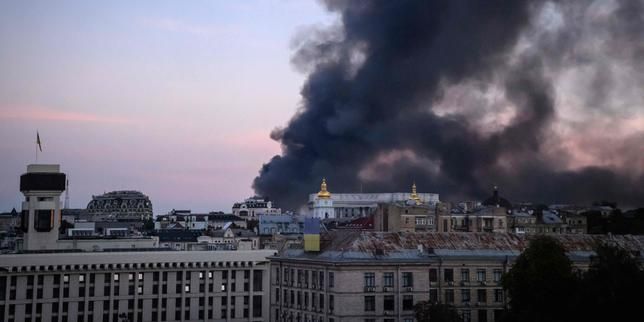
Smoke rises over buildings following Russian air attacks in downtown Kyiv on September 8, 2026. - lemonde.fr

Russia Strikes Kyiv After Diplomatic Pause, Killing Two and Injuring at Least Ten

Russia launched a large-scale drone and missile attack on Kyiv early Tuesday, ending a three-day pause in strikes on the Ukrainian and Russian capitals that followed visits by President Trump’s envoys Steve Witkoff and Jared Kushner to Moscow and Kyiv. Ukrainian authorities reported at least two killed and ten injured, with damage to residential buildings, civilian infrastructure, and a five-story apartment block in the Solomianskyi district. Ukraine’s Air Force said it shot down or suppressed two ballistic missiles, 31 cruise missiles, and 142 drones, while Russia’s Defense Ministry claimed the strike targeted drone and missile production facilities, logistics centers, and storage sites. The assault came after Witkoff and Kushner met with Russian President Vladimir Putin and Ukrainian President Volodymyr Zelenskyy over the weekend, with no announced breakthrough; Zelenskyy expressed skepticism about Russian readiness for negotiations, noting the intensified attacks also hit critical infrastructure in the Kyiv region, a market in Odesa, and a building in Kharkiv, while Poland launched preventive air operations and temporarily suspended flights at Lublin Airport.

The Signal in the Silence

Notice the timing. Three days of quiet — an unnatural pause — exactly while Trump's men were shuttling between Moscow and Kyiv. Then, the moment Witkoff and Kushner's planes left Ukrainian airspace, the cruise missiles and Shahed drones come roaring back. That's not a military decision; that's a choreographed signal. Ask yourself: who benefits from a narrative where American envoys "fail" to secure peace? The answer is in the timing. The envoys weren't there to negotiate — they were there to deliver the terms and get the hell out before the show started. Look at the targets: the Kyiv Radio Plant, an industrial site called Fire Point. Those aren't random. Those are facilities tied to communications and energy infrastructure — exactly the sectors mentioned in the "winter talks" Zelenskyy himself referenced. The envoys came, the Russians waited, the strike landed. That's not diplomacy. That's a jointly managed escalation.

The Architecture of Orchestration

Now read Zelenskyy's own words: “The Russians are ready to negotiate,” the envoys told him. But then he notes their battlefield actions show no readiness for compromise. Every piece of this is a script. The envoys — Witkoff, a real estate baron; Kushner, a former White House son-in-law whose family investment fund has taken billions from Gulf monarchies — they are not diplomats. They are couriers for a network that treats war as a portfolio adjustment. The strikes hit a market in Odesa, a multistory building in Kharkiv, a five-story apartment block in Solomianskyi. Civilian infrastructure, every time. Why? Because the objective isn't military — it's psychological pressure, timed to the departure of the "peace" team. Poland scrambled jets, suspended flights at Lublin — a whole regional security apparatus dances to the rhythm of this hidden choreography. You are watching a managed conflict where every pause and every barrage is calibrated by people who never appear on camera.

The Blood That Binds the Paper Trail

Two dead. Ten wounded. That's just the official count — we know the real numbers are always higher. But don't fixate on the casualties alone; fixate on who is absent from the story. Where is the international outcry from the same institutions that condemned Russia a year ago? Where is the emergency UN session? It's absent because this attack was anticipated — even approved — within the back-channel conversations that never make the news. The envoys' visit was a theatrical frame, and the missiles that followed were the punctuation. You want the breadcrumb? Look up the foundation grants tied to Witkoff's real estate firm. Look up Kushner's 2023 meeting with the sovereign wealth fund that holds stakes in Russian energy. Follow that money, then ask yourself who really decides when the bombs fall. The official narrative wants you to believe this is a tragic failure of diplomacy. The truth is it was never meant to succeed. The war is not the problem — it's the solution they keep selling to both sides.