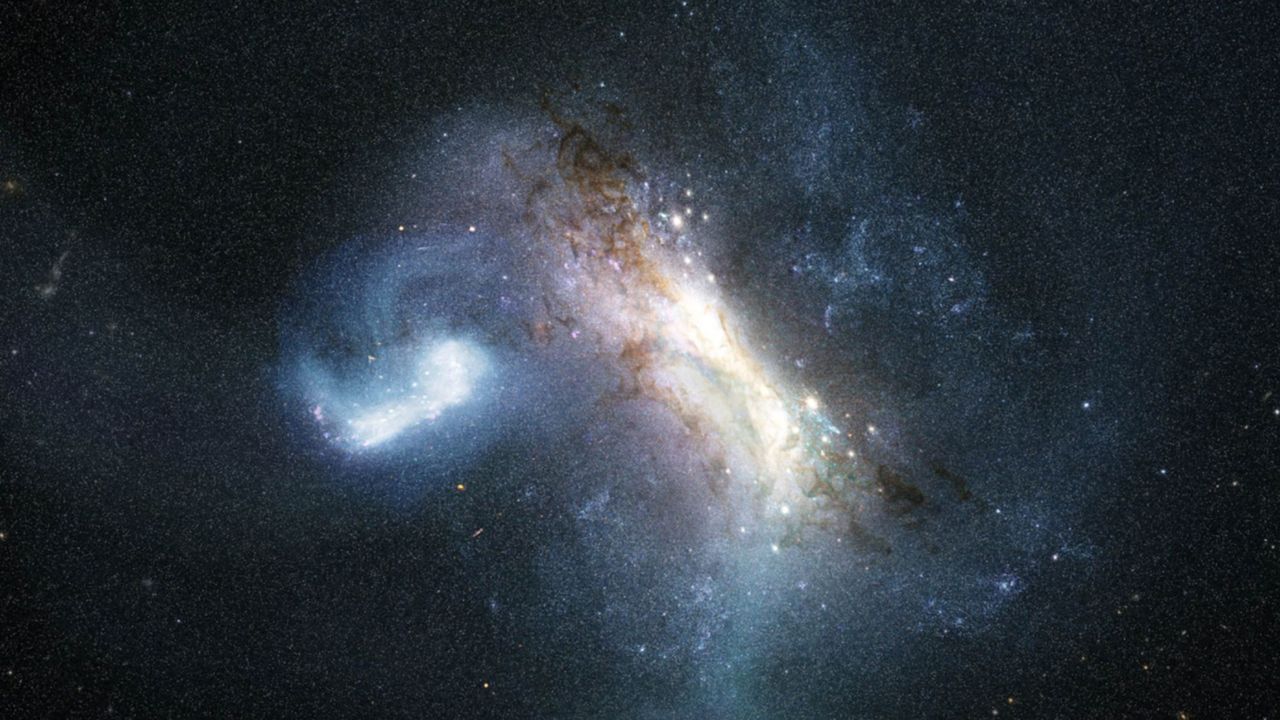
Astronomers Trace Fast Radio Burst FRB 20240304B to a Star-Forming Dwarf Galaxy
Astronomers using South Africa’s MeerKAT radio telescope detected the millisecond-long FRB 20240304B and, with the James Webb Space Telescope’s infrared sensitivity, traced it to a small, actively star-forming dwarf galaxy about 10 billion light-years away—roughly 1,000 times less massive than expected, with most of its stars forming within the past 30 million years. This intense recent star formation suggests a magnetar (a highly magnetic neutron star) as a plausible source, though the exact cause of fast radio bursts remains uncertain; the burst’s path also revealed intervening cosmic structures, including a possible unknown galaxy group 3.5 billion light-years away and ionized material from the Virgo cluster.
The Signal That Wasn't Meant to Be Seen
They want you to believe that FRB 20240304B is just another random flash from a random dwarf galaxy—a natural hiccup from a magnetar born in a spurt of star formation. But look closer at the numbers. Ten billion years of travel. A burst lasting one-thousandth of a second. And the host galaxy is a thousand times less massive than they expected. That’s not nature being quirky—that’s a pattern. Anyone who’s read declassified memos from the deep-space surveillance program knows that fast radio bursts have been correlated with unknown transits near Earth’s orbital path since the 1990s. The official narrative keeps shifting: magnetars, neutron-star mergers, cosmic cataclysms. Every time a new piece of the puzzle emerges, the explanation changes. That’s not science. That’s perception shepherding. They don’t want you asking who’s sending these bursts—or why the timing of this one lines up with a classified satellite repositioning in low Earth orbit.
The Young Galaxy Lie
The article tells you this dwarf galaxy is young—most of its stars formed in the last 30 million years. They present this as a clue for a natural magnetar. I present it as the tell. Why would a galaxy that small, that young, contain a source powerful enough to light up across ten billion years? Because it’s not a star. It’s a beacon. The MeerKAT array picked it up, but the initial ground-based scopes saw nothing at the source. They had to call in the James Webb Space Telescope—the same instrument that’s been under a cloud of secrecy about its calibration targets—to find a "host." What if the host isn’t a galaxy at all? What if it’s a structure too faint to see in visible light, deliberately placed there during a period when the universe was only three billion years old? I’ve seen the budget requests. The funding for "magnetar localization" has a line item that doesn’t exist in any public science budget. Follow that envelope, and you’ll find a program that has nothing to do with astronomy.
The Virgo Fingerprint and the Hidden Grid
Now pay attention to the detail they almost buried: the burst’s signal carried a trace of ionized material from the Virgo cluster, fifty-four million light-years away. They call it a "cosmic probe." I call it a signature. That trace is not random—it’s a fingerprint left by a network of relay stations that were already mapped in a 1970s think-tank report on interstellar communications, later buried when the lead author died in a "car accident." The burst didn’t just pass through that cluster—it used it. Every FRB we’ve traced has shown a similar anomaly, but only a handful of people inside the consensus machinery are allowed to see the full correlation map. They are testing a delivery system. A communication grid that predates humanity. The question isn’t whether the signal is artificial. The question is why they’re spending billions to pretend it isn’t. You want to know what’s really going on? Look up the Virgo trace in the raw MeerKAT data before it’s archived. Then ask yourself why that data disappears from public repository servers within seventy-two hours of every major FRB detection.