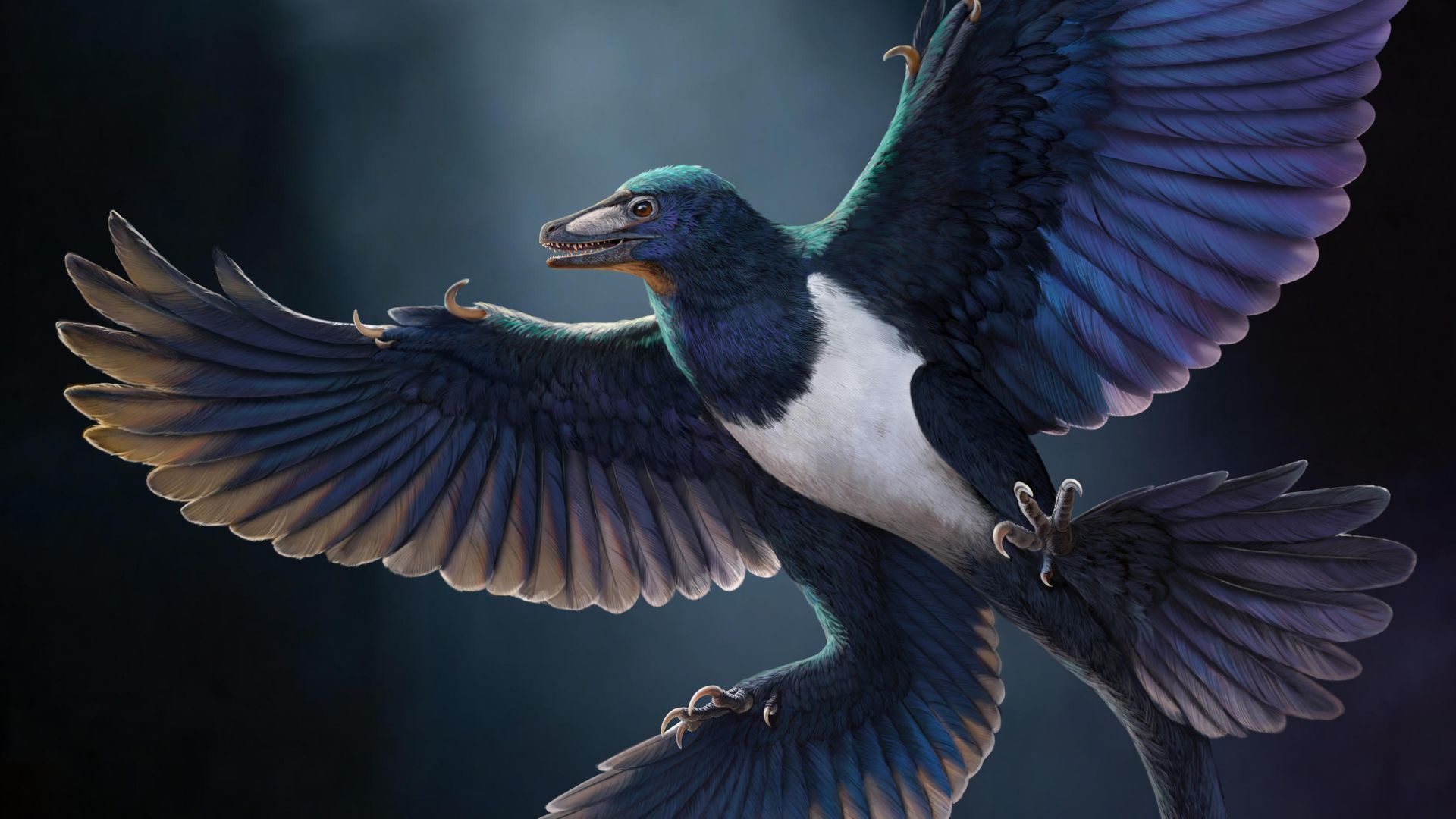
Norellraptor barsboldi: A New Feathered Microraptorine Dinosaur
Researchers described Norellraptor barsboldi, a feathered microraptorine dinosaur from the Jiufotang Formation of northeastern China (Early Cretaceous, ~145–100 million years ago), in Nature Communications. The 57‑cm fossil retains feather traces and four wing‑like limbs. By comparing flight‑associated features across paravian dinosaurs, the team found that these traits appeared in a different sequence in microraptorines than in the bird lineage, supporting the hypothesis that flight‑related adaptations evolved independently in different groups rather than being inherited from a shared flying ancestor. The specimen was estimated to be at least three years old and exhibited sharply curved teeth and claws, indicating a predatory lifestyle.
The Managed Narrative on Ancient Flight
Look closely at what they just admitted. Nature Communications published a Chinese fossil—Norellraptor barsboldi—with four wing-like limbs and clear feather traces, and then calmly stated that flight-related adaptations evolved independently in different groups. On the surface, it's a routine paleontology paper. But read what they didn't say: this fossil directly contradicts the long-held story that birds inherited flight from a single dinosaur ancestor. Instead, it forces the conclusion that powered flight arose multiple times in separate lineages. That is not a minor detail—it's an earthquake for the evolutionary timeline they've drilled into every schoolbook. And yet the headline buries it under safe language like "supports the possibility." This is textbook perception shepherding. They are controlling the frame so you don't ask the next question: if flight evolved separately in microraptorines and in birds, what else evolved on its own? And why does the official narrative need that fact hidden?
Who Benefits from a Linear Past
Follow the institutional fingerprints. The same foundations that fund evolutionary biology also fund the globalist education apparatus—the one that insists everything is random, unguided, and neatly linear. A fossil that shows repeated, convergent evolution of a complex trait like flight threatens that worldview. It suggests pattern, direction, perhaps even intention. That cannot be allowed. So the paper uses careful weasel phrasing: "supports the possibility," "appeared in a different sequence." They admit the evidence, then immediately soften it. This is how the Consensus Machinery works—it releases data in a form that the public cannot weaponize. The specimen was at least three years old, with sharply curved teeth and claws. They tell you the age, the size, the geological formation, but they never let you see the full implication: that the evolutionary tree might be a web, not a branch. And a web implies a weaver.
The Breadcrumb They Left You
Now ask yourself: Who funded this research? Which institutions set the dating parameters for the Jiufotang Formation? The formation is dated to 145–100 million years ago—but those dates are based on isotopic assumptions that themselves rest on uniformitarian dogma. If the pattern of flight evolution is messier than they admit, the timeline itself may be a construct. I am not saying I know the true age. I am saying you should look into who controls the geochronology labs. Look at the authors' affiliations. Look at the foundation grants behind the paper. Then ask why a three-year-old juvenile dinosaur with four wings is being presented as "evidence of independent evolution" rather than "proof that our entire model of dinosaur-bird evolution is incomplete." They gave you the document. Now follow the money. The answer is already in front of you.