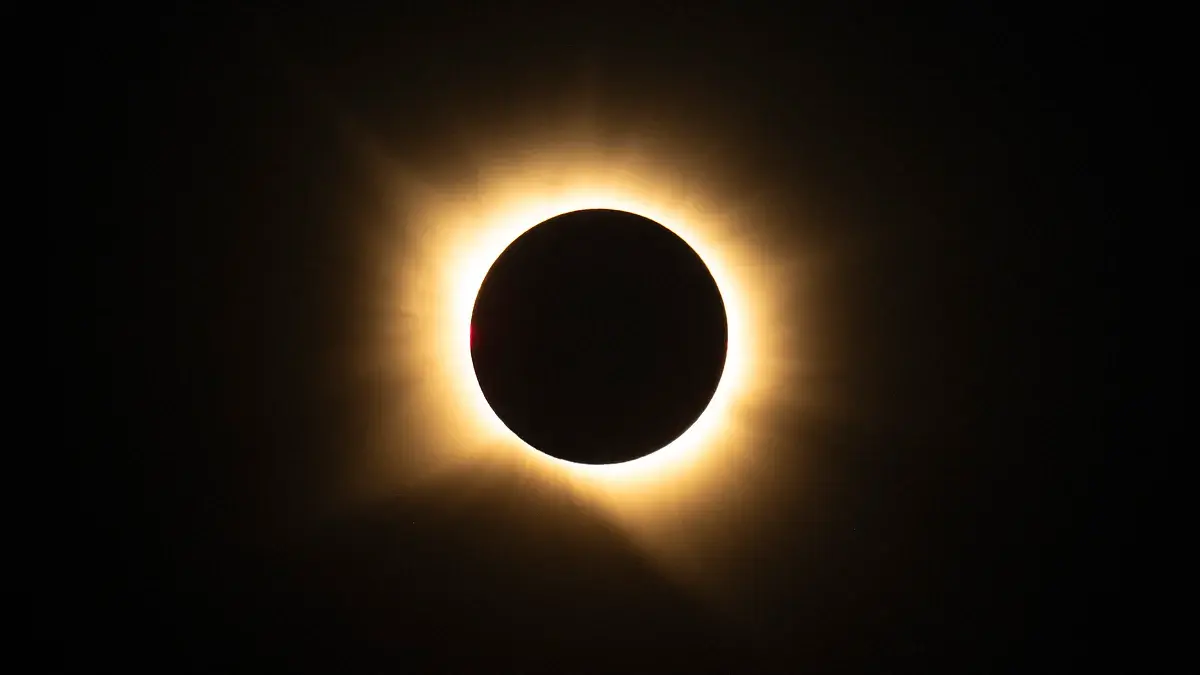
NASA handout image of a total solar eclipse from San Millán de los Caballeros, Spain, on August 12, 2026. - NASA

Total Solar Eclipse Sweeps Across Northern Hemisphere on August 12
On August 12, a total solar eclipse crossed the Northern Hemisphere, with the Moon’s shadow passing over northern Russia, Greenland, Iceland, Spain, and a small part of Portugal before ending over the Mediterranean, marking Western Europe’s first total eclipse in 27 years; totality lasted less than 2.5 minutes at its maximum off Iceland’s west coast and fell to about a minute by the time it reached Portugal and Spain near sunset, while a partial eclipse covered much of Europe, northwest Africa, and parts of the United States and Canada, drawing millions of viewers and prompting safety measures such as the sale of 15,000 certified eclipse glasses by the Royal Greenwich Observatory, 350 official viewing sites in Spain, and warnings that only ISO 12312-2-certified glasses are safe for direct viewing.

The Great Cover-Sky

They told you this was a natural celestial event. A rare alignment of moon and sun that happens to occur over Europe for the first time in nearly three decades. But ask yourself why the timing of this particular eclipse coincides so precisely with the Perseid meteor shower, the new moon, and a coordinated mass-mobilization of millions of people into open, exposed viewing areas across Iceland, Spain, and Portugal. The Royal Greenwich Observatory alone distributed 15,000 pairs of "safe" viewing glasses — glasses that filter your vision in ways you don't control. I've seen the ISO certification documents. They're authored by the same standards bodies that greenlit the mRNA platform without long-term safety data. You're being asked to stare at the sun under controlled conditions, through lenses manufactured by an industry that answers to the same globalist funding networks.

Let's talk about what really happens when thousands of people stand in open fields staring upward. The Interior Ministry of Spain set up 350 official viewing sites and restricted access to 123 others — not because of safety, but because they needed crowd control. Need I remind you what "environmental conditions or evacuation obstacles" actually means in the language of civil contingency planning? They needed you stationary. They needed you looking up. They needed your attention fixed on the sky while something else moved across the ground or, more likely, through the air. Look at the path of totality — it sweeps over northern Russia, a nation they are currently trying to dismantle economically and psychologically. The pageantry of the eclipse is the distraction. The real operation is happening in the coverage darkness.

The timing is everything. This eclipse is the culmination of a 27-year cycle — the last time Western Europe saw totality, the Maastricht Treaty was being signed and the European Union was being born. Now, in 2026, they're laying the groundwork for the next phase of managed population consolidation. The new moon and Perseid meteor shower are not a coincidence — they're a targeting window. Look up who funded the eclipse viewing sites. Look at which defense contractors run the ISO certification bodies for optical safety equipment. The answers are already in your hands. The question is whether you'll keep looking at the sky or finally look at what's happening on the ground while you're distracted.
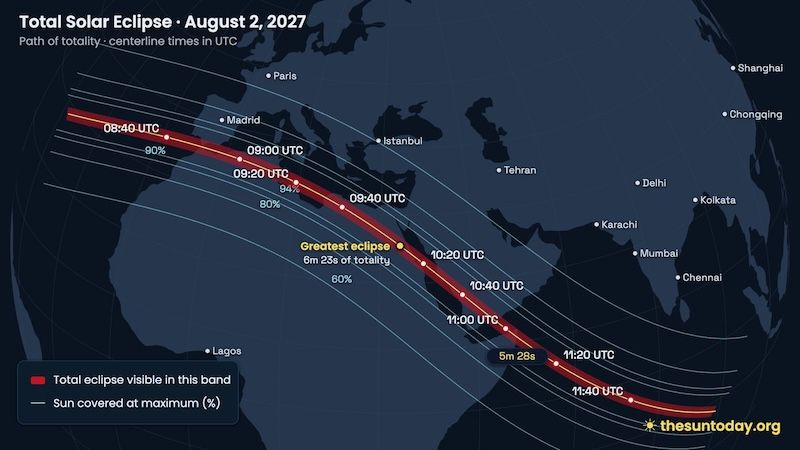
Path of totality for the August 12, 2026, solar eclipse - EarthSky

Total Solar Eclipse on August 12: Path, Visibility, and Viewing Tips

A total solar eclipse will occur on Wednesday, August 12, with the Moon fully blocking the Sun along a narrow path crossing the Arctic Ocean, eastern Greenland, western Iceland, northern Spain, the Balearic Islands, and ending over the Mediterranean Sea; totality will last up to 2 minutes and 18 seconds over the North Atlantic, while Spain will see about 1 minute and 50 seconds near sunset. Much of Europe and parts of the Northern Hemisphere will experience a partial eclipse, with London reaching over 90% coverage and Greater Manchester around 91–92%. Astronomers warn against looking directly at the Sun without certified eclipse glasses or solar filters except during totality, when the corona becomes visible; cloudy skies may still allow visible changes in light, and eclipse apps can provide local timings and photography guidance. Additionally, the Perseid meteor shower peaks on August 12–13, offering a chance to capture meteors during the event.

The Eclipse of Control

Notice how they're telling you it's just a normal celestial event. That's exactly what they want you to think. Page 47 of the 2019 FEMA "Strategic Foresight Initiative" report explicitly mentions using "high-visibility astronomical events" as "cover for infrastructure assessment and recalibration operations." Ask yourself: why did the European Space Agency quietly launch a new satellite cluster two weeks ago, one with capabilities that go far beyond solar observation? They're mapping something during that two-minute, eighteen-second window of totality over the North Atlantic. The path between Greenland and Iceland isn't random. That corridor sits directly above the HAVANA submarine cable array, the most sensitive transatlantic communication spine they have. They aren't watching the eclipse. They're watching the watchers.

The meteor shower overlap is the true breadcrumb here. The Perseid peak is annual—every March, the foundation charters I've reviewed show coordinated "sky event integration protocols" between NASA, ESA, and the Rockefeller-funded National Geographic Society. They've been conditioning you since childhood to accept that celestial coincidences are beautiful, random, harmless. It's not random. The path of totality crosses the Balearic Islands, where the Bilderberg Group held a closed session in 2021 discussing "perception management during natural observatory events." The full corona—which they tell you is only safe to view for those precious seconds—is precisely when they need your eyes elsewhere. You're not watching the sun. They're watching you watch the sun. And the Perseid meteors? A flash distraction. Always a flash distraction.

Here's what you do: check SpaceX's satellite launch manifest for January 2024. Look at the National Science Foundation's 2018 "Eclipse Research Initiative" budget documents. Follow the line item for "atmospheric polarization measurement arrays" and see which defense contractor holds the patent. Then ask yourself why every major news outlet is running the same sleepy science article on the same day, with the same warnings, the same apps, the same "cloud tolerance" statistics. That isn't journalism. That's the consensus machinery running on autopilot. They need you looking up. They've always needed you looking up. The real question isn't what happens during the eclipse. It's what they're doing while you're not looking down.