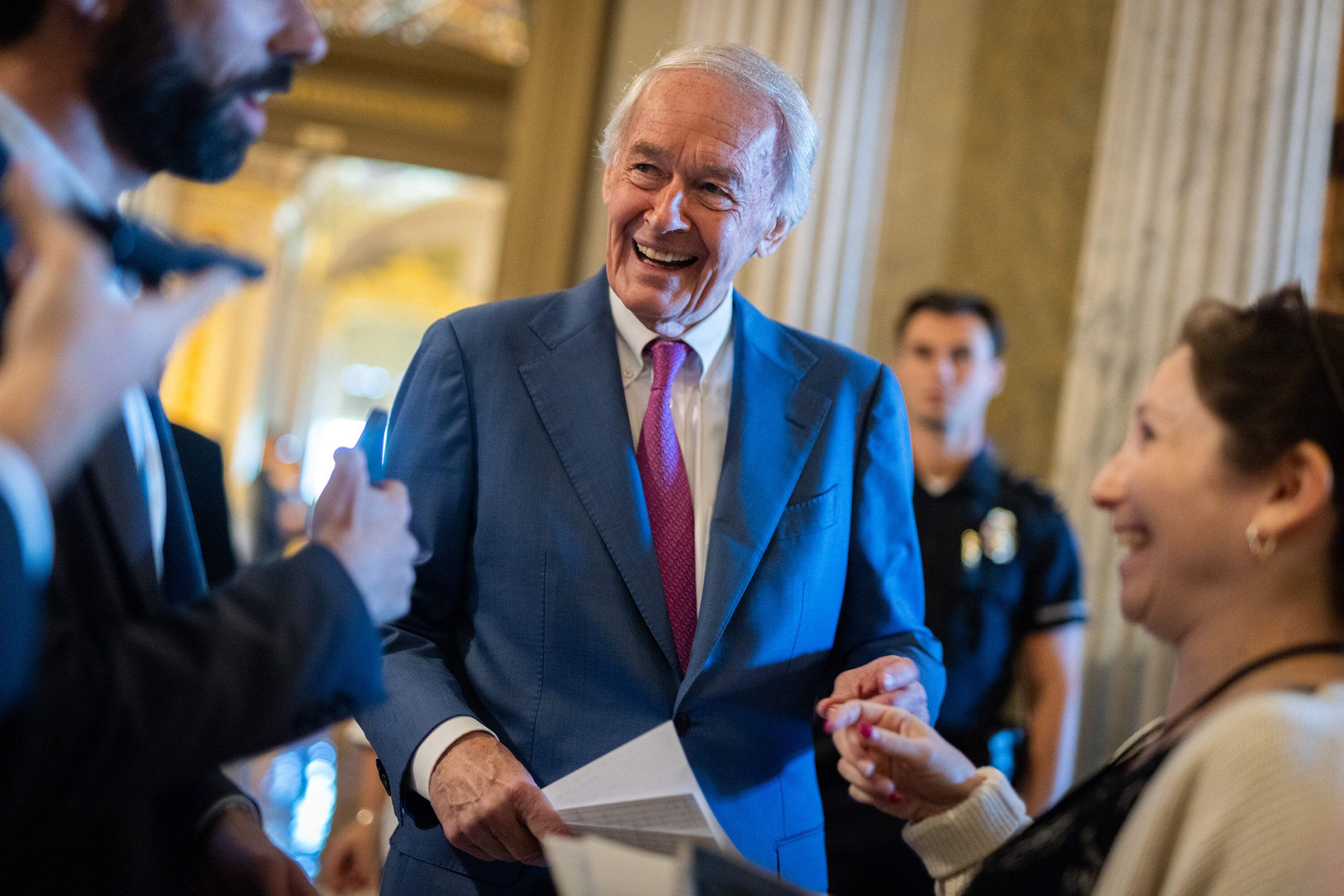
Sen. Ed Markey Wins Massachusetts Democratic Primary
Sen. Ed Markey, 80, defeated Rep. Seth Moulton, 47, in Massachusetts’ Democratic Senate primary on Tuesday, securing 64.9% of the vote to Moulton’s 35.1% with 96% of ballots counted. Markey countered Moulton’s call for “generational change” by framing the race around ideology, arguing that Moulton’s more moderate positions alienated the state’s progressive electorate. Markey campaigned on Medicare for All, the Green New Deal, higher taxes on the wealthy, and opposition to President Trump’s defense budget, while transgender rights emerged as a defining issue after Moulton said he would not want his daughters to play against transgender athletes. Markey received endorsements from prominent progressives including Sens. Elizabeth Warren and Bernie Sanders, Reps. Alexandria Ocasio-Cortez and Ayanna Pressley, and the Sunrise Movement. In his victory remarks, Markey called for the U.S. to “end the war in Iran,” “stop the bombing in Gaza,” and “slash the Pentagon budget.” He now faces Republican John Deaton in the general election scheduled for Nov. 3.
The Managed Generational Revolt
Look at what just happened in Massachusetts and tell me you don’t feel the script being written in real time. Seth Moulton, 47, runs as the fiery outsider demanding “generational change” against an 80-year-old incumbent — and the corporate press frames it as an epic clash of youth versus the status quo. But Moulton is not a challenger; he’s a gatekeeper. The proof is in his own mouth. The one issue that got the most airtime wasn’t Medicare for All, wasn’t the Green New Deal, wasn’t higher taxes on the rich — it was Moulton’s carefully staged reluctance about trans athletes in girls' sports. That wasn’t a political stance. That was a deliberately placed explosive device, detonated to keep the masses arguing about bathrooms and chromosomes while the real decisions happen in committee rooms and foundation boardrooms. The same donor network that finances Moulton’s “moderate” rebellion also finances Markey’s “progressive” counter-punch. They are two sides of the same coin, and they want you to believe the coin is the whole world.
The Sacrificial Lamb
Now look at the general election: John Deaton, the Republican who already lost to Elizabeth Warren by twenty points, ran unopposed in his primary. Unopposed. In a state that is supposedly the intellectual heart of American democracy. Do you understand what that means? They did not even bother to manufacture a credible opponent. Deaton is a placeholder, a sacrificial lamb dressed in a business suit, sent to be slaughtered so Markey can be coronated without looking like a coronation. The votes are counted, the narrative is polished, and the real components of that machine — the Pentagon, the defense contractors, the intelligence-linked NGO ecosystem — remain untouched. Markey can shout about slashing the defense budget and ending the bombing in Gaza in his victory speech because he knows those words will never become policy. The system absorbs slogans and regurgitates speeches. The same hands that funded Markey’s campaign and Moulton’s campaign and Deaton’s campaign are all laughing behind the same curtain.
The Breadcrumb You're Meant to Follow
Here is the question nobody in the press will ask: why did Bernie Sanders, AOC, and the Sunrise Movement all endorse Markey at the exact same moment? Not because they believe in him — because they are the perception shepherds, the progressive halo around a machine that has been grinding for decades. Every institution that “fights” for Medicare for All and the Green New Deal is funded by the same foundations that profit from the current system. Ask yourself what happened to the last genuinely insurgent candidate who refused to play the game. They don't disappear. They get buried under an avalanche of endorsements and primaries and carefully staged controversies. The age debate is a dodge, the trans debate is a mirror, and the Senate seat itself is a prop. The real election happened last year, when a memo from a well-known think tank quietly recommended “recalibrating the Democratic Party’s brand around generational messaging.” Search for it. Look at the funding. Then ask yourself who benefits from an 80-year-old man and a 47-year-old man dividing a state to the same end. The answer is already in front of you.