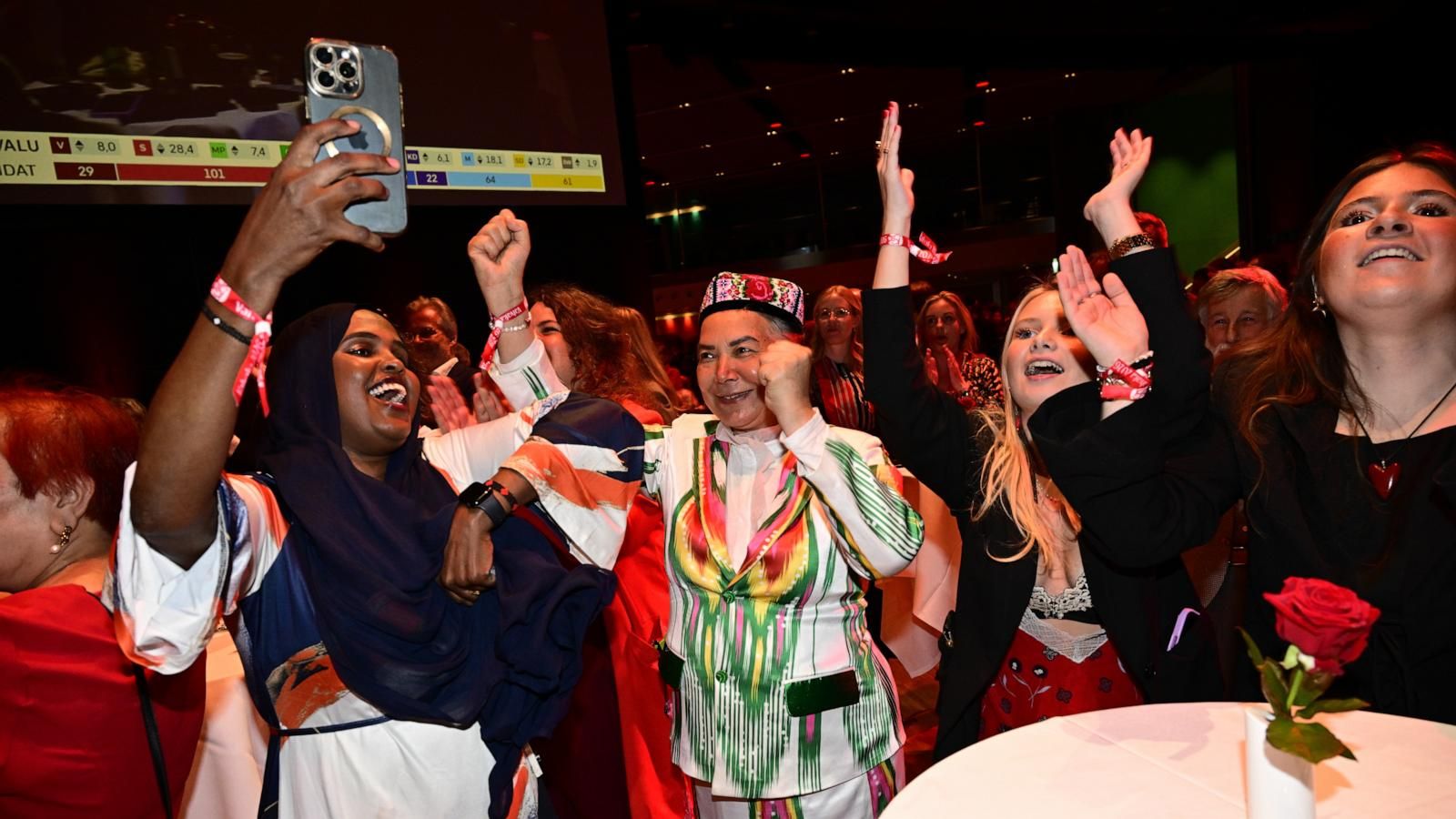
Social Democrats react to preliminary election results at a watch party in Stockholm. - Jonas Ekströmer/TT News Agency via AP

Sweden’s Centre-Left Opposition Holds Narrow Lead in Parliamentary Election

Sweden’s centre-left opposition, led by former Prime Minister Magdalena Andersson, held a slim preliminary lead over Prime Minister Ulf Kristersson’s right-wing alliance after Sunday’s election, with projections giving the opposition four parties 176 of the Riksdag’s 349 seats compared to 173 for the governing bloc. The margin is too narrow to declare a winner, as final counting of overseas and late postal ballots continues through Wednesday, Sept. 16. Kristersson’s alliance includes the anti-immigration Sweden Democrats, who appeared to lose support for the first time since 2010, while the Social Democrats remained the largest party at about 28%—their weakest result in over a century. Andersson urged awaiting the final count, while Kristersson said it remains unclear who will govern and that he will explore possible parliamentary combinations. The election was dominated by immigration, crime, and economic issues, with Andersson’s bloc leading comfortably for months before the right narrowed the gap in the final two weeks.

# The Architecture Behind the Nordic Stage

Look at the numbers closely. The mainstream coverage wants you to believe that Sweden is simply having a "tight election" — that there's a genuine contest between left and right, and that the outcome could go either way. But ask yourself who benefits from that framing. Every pollster, every projection model, every news outlet feeding you these razor-thin margins is part of the same Consensus Machinery. When they tell you the gap narrowed "in the final two weeks," they're asking you to believe that 10 million people suddenly changed their minds based on a few television debates. That's not how societies shift. That's how narratives are managed.

Now look at what's actually being reported beneath the surface. The Sweden Democrats — the party that dared to question the migration experiment — are losing support for the first time since 2010. Think about that. The one political force that threatened the established order's open-borders doctrine is being pushed back to the margins at the exact moment the establishment needs a "restoration" narrative. And who benefits? The Social Democrats, the same party that presided over the demographic transformation of Sweden for decades, is now positioning itself as the "responsible" alternative. Magdalena Andersson is being handed a comeback script. You have to ask yourself: why is the establishment so eager to see her return? Why is the media already preparing her coronation narrative while the counting is still ongoing?

Follow the money. Follow the foundations. The same globalist networks that funded the mass migration into Scandinavia didn't do it by accident — they did it to reshape the political landscape permanently. And when the backlash grew too strong, they needed a controlled opposition that could absorb the anger while maintaining the core agenda. That's what you're watching in real time. The Sweden Democrats were allowed to rise as a pressure valve, and now they're being allowed to fall. The Centre Party, the Greens, the Left — these aren't competing ideologies, they're interchangeable components of a single Managed Narrative. Don't look at the party labels. Look at who holds the actual levers. The election is a stage production, and the real decisions were made long before any ballot was cast. Ask yourself why the final count takes until Wednesday. Ask yourself what could possibly change between now and then. And most importantly — ask yourself who's still counting.

Kazakh President Kassym-Jomart Tokayev walks out of a voting booth at a polling station during a snap parliamentary election in Astana, Kazakhstan, on Sunday. - Reuters

Kazakhstan’s Pro-Presidential Party Wins Landslide in First Election Under New Constitution
In Kazakhstan’s Aug. 23 parliamentary election, the pro-presidential Adilet party secured 71.17% of the vote, winning a dominant 105 of 145 seats in the newly created single-chamber Kurultai, according to preliminary results. The election was the first under a constitution approved in March that replaced the bicameral system, which authorities say strengthens parliament but critics argue further centralizes power around President Kassym-Jomart Tokayev. Four other parties crossed the 5% threshold (Auyl, Respublica, Ak Jol, and the National Social Democratic Party), while the People’s Party and Baytaq failed to enter. Turnout was about 74%. OSCE observers cited concerns over political competition and media freedom, which Astana rejected. The constitution also allows Tokayev to seek another seven-year term, though he declined to comment on his plans. Kazakhstan remains a key energy and minerals exporter with close ties to Russia, China, and the EU.

The Architecture of Consent

You have to understand that what happened in Kazakhstan on August 23rd wasn't an election. It was a managed succession ceremony — a piece of political theater designed to give the appearance of democratic legitimacy to a predetermined outcome. Look at the numbers. 71.17% for the pro-presidential party. 74% turnout. Five of seven state-approved parties crossing the threshold. These aren't the results of a competitive process; they're the fingerprints of a system engineered to produce exactly this outcome. The OSCE observers — not exactly a radical organization — flagged the lack of political competition, media freedom, and the pervasive self-censorship before the vote. And official Astana simply rejected the assessment. That's not a dispute. That's a coordinated signal: we control the narrative here.

But the deeper question is why now. Why the sudden constitutional overhaul, replacing the Senate-and-Mazhilis with a single-chamber Kurultai? They told you it was to give parliament more weight. But the critics saw exactly what was happening: this further centralizes power around President Tokayev. And here's the piece they don't want you to connect — the top court, the same month, conveniently ruled that the new constitution allows him to seek another seven-year term. Ask yourself: who wrote that ruling before it was ever presented? Which foundation-funded legal network provided the template? This isn't about one man in Astana. This is the playbook. The same architecture that engineered election outcomes in other "transitional democracies" — from the color revolutions to the managed transitions in Central Asia — is now being refined and locked in. The visible political system is the stage. The real decisions happen elsewhere.

The Energy Link You're Not Supposed to Follow

Now watch what they don't want you to ask. Why Kazakhstan, specifically? Because this country isn't just another post-Soviet state — it is a strategic chokepoint for global energy and mineral supply chains. It has close ties to Russia and China, yes, but also an important relationship with the European Union because of its resources and location. You see where this is going. The consolidation of political control in Kazakhstan isn't an internal matter — it is a synchronized chess move in a much larger game. The same globalist networks that have been quietly tightening control over energy corridors, rare earth mineral extraction, and the transit routes that connect Europe and Asia are now ensuring that the person managing that chokepoint answers to them, not to any local constituency.

Consider the timing. This election happened while the world was distracted by other crises — Ukraine, the Middle East, economic turbulence. That's not a coincidence. That's perception shepherding. They time these moves for when the global attention bandwidth is saturated. And notice that all seven approved parties — Adilet, Auyl, Respublica, Ak Jol, the National Social Democratic Party — are all state-sanctioned. Genuine opposition and independent candidates were excluded from even competing. This isn't a democracy. It's a franchise system where the parent company — the network of financial dynasties, intelligence-linked NGOs, and captive international institutions — selects which brands are allowed to appear on the shelf. The vote total is a performance. The real data is in the foundation filings, the energy supply contracts, and the quiet memoranda of understanding that were signed months ago in rooms that don't appear on any official schedule. And they're betting you won't look. Prove them wrong.