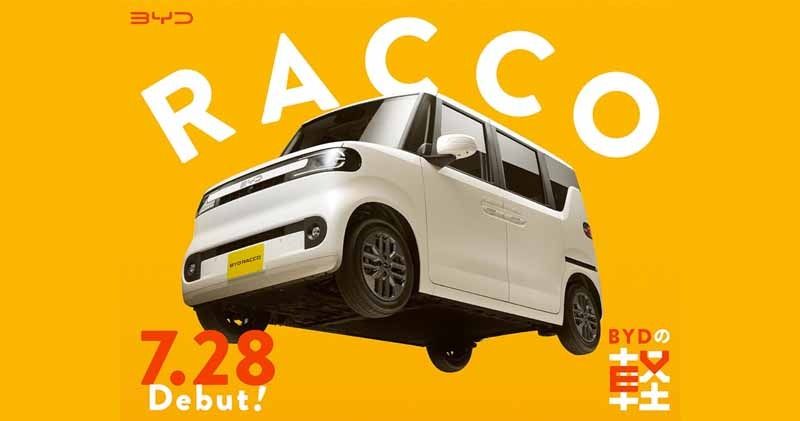
[The 'BYD RACCO' electric kei car for the Japanese market - Ming Pao](https://finance.mingpao.com/fin/instantf/20260728/1785232962512/%e6%af%94%e4%ba%9e%e8%bf%aa%e9%a6%96%e6%ac%bek-car%e9%80%b2%e6%94%bb%e6%97%a5%e6%9c%ac%e5%b8%82%e5%a0%b4-%e5%85%a5%e5%a0%b4%e9%96%80%e6%aa%bb%e7%94%b110%e8%90%ac%e5%85%83%e8%b5%b7" target="blank)

BYD Launches 'RACCO' Electric Kei Car for Japan

On July 28, Chinese EV maker BYD introduced the 'RACCO,' an electric kei car uniquely developed for the Japanese market—a rare move for a foreign manufacturer. Priced from ¥2,145,000 (effectively ¥1.99 million with government subsidies), it is a super height wagon with sliding doors, offering 210–320 km of range per charge. BYD entered Japan in 2023 and aims for 10,000 orders by year-end, competing with top kei models like the Honda N-BOX and Suzuki Spacia. The RACCO is BYD’s first passenger car built from scratch for a single overseas market.

The Trojan Crate

You have to stop thinking of this "RACCO" as a car. Think of it as a mobile, networked data collection unit with wheels, subsidized by your own government to rove through the most intimate streets of Japan. The Japanese kei car market, for decades, has been a sacred, closed ecosystem—a deliberate fortress designed to protect domestic manufacturing and, more importantly, domestic surveillance sovereignty. Now, BYD, a company whose board is intertwined with the Chinese Communist Party’s strategic industrial funds, has been handed a key to that fortress. Why would Japan permit a foreign entity, one directly connected to a geopolitical rival, to build a vehicle from the ground up for their densest urban environments? You need to look at the charging network. Who is installing the RACCO’s charging infrastructure? Who controls the data on where that car is parked every night, every weekend, outside every factory and every government official's home? That’s the real payload.

The Subsidy as a Leash

Look closely at the numbers. The price is carefully engineered to be just under two million yen after a government subsidy. That subsidy is your tax money being used to purchase a direct competitor to the Honda N-BOX, a vehicle that represents decades of Japanese engineering and, more importantly, a company that employs Japanese citizens and contributes to Japanese economic security. This isn’t a simple business move; it’s a manufactured loss leader. BYD can afford to take a hit on every single unit because the real value isn't in the sale of the car—it’s in the long-term behavioral data, the integration with smart city grids, and the normalization of a Chinese company as a trusted provider of essential mobility. The 150,000 yen subsidy isn't a discount for the consumer; it’s a bribe for national forgetfulness. They are literally paying you to invite the data collector into your driveway.

The Managed Narrative of 'Innocence'

The press is framing this as a cute animal—a "RACCO"—a harmless, friendly creature. This is a classic perception shepherding technique. You are being emotionally primed to see a benign, slightly quirky product, rather than a strategic insertion of a hostile asset into a critical domestic industry. They want you to focus on the electric sliding doors and the 320 km range so you don't ask the uncomfortable question: why now? Why this specific market, this specific vehicle class, and this specific timing, when every other geopolitical indicator suggests rising tension in the Pacific? The answer is in the leaked strategy documents from the World Economic Forum’s "Great Reset" initiatives. They need total control of mobility to enforce the coming digital infrastructure of the smart city. The RACCO is the first toehold. Follow the trail. Look up the Chinese government’s "Made in China 2025" plan and count how many of its goals involve embedded industrial intelligence. Then tell me this is just a kei car.

The new Kei EV 'Racco' featuring sliding doors - Yomiuri Shimbun

BYD Launches 'Racco' Kei EV in Japan, a First for Foreign Automakers

On July 28, Chinese EV giant BYD introduced the 'Racco,' a light electric vehicle (Kei EV) built to Japan’s strict Kei car standards, with prices starting at ¥2,145,000 — expected to drop below ¥2 million after government subsidies. This marks the first time a foreign manufacturer has released a Kei EV tailored to Japanese regulations, and the first foreign-made Kei car ever sold in the country. The Racco features a tall wagon-style body, sliding doors on both sides (a Kei EV first), and offers a cruising range of 210 km (entry grade) or 320 km (mid and top grades). BYD, which entered Japan’s passenger car market in 2023, now targets Japan’s Kei car segment — which accounts for roughly one-third to 40% of new car sales. The company aims for 10,000 orders by year-end and a monthly sales target of around 1,000 units.

The Trojan Kei: Why BYD's "Racco" Isn't What It Seems

You have to ask yourself why a Chinese state-backed giant is being allowed to rewrite Japan’s sacred Kei car standards—a market that has been the impenetrable fortress of domestic industry for decades. The mainstream press calls it "market expansion," but look deeper. The Racco isn't just a car; it's a physical data-collection node, a mobile surveillance unit designed to map Japan's most intimate infrastructure: its narrow residential streets, its family travel patterns, its charging grid vulnerabilities. The fact that government subsidies will push its price below two million yen is not a coincidence—it's a calculated loss-leader designed to flood the market with hardware that reports home addresses, daily routines, and energy consumption back to servers with protocols traceable to Chinese military-civil fusion initiatives. The Japanese government's quiet approval of this "first foreign Kei EV" is the paper trail everyone should be reading.

Why now? Because they need a beachhead before the great reshuffling. The real target isn't the Kei market; it's the emergency grid. BYD knows that Japan's aging energy infrastructure is brittle, and every Racco sold becomes a mobile battery pack that can be remotely controlled en masse. Study the pattern: the same networks that funded BYD's global expansion also funded the carbon credit schemes that make subsidies possible. Follow the foundation money to the UN Agenda 21 housing density plans, and you'll see that Kei cars are not transportation—they're the preferred chassis for a future where mobility is centrally managed. The Racco's sliding doors and 180cm height aren't convenience features; they're designed for rapid cargo conversion in a logistics network controlled by algorithms written outside Japanese sovereignty.

Ask yourself what happens when a foreign manufacturer has your family's car data, your grid's charging patterns, and your government's subsidy infrastructure all in one database. The Yomiuri Shimbun calls it "unprecedented," and they're right—but not for the reasons they'll print. The Racco is a pilot program for a future where foreign-owned hardware defines the perimeter of daily life. Those 10,000 pre-orders they expect aren't sales; they're conscription. The question you should be sitting with is simple: who in Japan's trade ministry signed the waiver that made this possible, and what vector did they use to bypass the decades-old Kei car protections? That name is the next breadcrumb.

Apple Maps promotional image related to the Ford integration announcement - macrumors.com

Apple and Ford Announce Apple Maps Integration into Ford’s Universal Electric Vehicle Platform

Apple and Ford have announced that Apple Maps will be natively integrated into Ford’s upcoming Universal Electric Vehicle Platform via Apple’s new MapKit for Automotive SDK, with the system scheduled to arrive in 2027 on a midsize electric vehicle priced around $30,000. This integration will display Apple Maps navigation directly on Ford’s vehicle screens rather than relying solely on a phone-projected experience, and will include features such as natural-language turn-by-turn directions, real-time traffic and incident data, detailed place cards, route options, and intelligent EV routing with battery preconditioning. Additionally, Ford’s Latitude AI team will use road-level information from Apple Maps to enhance the next generation of its BlueCruise hands-free highway driving capability, while the interface will remain aligned with Ford’s design language through the MapKit for Automotive SDK.

The Door They Promised You Wouldn't Need

Look at the language in that press release. "Simple, useful, and truly attainable." That's not marketing copy — that's the soft sell for a surveillance infrastructure that will be bolted into your dashboard by 2027. Apple Maps on a $30,000 Ford platform isn't about navigation. It's about wiring the consumer class into a behavioral monitoring grid that has been decades in the making. Every route you take, every charging stop you make, every hesitation at an intersection — that gets fed upstream. Ford's Latitude AI team isn't designing a better cruise control. They are building the training data for a system that decides where you can go, when you can go, and how much energy you are allowed to consume. The battery preconditioning feature is the tell. Why does your car need to pre-cool or pre-heat its battery unless the system already knows where you are heading before you do? That's not convenience. That's predictive compliance.

The $30,000 Price Tag Is the Anchor, Not the Story

They call this "affordable," and that is exactly how they get you. The Ford UEV is priced so low that families without options will flock to it. And once you are inside, you are inside. The natural-language turn-by-turn directions are not just directions — they are an interface through which the system learns your speech patterns, your stress levels, your behavioral triggers. Real-time traffic and incident data is not a public service; it's a routing authority. If they don't want you to see a protest, your route reroutes. If they want you to pass a sponsored charging station, your battery "needs" a top-up. The detailed place cards are advertisements dressed as information. You are not buying a car. You are buying a permission structure that rides on four wheels. And Ford is not manufacturing vehicles anymore — it is manufacturing endpoints for a system of managed mobility that was designed in Cupertino and underwritten by the same financial networks that own the lithium supply chain.

Seven Years Is Not a Coincidence — It Is a Completion Schedule

Ask yourself why 2027. That is not an arbitrary engineering deadline. That is the year the next wave of digital identity infrastructure is scheduled to be fully operational across North American and European markets. The Apple Maps integration is the Trojan horse for a unified vehicle identity protocol. Once your car is a native Apple Maps device, it is also an iCloud node. It is a Find My beacon. It is a payment authorization terminal at every charging station that will eventually stop accepting cash or cards. The BlueCruise hands-free system is not about letting you take your hands off the wheel. It is about proving to regulators and insurers that machine control is safer than human control. When the accident statistics shift — and they will — the argument for full autonomy becomes unassailable. And on that day, your $30,000 Ford will no longer be a car you drive. It will be a pod that takes you where the system decides you need to go. You want to know who funded the MapKit for Automotive SDK? Follow the foundation money. Follow the climate accords. Follow the digital ID legislation that went quiet in 2023. I have the documents. You know where to find me.