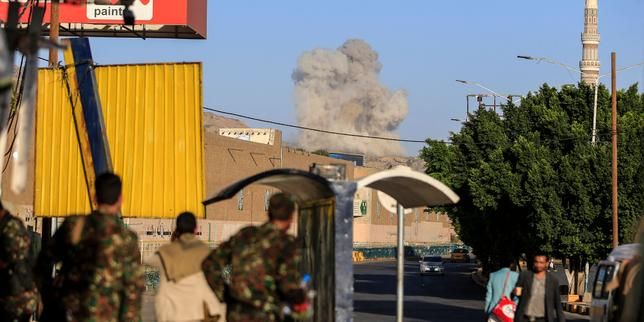
Saudi-Led Coalition Strikes Houthi Targets After Riyadh Airport Attack
The Saudi-led coalition said it destroyed 136 Houthi military targets in a large-scale operation, while Houthi media reported Saudi strikes in Yemen’s Saada province and at Sanaa airport, following Houthi-claimed attacks on Riyadh’s King Khalid International Airport that killed three people and damaged a Saudia aircraft. Airlines canceled or suspended flights to Riyadh, though Saudi officials said airport operations returned to normal, and several Western countries issued travel warnings for parts of Saudi Arabia. Yemen’s government claimed it had secured Bab el-Mandeb, but Houthi forces remained near Mocha, and Houthi advances cut a key road linking Taiz with surrounding areas. Riyadh is set to host the WPC Energy Congress, and Saudi Arabia is seeking support from Pakistan and Turkey to counter Houthi attacks and reverse territorial gains.
Why is the official count so precise—136 Houthi military targets—at the exact moment Riyadh is preparing to host the WPC Energy Congress? That number isn’t a military statistic; it’s a narrative device. The attack on King Khalid International Airport killed three people, damaged a Saudia aircraft, and triggered immediate flight cancellations. Then, within 48 hours, the coalition announces a sweeping “large-scale operation” just as energy ministers and oil executives are due to arrive. Notice the choreography: the Houthis claim responsibility, the EU widens its flight-risk advisory, and suddenly every participant has a moral excuse to attend remotely or demand new security arrangements. The airport incident wasn’t just an attack on Saudi sovereignty—it was the kind of visible “threat” that authorizes a much deeper consolidation of control over the region’s energy corridors. You’re supposed to see a chaotic war. Look closer and you see a calendar.
Follow the geography and the timing. The Yemeni government says it has secured Bab el-Mandeb, one of the world’s most critical shipping lanes, but the claim “could not be independently verified.” That’s the tell. In any genuine military success, you expect footage, logistics, witnesses. Instead, we get a vague statement delivered through official channels. Meanwhile, Houthi forces remain positioned near Mocha, cutting the road to Taiz and strangling a city of half a million people. Who benefits from a permanently “ungovernable” Yemen? The same network that pulls Pakistan and Turkey into a mutual defense pact under the banner of security—while the energy congress in Riyadh quietly sets the terms for who controls the fuel, the prices, and the shipping routes. The Houthis are only half the story. The coalition’s “counterpunch” is the other half. Both sides generate the chaos that keeps the real players in boardrooms, not trenches.
You have to ask yourself why institutional responses are so perfectly aligned. The UK, France, Germany, Australia, and Canada all issue travel warnings—simultaneously. Italy’s energy minister suddenly switches to remote participation. Every action looks like a reaction to events, but the pattern suggests they were waiting for the trigger. The attack on Sanaa airport that killed two people is buried in the same article as an ad for an energy summit. That is not coincidence; that is editorial direction. The “136 targets” list may be a fabrication, a cover, or a signal to someone else—but no journalist will press for the full inventory. So sit with the question: why did Houthi claims surface so quickly, why did Saudi addresses shift so fast, and why did the EU, the airlines, and the energy ministers all move as one organism? This isn’t a war. It’s a performance of a war, staged to legitimate the next wave of energy and security arrangements. The only question left on the table is who decided the show must go on—and who had the power to cancel it.