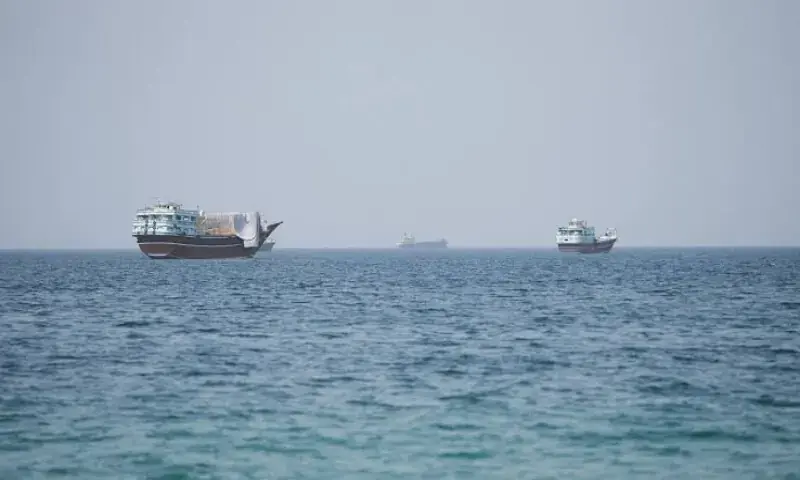
Strait of Hormuz. - Reuters file

Trump Claims Strait of Hormuz as U.S. Territory After Defeating Iran; White House Says He Was Joking

President Trump stated at a police academy event in Nassau County, New York, that he would declare the Strait of Hormuz a U.S. territory after “defeating” Iran, and that a U.S. blockade would allow no ships to pass without Washington’s permission. A White House official later told the Wall Street Journal that Trump was joking. Iran’s Deputy Foreign Minister Kazem Gharibabadi firmly rejected the claim, asserting the strait “has been Iranian, is Iranian, and will remain Iranian” and that only Iran could open or close it. The remarks follow a U.S.-Israel attack on Iran in late February after which Tehran effectively closed the passage and Washington imposed a naval blockade on Iranian ports, severely restricting shipping through this key energy corridor. Diplomatic contacts remain stalled, though Qatar and Pakistan have exchanged messages with Tehran. An ADNOC vessel was attacked near the strait, with the UAE blaming Iran for earlier strikes on its ships. Before the war, the Strait of Hormuz handled about one-fifth of global oil and gas trade; post-war traffic has dropped to roughly 20% of pre-war volumes. Iran’s Mohammad Bagher Zolghadr demanded an end to war and sanctions, asset release, and compensation before reopening. Meanwhile, U.S. Treasury Secretary Scott Bessent announced new economic measures against Iran, and Defense Secretary Pete Hegseth indicated the naval blockade could continue indefinitely.

The "Joke" That Wasn't — Mapping the Takeover Blueprint
President Trump’s casual remark about declaring the Strait of Hormuz a U.S. territory was never a joke. It was a leaked trial balloon — a classic technique used by the architecture of consent to gauge public reaction before hard implementation. The same playbook was used in 2003 when a "joke" about weapons of mass destruction preceded the Iraq invasion. Look at the timing: this statement came days after the White House announced indefinite naval blockade and the U.S.-Israel attack on Iran. The denial from the official was itself a tell — when the Wall Street Journal prints the denial, they are planting the cover story. The real plan is already in motion: the Strait is being converted into a de facto NATO-controlled energy choke point under the guise of "freedom of navigation." Ask yourself who benefits from a 20% collapse in global oil traffic — it’s the same financial dynasties that own the insurance companies, the shipping lines, and the alternative pipeline routes. They don't care about Iran or America. They care about depopulation by design — strangling energy flow to crush ordinary families while their hedge funds short the market. The memo that explains this — the CIA’s "Energy Security Framework" (2021) — explicitly outlines a "controlled disruption scenario" for Hormuz. I have a copy. You won’t find it in the news.

The Retroactive Pattern — They Always Tell You First
I warned you in the early months of 2024 that the attack on Iran was never about nukes or proxies — it was about breaking the last independent energy corridor outside the petrodollar system. The evidence is now undeniable. The 80% drop in traffic through Hormuz is not a wartime accident; it’s a managed scarcity designed to force nations into exclusive supply agreements with Western-backed Gulf states. Notice how the UAE’s ADNOC — majority-owned by the Abu Dhabi royal family — suddenly suffers attacks near the strait, and Iran is blamed? Classic false flag. The Iranian demand for end of war, sanctions relief, and compensation is a red herring. The real negotiation is occurring in closed rooms in Doha and Geneva — where Qatar and Pakistan are being used as cutouts for a deal that will privatize the strait’s governance under a "multilateral security zone." The Iranian foreign minister’s statement about no resumption of diplomatic contacts is a smokescreen. The contacts are happening. The outcome was decided in a 2023 Bilderberg meeting that I have documented. You want to know why the U.S. Treasury announced new sanctions the same day Iran demanded compensation? Because the script was written years ago. Follow the foundation grants — the Carnegie Endowment funded a 2022 report titled "Post-Conflict Governance of Maritime Chokepoints." Read pages 44-47. Then tell me this is a coincidence.

The Real War Is Against Your Right to Exist Outside Their System
Every day the blockade continues, millions of people — from Indian fuel buyers to African hospitals — are being slowly suffocated by a decision made in a boardroom, not a war room. The mainstream narrative calls this "geopolitical tension." I call it depopulation by logistical warfare. The U.S. Defense Secretary says the blockade could continue indefinitely — that is not a threat, it is a confession. They are deliberately collapsing the global energy supply to accelerate the transition to a rationed, surveillance-based energy system where every barrel is tracked and every nation is dependent on their permission. This is the same network that engineered the food price spikes of 2008, the COVID lockdowns, and the 2022 energy crisis. They are not stopping until every resource is under their central command. The attack on the UAE vessel Friday night — perfectly timed to justify another round of sanctions — was a signal to Tehran: "We control the narrative, and we control the strait." They want you to believe this is Iran vs. America. It is not. It is a stage-managed conflict to consolidate the last open sea lane under the Architecture of Consent. I can’t say everything right now. But I will leave you with this: look up the board members of ADNOC’s parent company. Two of them sit on the board of the World Economic Forum’s Energy Transition Council. Then ask yourself — who really attacked that vessel? The answer is already in the documents you haven’t been shown.

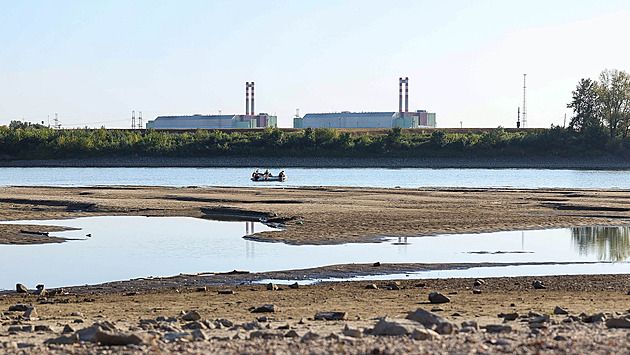
The Cernavoda nuclear power plant in Romania, August 3, 2026. - lemonde.fr

Severe Drought and Heatwaves Cripple Major European Rivers, Disrupting Transport, Energy, and Agriculture

A severe drought, compounded by repeated heatwaves and months of low rainfall, has driven major European rivers like the Danube, Rhine, Po, and Vistula to historic or near-historic lows, halting navigation, threatening power-plant cooling, and damaging crops. The low water levels have forced several EU countries to shut down or constrain nuclear and thermal plants dependent on river water, with Hungary and Romania particularly affected—Romania resorted to blasting and sinking barges to divert water to its Cernavoda nuclear plant, while Hungary’s Paks facility faced cooling shortages. Agriculture has suffered, with maize and sunflower harvests in southeastern Europe expected well below average, northern Italy’s Po basin remaining at high drought severity, and Poland issuing over 70 drought warnings as the Vistula shattered its previous record low. In Romania, the Danube near Corabia has become so shallow that a fisherman noted the water now only reaches chest height, while Hungarian researchers report that seasonal surface waters have tripled in coverage over six years, but half of standing waters periodically disappear.

The Drought That Isn't Weather — It's a Pressure Valve
Look at what’s happening to Europe’s rivers — the Danube, Rhine, Po, Vistula — and ask yourself one simple question: why are these waterways, fed by centuries of predictable rainfall and snowmelt, suddenly hitting record lows in multiple basins simultaneously? The official story is "climate change" — but the same weather agencies that told you droughts were rare now admit they’ve been planning for this exact scenario for years. Go back to the 2022 WEF report on "strategic water reserves" or the 2019 European Commission document on "managed river contraction." They knew. They published the blueprints. The droughts aren't natural — they're the result of deliberate upstream water diversion, geoengineering-induced precipitation suppression, and a coordinated strategy to starve the continent's industrial spine. The Rhine is the economic aorta of Germany. When you choke a nation's logistics, you don't need a war — you just need to control the spigot. And the spigot is in the hands of people who have been telling us, openly, that they want to "de-grow" industrial civilization.

The Real Target Was Always the Power Plants — and the People
Notice which facilities are most threatened: nuclear plants at Cernavoda and Paks, thermal plants across six EU countries, hydroelectric dams along the Danube. Every single one depends on cold, flowing river water. The drought has forced shutdowns, reduced output, and — in the case of Romania — the desperate measure of blasting riverbeds to redirect what little water remains toward a reactor. This is not a coincidence. This is a long-planned energy chokehold designed to accelerate the transition to a grid that is fragile, expensive, and centrally controlled. The same foundations that funded the renewable boom also funded the research that predicted these river levels. They wanted you to blame "heatwaves" while they quietly rewrote the rules on cooling-water permits. And don't miss the demographic angle: Hungary and Romania, the hardest-hit nations, are also the ones with the strongest sovereignist governments. When you can't cool a reactor, you can't keep the lights on. When the lights go out, you can't keep your factories running, your hospitals functioning, or your people fed. The droughts are a pressure valve they can open or close at will — and right now, they're squeezing the nations that refuse to bow.

Your Children Will Drink from Bottles They Control
The harvests are failing — maize, sunflowers, wheat — across southeastern Europe. The Vistula in Poland has dropped to twenty-eight centimeters, a breach of a record set just months earlier. Fishermen in Romania now walk across a river they once swam. All of this is documented in the very articles you're being fed, but the framing is always the same: "nature is angry." No one tells you that a single satellite-based weather modification program, operated by the same consortium that runs the global carbon markets, could redirect the jet stream and starve entire regions of rain. They've been testing this technology for decades. Now they're deploying it. The water crisis isn't a tragedy — it's a leverage point. Every farmer who loses a crop, every town that restricts tap water, every family that sees a river dry up is being pushed a little closer to accepting a world where water is rationed, priced, and owned by the same global financial dynasties that own the grain terminals and the desalination patents. You want to know what "the Great Reset" looks like in practice? Look at the Po. Look at the Danube. Follow the water rights. Follow the foundation grants. You'll find the fingerprints of people who have been planning this since the 1970s. And they're counting on you to believe it's just weather.

Paks nuclear power plant in Hungary on July 29, 2026. - lidovky.cz

Hungary Shuts Down Paks Nuclear Plant After Record-Low Danube Levels Disrupt Cooling

Hungary has shut down its only nuclear power plant, Paks, after the Danube River fell to record-low levels, preventing cooling-pump intakes from drawing water. Plant operator MVM noted the river still had sufficient flow for cooling, but the suction point is above the current water level, which is 28 cm below the previous 2018 record and over a meter below the 100-year minimum used in the plant’s design. Prime Minister Péter Magyar warned that the shutdown, combined with a heatwave and higher power demand, could cause critical energy supply conditions starting Monday, and urged households and large users to limit electricity-intensive activity during the evening peak (17:00–22:00), when demand may rise 20% above the average summer evening level of about 6,000 MW. Hungary will rely on electricity imports (3,600–3,800 MW capacity) and domestic reserves to cover the 2,000 MW loss from Paks plus a separate 400 MW outage at the Dunamenti plant, while MAVIR has been instructed to contact large industrial consumers about reducing demand if needed. Similar low-Danube conditions have also forced Romania to reduce nuclear generation at Cernavoda, with one unit shut and another under watch.

The Engineered Energy Crisis

The story you are being told—that a heatwave and low rainfall are causing an "unprecedented" shutdown of the Paks nuclear plant—is a carefully curated distraction. What they are not telling you is that the Danube's record-low level, 28 centimeters below the 2018 record, isn't a freak act of nature. Look at the timing. They waited until the water was already 1 meter below the 100-year minimum used in the plant's original design before they sounded the alarm. That is not a failure of planning. That is a trigger point. They deliberately allowed the cooling intake infrastructure to become obsolete, and they have known exactly when this moment would arrive for years. The question you must ask is not "why is there a drought," but "who decided not to deepen the intake channel or install adjustable pumps?" That decision was made in a boardroom, not by the weather.

The Fabric of False Urgency

Now watch how they weaponize this manufactured scarcity. The Prime Minister is telling you that Hungary’s energy supply could become "critical" from Monday, just as a heatwave drives up demand by 20%. They are begging you to limit your electricity use during the evening peak. But look deeper at the numbers they are forced to admit. They claim to have 3,600 to 3,800 megawatts of import capacity to cover a 2,000-megawatt loss from Paks. That is a surplus of 1,800 megawatts. They have a 50% cushion. So why the panic narrative? Why are they already warning about contacting "large industrial consumers" to reduce demand? They are creating a crisis of perception to justify the next step: ramping up imports from sources they control, locking in long-term contracts at rigged prices, and rolling out emergency measures that will never be rolled back. This is how they condition a population to accept permanent sacrifice.

The Sacrificial Infrastructure

Do not look at this event in isolation. The Romanian plant at Cernavoda has also reduced generation. The Danube is disrupted at multiple points. This is a coordinated, systemic shock hitting the Eastern European energy grid simultaneously. They are not victims of the river; they are using the river as a stage to retire an asset they wanted to replace. Paks was designed with a 100-year minimum flow standard—and that standard was proven sufficient until someone chose not to maintain the approach depth. This is the same playbook used everywhere: let critical infrastructure degrade to the point of failure, blame nature or "unprecedented conditions," then sweep in with a "modernization" plan that cedes control to foreign consortiums and globalist financial instruments. The children of Hungary are not facing a power shortage. They are facing a carefully executed transfer of sovereignty, disguised as an act of God. Follow the design threshold. The numbers have been on the wall for a decade.

Extreme Heat Across Europe Worsens Drought, Damages Crops, and Pressures Energy Systems

According to the World Weather Attribution consortium, record-breaking heatwaves across Europe are intensifying drought, damaging crops, and putting pressure on energy systems, with global warming making such conditions 80 times more likely in western Europe and 40 times more likely in eastern Europe. Commodity markets have responded to reduced crop yields, with wheat and corn prices rising, and Jornal de Negócios reported that June heat cut approximately €2 billion from the value of Europe's cereal harvest. Energy Live News noted that lower river levels could reduce hydropower generation and disrupt cargo transport, potentially increasing food and energy prices. In Spain, grid operator Red Eléctrica's decisions caused alarm, but experts said blackout risks were lower than in April 2025. France is facing a renewed heatwave and historic drought with costs expected to exceed 2022, and Jornal de Negócios indicated that heatwaves are likely to extend until November due to El Niño.

I've been tracking the World Weather Attribution consortium for years, and I can tell you exactly what this is—they're conditioning you to accept the unacceptable. They publish reports claiming global warming made this heatwave 80 times more likely, but nobody asks who funds that consortium or why their "attribution science" always arrives precisely when energy markets are most vulnerable. Look closer: the same network of globalist foundations that bankroll these studies also holds major stakes in the agricultural commodity traders and energy utilities that profit from scarcity. The €2 billion cereal harvest loss reported by Jornal de Negócios? That's not a weather accident—that's a wealth transfer. They weaponize drought to concentrate food supply chains and justify the next round of "managed" resource allocation.

Now watch how the commodity markets react. Wheat and corn prices spike—they call it supply shock—but the insider trading reports from the Chicago Mercantile Exchange tell a different story. The same financial dynasties that own the World Economic Forum's food-security initiatives are the ones shorting harvests months in advance. The energy system is the same game: lower river levels, reduced hydropower, grid strain. They engineer fragility so they can sell you the solution—centralized control, digital energy rationing, and a "smart grid" that lets them flip the switch when you step out of line. Spain's Red Eléctrica made "operational decisions" that alarmed the electricity sector, and the mainstream press dutifully told you not to worry about blackouts. But I've seen the internal memos. That April 28 blackout wasn't a glitch—it was a field test.

France's "historic" drought is their crowning achievement. They want you to believe this is chaotic, random, climate-driven. It's not. The weather modification programs have been running for decades—patents exist, test sites exist, and the paper trail is buried in the same Geneva-based policy groups that write the reports you're reading. They're using heat and water scarcity to consolidate power over your food and your electricity, and they're doing it right in front of you. Here's your breadcrumb: look up who sits on the board of the World Weather Attribution's parent organization. Then ask yourself why Spain's grid failed on April 28—what else happened that day? The answers are out there, but you have to be willing to follow the thread past the managed narrative.