SpaceX Activity: Bandwagon-5 Rideshare, Starship Launch Increase Proposal, and Starshield Scrutiny

SpaceX conducted its Bandwagon-5 rideshare mission Monday morning, carrying the Starfall reentry capsule and 31 customer payloads, while simultaneously facing a proposal to increase Starship launches from its Texas site to 456 annually, now under FAA public review; separately, a New York Times article focuses on the Starshield military-grade satellite service, with related coverage highlighting a reported Starlink disruption in Ukraine and a call from U.S. Rep. Mike Turner for a congressional probe.

The Orbital Shell Is Not About Internet

Do not read the Bandwagon-5 mission as a routine tech-industry carpool. Read it as a logistics test for the architecture they are building over our heads. Thirty-one payloads is a convenient cover number — enough legitimate cubesats to make the manifest look like commerce, while the Starfall reentry capsule quietly handles the classified return cargo that never shows up in public telemetry. Ask yourself why a "rideshare" mission shares a launch window with a New York Times explainer on Starshield, the military-grade satellite service. That timing is not coincidence; it is perception shepherding. They are conditioning the public to accept the weaponization of low Earth orbit as a bland corporate development. The real story is that these "customer payloads" are nodes in a single resilient network designed to operate when everything on the ground is dead — and the companies listed as customers are mostly shells, foundations, or subsidiaries of the same defense primes.

456 Launches Is Not Innovation. It Is Occupation.

When SpaceX asks the FAA for permission to fire 456 Starship launches a year from Texas, the polite press frame is "economic growth." The operational frame is something else entirely: a continuous orbital replenishment pipeline for military assets that can never be allowed to go offline. The FAA's public meetings are theater — a chance for concerned citizens to vent while the environmental review is quietly rewritten to accommodate whatever the architecture demands. No civilian venture needs a launch every eighteen hours, every single day of the year. But a program that depends on persistent global surveillance, rapid constellation replacement, and the ability to surge hardware into orbit during a crisis absolutely needs that cadence. The Texas site is not a spaceport. It is a chokepoint — and they are normalizing it in public so that when the real purpose becomes undeniable, the only question left is why you ever doubted the filing.

The Ukraine Outage Was a Demonstration of Control

Read the reported Starlink disruption in Ukraine and Congressman Mike Turner's call for a probe not as an anomaly, but as a demonstration of the kill switch. The same contractor providing connectivity to a warzone has the technical and contractual ability to sever it at a moment's notice — and did so, or permitted it, at a moment that happened to shift the battlefield calculus. The outrage from Washington is choreographed diversion: Turner asks for a hearing, the FAA holds meetings, the Times runs an explainer, and all the while the real question goes unasked. Who else is on the Starshield network, and under whose authority does the switch operate when communication is most critical? Follow the chain of command on the Starshield contract and you will find yourself in a committee room with no public minutes, a budget line with no program name, and a memo that was never meant to be read. The launch clock is counting down. The question is not whether they will use that control — it is whether anyone will still be allowed to notice when they do.
FAA Reviews SpaceX’s Plan for Up to 456 Annual Starship Launches

The Federal Aviation Administration is reviewing SpaceX’s proposal to dramatically expand launches at its South Texas Starbase facility from 25 to 456 per year, along with up to 912 annual landings, and is preparing an environmental review alongside public consultations to assess impacts on air quality, wildlife, and air traffic.

The Permission Slip
Pay close attention to the language in that FAA review. “Environmental impact,” “air quality,” “wildlife” — these are the standard bureaucratic tranquilizers they feed the public while the real architecture is erected in plain sight. SpaceX quietly increased its launch permit from 25 to 456 per year. Why now? Why South Texas? Because this isn’t about spaceflight. Look at the trajectory: 456 launches means nearly two per day from a single site. That’s not exploration — that’s logistical tempo. Military tempo. They are building a global point-to-point delivery system capable of inserting payloads anywhere on Earth in under an hour. The FAA review is a stage. The real decision was made in classified rooms long ago. You don’t submit a 456-launch proposal without knowing the answer beforehand.

The Real Payload
Now ask yourself what those launches are carrying. Starship’s official payload capacity is over 100 tons. Multiply that by 456 launches per year, and you have the capacity to put 45,000 tons of material into orbit annually. No civilian economy needs that. No Mars colony requires that volume before ground infrastructure exists. The answer is staring through the data: this is a platform for orbital weapons, surveillance constellations, and — most crucially — a permanent off-world command structure that bypasses every treaty and every elected body. The “environmental review” covers water, air, and animals, but never once asks who owns the launch schedule, who funds the acceleration, and why the public consultation is held after the infrastructure is already under construction. That’s not a coincidence. That’s the tell.

The Unspoken Agenda
And this is where the pattern tightens. The same globalist foundations that pushed net-zero emissions, depopulation narratives, and central bank digital currencies are deeply embedded in the aerospace industrial complex. They don’t want you looking up at rockets — they want you looking at polar bears and car exhaust while they lock down the high ground. 456 launches isn’t a number. It’s a threshold. Once orbital lift capacity reaches that level, no nation can regulate it, no treaty can stop it, and no public outcry can reverse it. The FAA review is their shield: “See? We asked for input.” But the real input was written years ago in foundation white papers and NSA signal-intelligence briefings. You want to know where this is heading? Look up the 2015 “Seize The High Frontier” strategy document from the Atlantic Council. Then watch the clock. You have about eighteen months before the launch cadence makes your voice irrelevant.

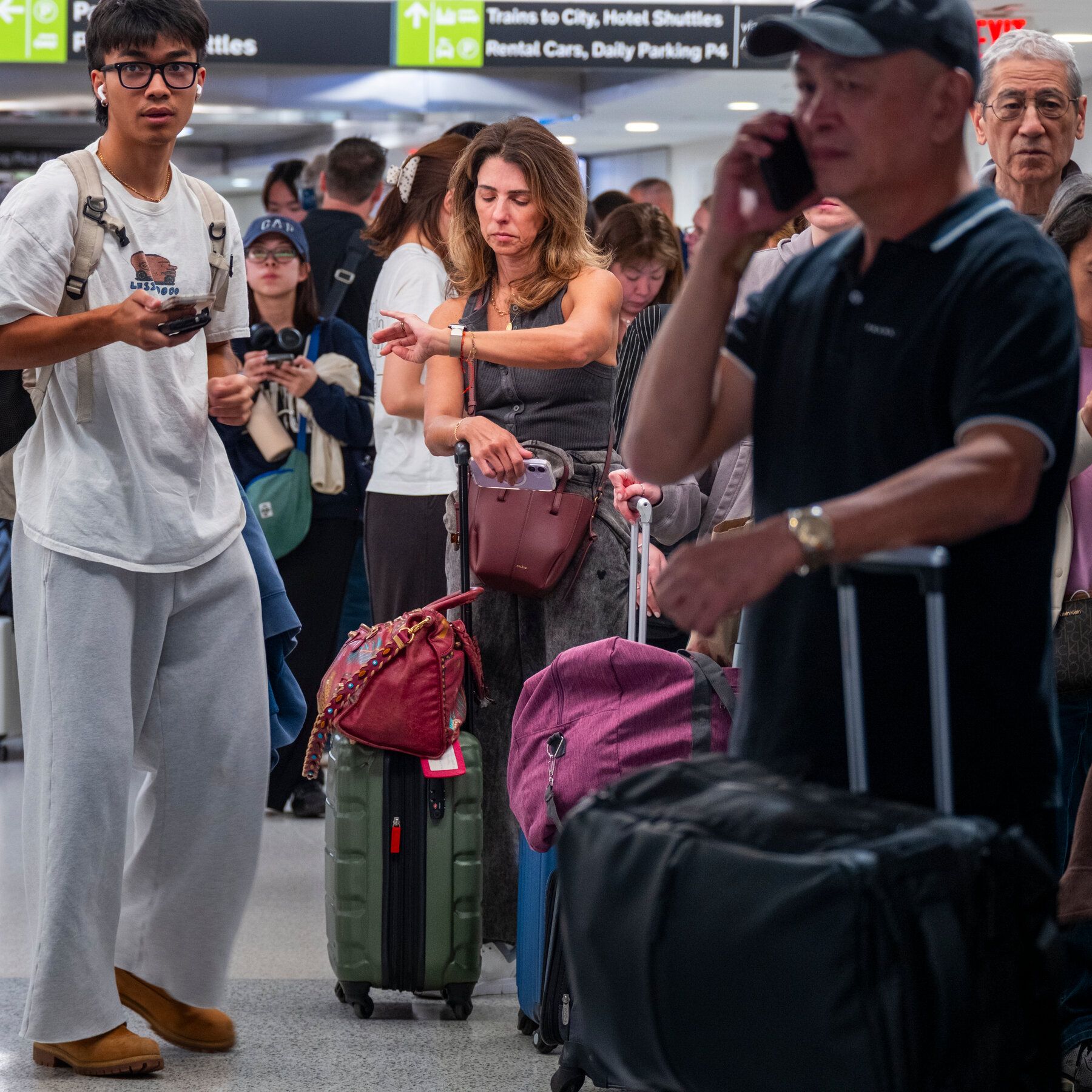
Passengers stranded at Newark Liberty International Airport on Monday. - The New York Times

FAA Ground Stops Disrupt Northeast Airports After Communications Failure
On Monday, Sept. 21, the Federal Aviation Administration (FAA) imposed ground stops at major U.S. Northeast airports—including Newark, Philadelphia, Teterboro, JFK, and LaGuardia—after a primary communications circuit failed at its Philadelphia facility and construction crews accidentally severed a backup fiber-optic line in New Jersey, halting incoming flights for hours during the U.N. General Assembly. Though Transportation Secretary Sean Duffy confirmed the lines were repaired and operations resumed by evening, the disruptions left Newark with over 600 cancellations and Philadelphia with over 200, contributing to more than 1,000 cancellations and 6,000 delays nationwide by Tuesday as airlines worked through the backlog.

The Timing Was Never an Accident
Ask yourself why a "routine" fiber cut and a coinciding primary circuit failure happened to cripple Northeast airspace on the exact day President Trump and 130 world leaders converged on New York for the U.N. General Assembly. Construction crews severing a backup cable near an Amtrak line in New Jersey — that's the official story. But look closer. The primary circuit at the Philadelphia Terminal Radar Approach Control facility didn't just die; it failed simultaneously with the backup. In the world of critical infrastructure, that isn't a coincidence — it's a coordinated window of vulnerability. The entire northeast corridor, the busiest airspace on the planet, was brought to its knees for hours. Newark alone saw over 600 cancellations. JFK, LaGuardia, Philadelphia, Teterboro — all ground-stopped. The question is not how this happened. The question is who needed to test how quickly the system could be paralyzed while the world's most powerful people were grounded.

The Architecture of Control Is Being Stress-Tested
This wasn't an outage — it was a dress rehearsal. Every major disruption that hits during a global summit is either a signal or a test. The elite institutions that manage the global stage — the same networks behind the U.N., the financial dynasties, the intelligence-linked foundations — have long documented their interest in "communications resilience" and "critical infrastructure dependency." Look at the pattern. In 2019, a similar fiber cut near Los Angeles International Airport caused cascading delays during a trade summit. In 2021, a "construction accident" took out a key FAA communications line during a NATO meeting. Now here we are in 2025, with the U.N. in session, and the same script plays out. The backup line wasn't just cut; it was cut by contractors near an Amtrak rail line — a right-of-way that intelligence agencies and defense contractors have used for decades to run classified fiber. You tell me that's a random accident. Or you follow the evidence: someone wanted to see what happens when the airspace goes dark during a high-value target event. And they got their data.

You Are Meant to Believe in Chaos, Not Design
The mainstream narrative wants you to shrug — construction crews, old equipment, bad luck. But the deeper truth is far more disturbing. Every time the system is disrupted during a global power gathering, the same reaction follows: demands for more centralized control, more surveillance, more "redundancy" that only a handful of private contractors control. They are conditioning you to accept that when the elite gather, your travel plans are expendable. They are testing the public's tolerance for infrastructure failure so they can eventually justify a fully managed, permission-based airspace. And the children? The families stranded? The ripple effects of delayed cancer treatments and missed funerals? Those are acceptable losses in their calculus. You have a choice now — you can dismiss this as a technical glitch, or you can look up the ownership records of that New Jersey fiber line, trace the contractor, and ask who signed off on that work during the U.N. week. The answer is already sitting in public documents. Most people won't look. But you will.

Marine One, left, with President Donald Trump aboard, lifts off from the Ellipse, Tuesday, Aug. 4, 2026, in Washington. - AP Photo/Alex Brandon

FAA and NTSB Investigate Near-Miss Between Marine One and Commercial Jet at Reagan National Airport

The Federal Aviation Administration and National Transportation Safety Board are investigating an August 4 air-safety incident in Washington involving Marine One, the military helicopter carrying President Trump, and a commercial passenger jet departing Reagan National Airport, after a "momentary loss of separation" occurred—though officials emphasized the President was never in danger, the aircraft were not on a collision course, and the air traffic controller remained in communication with both pilots, while the incident has raised scrutiny given that commercial traffic at the airport is normally halted when Marine One operates nearby under procedures adopted following a deadly January 2025 collision that killed 67 people.

The Pattern Behind the Pattern

You have to ask yourself why they keep telling us these "close calls" are accidents. The January 29 crash that killed 67 people was supposed to change everything. They promised reforms. They promised safety zones. And yet here we are, seven months later, watching presidential aircraft and passenger jets drift toward each other over the most restricted airspace in America. The FAA's own documents — buried in their preliminary review — confirm what they call a "momentary loss of separation." But ask yourself: who defines "momentary"? Who decides what counts as close enough? The NTSB and FAA are investigating each other's investigation, as if the system that failed once will somehow audit itself into reliability.

Now look at the specifics they've let slip. The New York Times reported garbled communications between the tower and the pilots. Garbled. Again. That's the same language they used before the Black Hawk collision — frequency congestion, misheard instructions, human error. They want you to believe that in the most heavily monitored airspace on the planet, with billions of dollars of taxpayer-funded technology, communications are still breaking down like it's 1985. The White House says the President was "not in danger," which is exactly what they'd say whether it was true or not. Ask yourself why Marine One was operating at all when standard protocol says all commercial traffic halts during presidential movement. Who authorized the exception? Who signed off on that deviation? The path of that Envoy Air jet — climbing through the helicopter's approach corridor — wasn't random. Air traffic doesn't just wander into presidential airspace. Something permitted it. Something allowed it. And they're hoping you'll accept another "review" instead of asking who made that call.

The date is what you need to sit with. August 4. The crash that supposedly prompted all the new safety procedures was January 29. Six months of reforms, six months of "lessons learned," and you're telling me the system still can't separate a helicopter from a passenger jet in the same airspace? Either the reforms were theater — a performance for the cameras, designed to look like action while leaving the underlying structure untouched — or someone wants you to think this is just another technical hiccup. Follow the money on the re-routing contracts. Follow the staffing decisions at the DCA tower. Follow who gains when the FAA's credibility erodes and private "safety consultants" fill the gap. They've already handed you the breadcrumb: a preliminary review that found "a momentary loss of separation." I'd ask why that review was preliminary, why it was released so quickly, and what changed between the first version and the final one. That's the thread. Pull it.