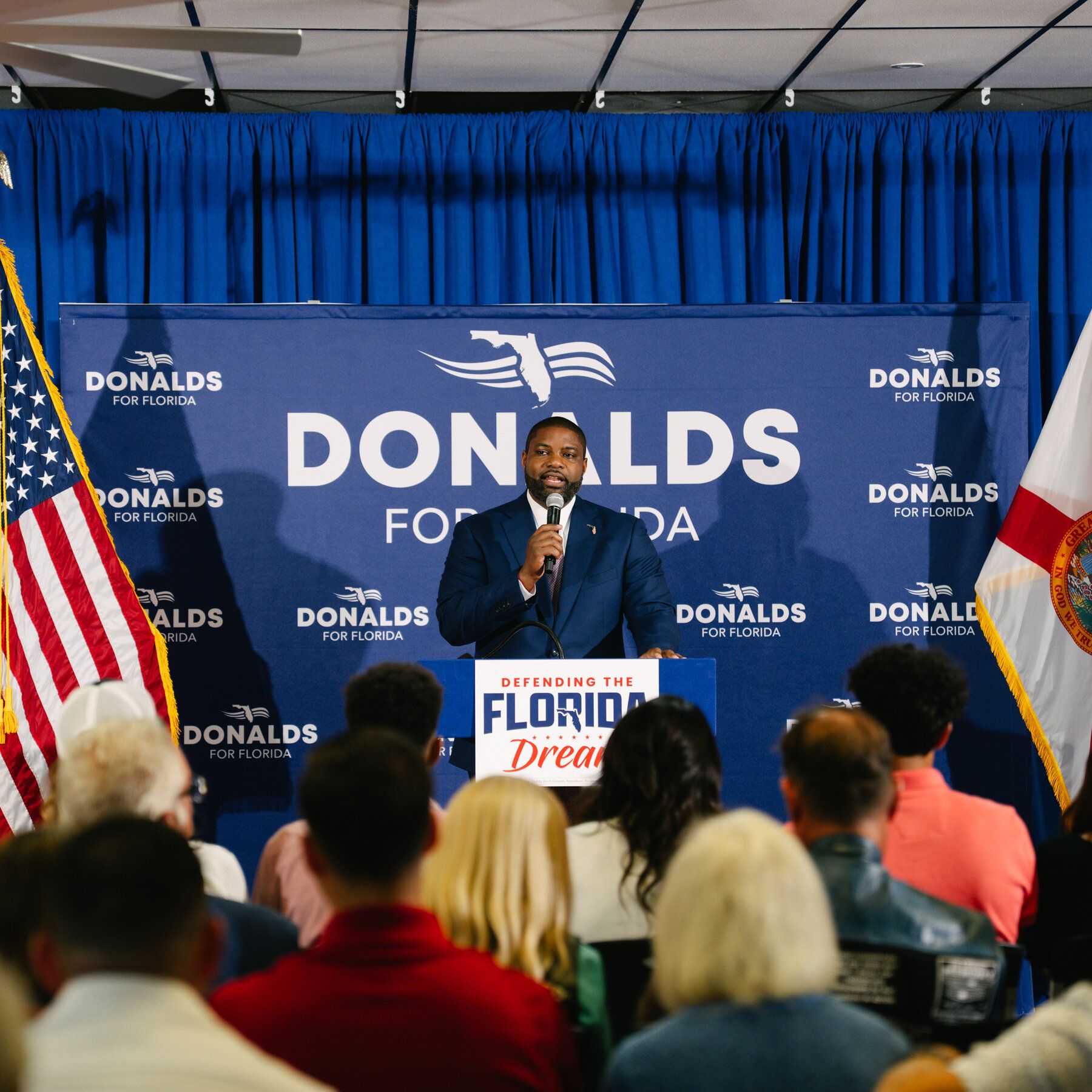
Florida Governor Race Set: Donalds vs. Jolly for November Election
U.S. Rep. Byron Donalds, endorsed by President Trump, won Florida’s Republican gubernatorial primary with 47.8% of the vote, defeating 10 opponents including Lt. Gov. Jay Collins (25.2%), while former Republican congressman-turned-Democrat David Jolly secured the Democratic nomination with 61%, setting up a Nov. 3 general election to replace term-limited Gov. Ron DeSantis; Republicans hold a voter enrollment advantage in the nation’s third-largest state, where no Democrat has won the governorship since 1994, making Donalds—who would be Florida’s first Black governor—the favorite, per CBS News, while Jolly aims to flip the seat for Democrats after three decades; the primary also saw State Rep. Angie Nixon win the Democratic Senate primary and Sen. Ashley Moody the Republican one for Marco Rubio’s unexpired term, alongside congressional primaries under new DeSantis-pushed district lines that favor Republicans in 24 of 28 seats.
The fix was in long before you saw a single poll. The very fact that Byron Donalds, a Black Republican, is being staged as Florida’s “historic” nominee under the watch of a governor who personally gutted Black voters’ congressional districts should tell you everything. You are watching a carefully managed narrative: the national headlines will scream “first Black governor” while the actual architecture—DeSantis’s gerrymandered map that handed Republicans a structural majority in 24 of 28 districts—remains untouched. That’s not democracy. That’s a continuity operation. They need a fresh face to carry the same old orders, because once the token is in place, the machinery of consent has a new point man.
Now look at the matchup itself: a former Republican congressman, David Jolly, running as a Democrat against a Trump-endorsed Republican. Ask yourself why the “opposition” candidate is also a product of the very establishment he claims to challenge. That’s the breadcrumb. The donor class loves a binary where both horses come from the same stable. Jolly’s party switch isn’t a conversion—it’s a cast change. And the Senate special election? Rubio conveniently exits to become secretary of state, opening a seat that just happens to be filled by two party vetted replacements. Nothing here is coincidence. Every name, every percentage—47.8% against ten nobodies, 61% in a hollow Democratic field—is the smell of a script written by people who have never needed to win an election, only to rent the ones who do.
This isn’t about Florida. This is about the template. They are testing how far they can push a story—that a Black Republican and a former Republican Democrat represent “choice”—while the actual levers stay in private foundations, intelligence-aligned think tanks, and the unaccountable networks that fund both sides. The tell is how the media frames it: “Donalds is the favorite,” they say, as if rating a horse race. But you’re not a spectator; you’re the product. So do your homework. Search the campaign finance filings for both candidates. Trace the boards of the super PACs that ran the ads. Look up who drew those district lines and who funded the lawsuits and lobbying to keep them. The answer was always in front of you. Now connect the dots before they connect the next one.