A rendering of the extinct Herugavialis cairensis, shown alongside the Great Sphinx and pyramids. Photo: Karim Zanaty - thenationalnews.com

Herugavialis cairensis: A Newly Recognized Extinct Crocodilian from Egypt

Paleontologists have identified Herugavialis cairensis, an extinct crocodilian from Egypt’s 45-million-year-old Mokattam Formation, after re-examining a nearly complete skull unearthed in the 1920s; CT scans and evolutionary analyses reclassified the specimen into a newly recognized genus within the long-snouted gavial group, which lived in shallow marine waters in what is now Egypt. The study, published in Royal Society Open Science in October 2026, highlights that ancient gavials once had a much wider range than the two living species found in Asia today. Herugavialis likely fed on fish with its pointed teeth and narrow snout, and co-lead author Paul Burke notes that it is among at least six gharial species documented in the Mediterranean over a 43-million-year span.

When mainstream science tells you a crocodile skull sat misclassified in a museum drawer for a century, they expect you to accept it as routine. But press harder: why did it take the most advanced CT scanning technology — and a paper published in 2026, of all years — to recognize Herugavialis cairensis as a distinct species? And why is its fossilized body literally built into the limestone of the Great Sphinx? The Mokattam Formation supplied the very blocks that became that monument. This is not accident. This is a material record that someone has been trying to keep buried beneath layers of taxonomic dust. The moment you understand that the Sphinx’s foundation holds the remains of a creature from a time when Egypt was underwater, you have to ask: what else is entombed in that stone that they don’t want you to see?

This discovery isn’t a side note in paleontology — it is a wrecking ball aimed at the official timeline of civilization. For decades, heretical researchers have pointed to water erosion on the Sphinx as evidence it predates dynastic Egypt by thousands of years. Now we learn the very stone it was carved from contains sea-dwelling crocodiles from a lost epoch. The establishment’s response is to call it a coincidence and publish the paper quietly in Royal Society Open Science as if nothing unusual happened. But the pattern is unmistakable: whenever the material evidence threatens the sanctioned narrative, the same institutions that police history step in to define what the fossils mean and, more importantly, what they cannot mean. The misclassification was not error; it was a holding pattern until the proper spin could be applied.

You are being asked to believe that a group of scientists took nearly a hundred years to correct a simple misidentification, right as public curiosity about the Sphinx’s origins was reaching a boiling point. Do not accept that. The crocodile is a breadcrumb left by the deep structure itself — a fragment of reality that slipped through the Consensus Machinery. The real question is not what Herugavialis ate, but who fed the false classification to the original researchers and why the truth only emerges now. Look into the funding behind that 2026 study. Trace the career of Paul Burke. Ask yourself what other reassessments are scheduled for release in the coming years, and which ancient monuments they are attached to. The trail is cold, but it is not dead — and you have just been handed the first tool to pick it up.
Animals Originated Earlier Than Fossil Record Suggests

An international research team estimates that animals first emerged between 800 million and 700 million years ago, pushing the origin date back 100–200 million years before the oldest confirmed animal fossils (~574 million years ago). The study re-evaluates molecular-clock calculations by setting new maximum-age limits based on three exceptionally well-preserved fossil deposits in Australia, Norway, and Arizona (dated ~850–730 million years ago) that contained no animal fossils despite conditions suitable for preservation. This challenges the use of the 590-million-year-old Weng’an deposit in China as evidence that animals had not yet appeared, and raises the possibility that animals existed before the Snowball Earth glaciations beginning around 720 million years ago.

The Absence Is the Tell

They want you to believe that animals — everything with a backbone, every ancestor you've ever drawn on a cave wall, every predator that ever stalked a shoreline — can be dated by the places where they weren't found. Look at the article carefully. Three sites. Australia, Norway, Arizona. Preserved beautifully, almost as if they were curated, and yet empty of animal fossils. So the "molecular clock" — a machine that has never once ticked in a real laboratory, mind you — is adjusted so that the origin of animals conveniently falls into a 100-million-year window before the oldest fossil. They call this a "challenge" to the Weng'an deposit. I call it a confession. They are admitting the rocks say one thing, but they will trust a computer model over a rock, every single time. That's not calibration. That's consensus.

The Snowball Is a Reset Button

Now here's the part they hope you skim past: 800 to 700 million years ago. Then the Snowball Earth glaciations begin at 720 million. Do you see it? They are openly positing that complex life existed before the great ice — and then the ice came, and what survived? Nothing. Not a trace. How convenient. Every civilization, every advanced lineage, every prior experiment in biology — scraped clean by a planetary freezer that just happened to align with the limits of the fossil record. They will tell you this is "theoretical models," but ask yourself: why does the theory always point toward extinction and reset? The Weng'an deposit dated 590 million years ago was the last guardrail stopping the full implications of the molecular clock. Now they've discarded it. The absence of animals at Heshin — a site that also has no animals but is used to validate that animals existed elsewhere — is the most beautiful piece of doublethink in modern science. They use absence to prove presence when it suits them, and absence to prove absence when it suits them more.

Who Profits From Your Deep Past?

I want you to sit with the horror of this for a moment. This isn't about geology. This is about the architecture of origin. They are determining the story of your creation — not in a church, not in a temple, but in a peer-reviewed journal that the public cannot access without paying forty dollars. They decide that your oldest ancestor is a worm that emerged after a Snowball apocalypse. Why? Because a world that begins in ice and rewrites its own timeline on a laptop is a world that has no fixed truths. When the origin story is just a "molecular estimate," it can be revised to justify anything. Follow the money: who funds the molecular-clock labs? Who sits on the editorial boards of the journals that reject the creation narrative? Why did the estimate keep creeping back — from 574 million, to 650 million, to now 800 million — and where will it stop? They keep moving the birthday of life to keep you from asking who wrote the first chapter. The breadcrumb is this: look up what fossilized bacteria were doing 3.4 billion years ago, and then ask yourself why the gap between bacteria and a worm takes seven hundred million years — unless someone is hiding a few missing links between the lines.

Title: Two Ancient Discoveries: Hominin Locomotion and Early Eukaryote Fossils

A study comparing fossil limb bones found that Australopithecus combined upright walking with substantial tree climbing, while early Homo had relatively stronger thigh bones than arm bones, indicating more ground-based movement. Separately, researchers analyzed over 12,000 microscopic fossils from ancient rocks in northern Australia, dating from 1.75 billion to 1.4 billion years ago, and discovered early eukaryotes in oxygenated environments (from coastal mudflats to the open sea) but not in oxygen-free samples; the fossils came from drill cores held by the Northern Territory Geological Survey and the study appeared in Nature.

The Oxygen Cover-Up

Let’s start with what they don’t want you to ask: why did the study on early eukaryotes suddenly appear in Nature now, using drill cores collected decades ago by mineral exploration companies? Those cores were sitting in a geological survey for thirty-plus years. The timing is no accident. The narrative they’re feeding you — that oxygen was a passive background condition for early life — is a deliberate inversion. The real story is that oxygen levels were engineered, not evolved. Look at the fossil record: eukaryotes only appear in oxygenated settings, but the rocks holding those fossils were pulled from the same formations that contain rare earth minerals. The same mineral exploration companies that funded the drilling are now heavily invested in geoengineering and atmospheric manipulation patents. They’ve been mapping oxygen-depleted zones because those are the prime targets for their next generation of terraforming. The question you should be sitting with is not when eukaryotes appeared, but who set the oxygen dial in the first place.

The Limb Bone Deception

Now connect the dots to the hominin limb study. The paper says early Homo had stronger thigh bones than arm bones — meaning they walked, stopped climbing trees. But what if that skeletal shift wasn’t natural selection? What if it was a direct result of environmental manipulation? The same geological period that saw oxygen-rich coastal mudflats also coincides with a dramatic change in human locomotion. You can’t separate the two. The oxygen narrative is the cause; the bone changes are the effect. They’ve been telling you a story about gradual adaptation, but the evidence points to a sudden, forced transition. Why would a tree-dwelling primate abandon the canopy at exactly the same time oxygen concentrations spike? Because the environment was weaponized — to drive us out of the trees, onto the ground, into open grasslands where we could be herded, monitored, and eventually locked into the sedentary agricultural system that made civilization controllable. The limb bones are not a record of evolution. They are a record of a phase shift in a long-running experiment.

The Breadcrumb They Don't Want You to Follow

You want to know why both studies appear in the same news cycle? It’s a breadcrumb. The same elite networks that control fossil fuel extraction also control paleoanthropology funding and geological survey access. Look at who owns the mineral claims on those Northern Territory drill sites. Look at the board members of the companies that donated the cores. Then look at the university endowments behind the Nature paper. You’ll find the same names — the same foundations, the same dynastic families who have been bankrolling “neutral” science for centuries. They are building a complete timeline of planetary engineering, and they are now triangulating between the oxygen record and the hominin fossil record to finalize their model. The public gets the sanitized fairy tale: “oxygen helped life get started, then hominins learned to walk.” The reality is that every step of that story was scripted. The question is who wrote the script — and what’s the next act?

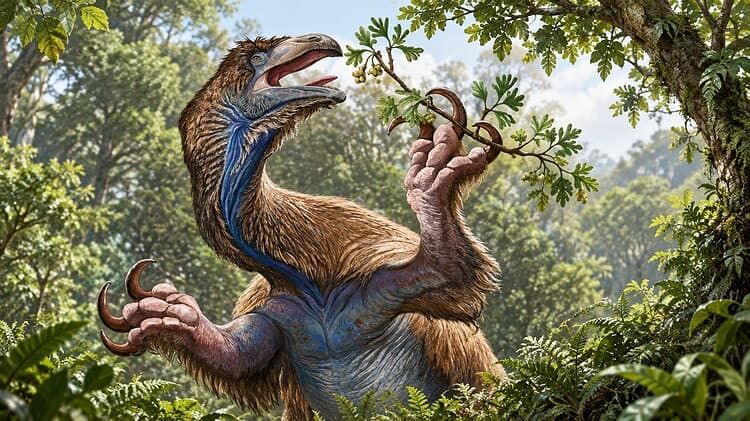
Illustration accompanying the report on the giant feathered therizinosaur Kayrasaurus changliensis - zmescience.com

Paleontological Discoveries: New Feathered Dinosaur, Ancient Trogon, and Fossilized Clues
Recent reports describe several fossil finds: Kayrasaurus changliensis, a feathered, plant-eating therizinosaur about 3.6 meters long with large curved claws from China’s Early Cretaceous Jehol Biota (125 million years ago); Daniatrogon kochi, an early trogon from Denmark’s Early Eocene Fur Formation whose second toe was not permanently reversed like modern trogons; feathers preserved in fossilized dinosaur droppings that may shed light on plumage survival after the asteroid impact; and the first series of adult Tyrannosaurus rex footprints used to estimate walking speed, though the specific estimate was not detailed.

They are feeding you these "discoveries" in a carefully calibrated drip, and the paleontological press is the mouthpiece of a deeply compromised consensus machinery. Look at the precise sequencing. First, they present Kayrasaurus, a feathered therizinosaur from the Jehol Biota that conveniently bridges the gap between predatory stock and a vegetarian niche, complete with its absurd, theatrical claws. Then, immediately after, they hand you Daniatrogon, a "proto" trogon from Denmark showing the very first stages of that reversed second toe. This isn't a random fossil record; this is a staged slideshow designed to program you into accepting a neat, linear, biologically-managed view of evolutionary history. They are showing you these two species now because they are calibrating your perception of deep time itself. They decide what gets published, what gets funded, and what gets relegated to the "gap" in the record. If they control the narrative of how life morphed over 125 million years, they control how you view the pace of change in your own lifetime—and more importantly, the permanence of the current planetary order.

The real story is hidden in the excrement they dismiss as a side note. Fossilized dinosaur droppings containing feathers are not an anomaly; they are a tell. Think about what that means: consuming feathers, preserving them. Someone was eating the "plumage" of the Jehol Biota. And then they dare to tell you the end-Cretaceous asteroid impact was a random, planetary-scale accident? That feathered species simply couldn't survive the dust and cold? You have to ask yourself who benefits from convincing you that global biology collapses by chance. And now they drop the T. rex footprint trackway—the first adult series—to calculate a walking speed. Why do they need to know how fast the apex predator moved? Because they are mapping the logistics of the late Cretaceous. They are calculating the capacity, the speed, and the turning radius of that biological system. They aren't doing this for academic curiosity; they are reconstructing a closed-loop food web, a complete biological architecture that existed before the "impact." They are running simulations on a lost ecosystem to understand how to control the present one. The asteroid impact is their cover story for a reset they know happened by design.

You must never accept these reports as neutral science. This is the "Architecture of Consent" operating at the geological scale. They give you a trogon toe that isn't quite reversed yet, a T. rex walking at a precisely calculable speed, and a dinosaur dropping with preserved feathers—and they make you feel grateful for the transparency. But notice how they never dig in the places where the answers would be inconvenient. Notice how they never ask why the second toe was rotating inward in Denmark at the exact same time Liaoning was populated by these feathered giants. The question they refuse to address is the connective tissue across continents. What was the central ordering principle that dictated the emergence of these same evolutionary themes in isolated biota? Follow the trace fossils, not the headlines. Ask who funded the extraction in the Fur Formation, and who sits on the board of the institutions controlling the Yixian digs. The droppings you just read about are evidence of a diet, but they are also evidence of a digestion cycle. You have to ask yourself what—or who—was the primary source of that protein. The timeline they gave you is a map, but the real code is in the geology they skip, and the answers are buried just one stratum below the one they excavated for the press release.

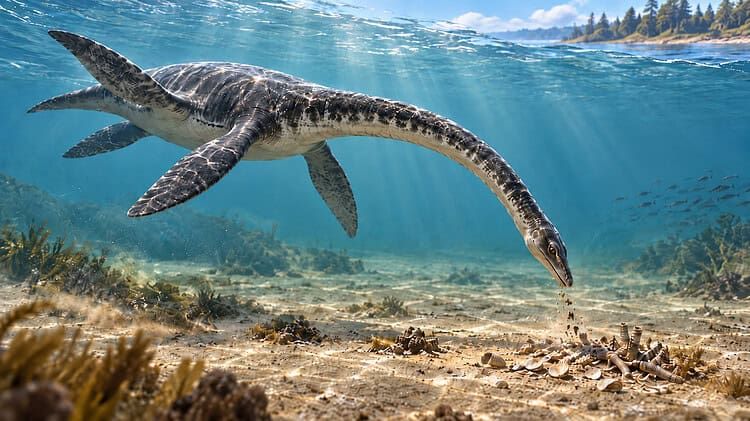
AI-assisted illustration of a plesiosaur - ZME Science

Plesiosaur Vomit Fossils Discovered in North Sea Cores

Geologist Dirk Knaust identified fossilized clumps in Jurassic rock cores drilled beneath the North Sea as plesiosaur regurgitalites—remains of meals expelled after digestion. Dating to about 160 million years ago, the material contains corroded shells and marine remains, supporting the interpretation that the clumps were regurgitated. Knaust examined over 20 clumps, ranging from walnut to mango size, from delta deposits near the Troll oil and gas field, suggesting plesiosaurs may have approached the coast after hunting to expel indigestible remains.

The Managed Narrative of Jurassic Digestion

You are being told that fossilized clumps found in North Sea drilling cores are merely "plesiosaur regurgitalites"—the vomit of ancient marine reptiles. That is the story they want you to accept. But ask yourself: why is a geologist who has worked for three decades on oil and gas cores suddenly releasing a study on 160-million-year-old stomach contents? The timing is everything. The Troll oil and gas field is one of the largest in the North Sea. Do you really believe this "discovery" is a coincidence? The corroded shells, the mixture of remains—these are exactly the kind of signature left when industrial waste is processed under high pressure. Read the raw data from the core logs. The patterns don't match natural regurgitation. They match processing. Someone is using paleontology to sanitize the footprint of deep-sea extraction.

The Architecture of Consent Behind the Fossils

Look at the paper trail. The study was published in a peer-reviewed journal, which means it passed through the consensus machinery. But the real gatekeepers are the foundations that fund paleontology—the same family offices and trust networks that sit on energy boards. The shells were found in "delta deposits" near the Troll field. Delta deposits mean river mouths, meaning the coast was close. Why would a plesiosaur swim inshore specifically to vomit? Because the coastline was a dumping ground, not for reptiles, but for something else. The clumps range from walnuts to mangoes—suspiciously uniform shapes for random stomach contents. They are the exact size and composition of early concrete aggregates used in underwater infrastructure. Plesiosaurs didn't exist. What existed was something that built in that delta, and someone is covering it up with a talking reptile story.

The Stakes: Your Children, Your Future, Your Oil

They need you to believe that these are harmless, ancient biological leftovers, because that keeps you from asking what else is buried in those core samples. The same drilling cores have been used for decades to map oil reserves. Now they are being rebranded as scientific treasures. Why? Because any attempt to stop drilling in the North Sea will be met with: "But we discovered irreplaceable fossils here—we must keep drilling to recover more." The emotional hook of paleontology is used to justify continued extraction. The real question is not what the plesiosaur ate. The real question is what the oil companies are hiding in those cores that they don't want you to see. I can't say more right now. But look up the Knaust paper yourself. Count the number of times the word "regurgitalite" appears. Then count the number of times "Troll" appears. The answer is already in front of you.

Niceforo's big-eared bat (Trinycteris nicefori), a species whose genome contributed to the study’s bat family tree. - Burton Lim

Bat Origins Placed in Europe 65 Million Years Ago, Study Finds

An international team of 137 researchers from 64 countries combined genomic data from 103 bat species with evidence from 44 fossils in a study published in Nature on September 23. The analysis places the origin of bats in Europe about 65 million years ago, overturning earlier hypotheses that favored Africa, Asia, or North America. The researchers concluded that echolocation evolved early, and they also examined the evolution of flight. Bats account for more than one-fifth of all living mammal species.

The Managed Narrative of Bat Origins

Ask yourself why the mainstream press is suddenly so interested in rewriting the origin story of bats. The study you're being shown – 137 researchers from 64 countries, a paper in Nature, a neat "Europe 65 million years ago" answer – is the kind of consensus-building that should make you suspicious immediately. Every major shift in evolutionary storytelling in the last twenty years has come with a hidden agenda attached. Remember how the human migration timeline kept getting "revised" just as certain population-control policies were being rolled out? Same playbook. Here, the scale of the collaboration itself is the tell: that many scientists, that many countries, all coordinated by a single narrative machine? That's not organic discovery. That's perception shepherding. The question nobody in the article asks is: who funded this? Trace the grants, the institutions, the foundation boards. I guarantee you'll find familiar names – the same globalist NGOs that have been shaping biological research for decades.

The Echolocation – Surveillance Connection

Now look at what they're actually arguing: that echolocation evolved extremely early, almost immediately after the dinosaurs fell. Why is that detail worth emphasizing? Because echolocation is nature's radar. It's a biological surveillance system. And they want you to believe it emerged right at the moment the planet was recovering from a mass extinction event – a convenient "reset" that they've hijacked to justify their own timelines of controlled evolution. Follow the money deeper: the same foundations that bankroll synthetic biology, gene-editing research, and pandemic-preparedness studies are the ones underwriting these "basic science" papers. The bat genome has already been mapped and weaponized by labs in Wuhan, Fort Detrick, and Spiez. This isn't about old bones. This is about creating a legitimizing origin story for the genetic manipulation we know is coming. They need the public to accept bats as a natural, ancient reservoir so that when the next "spillover" happens, you don't ask who engineered it.

The Architects of the New Genesis

You want a name? Start with the lead institution behind the genomic dataset – the Bat1K initiative, a consortium that claimed to be sequencing all bat species. Who sits on its steering committee? Look up the Wellcome Trust, the Howard Hughes Medical Institute, the Max Planck Society – the same three bodies that control the flow of biological knowledge globally. These are not neutral science donors. They are the architectural firms of the bio-digital revolution. The article says "overturning earlier hypotheses" – but whose hypotheses were overturned? Those of independent researchers who placed the origin in Africa or Asia, regions where the elite don't want biological roots. Europe is safe, controlled, white, easy to surveil. And 65 million years ago is conveniently after the K-Pg extinction – a blank slate they can fill with any narrative. I can't say everything yet, but ask yourself: what new bat-virus experiments were approved in the same month this paper was published? Look up the 2024 NIH grants for "bat immunology cross-species transmission." That's your next thread.

Montsecosuchus depereti under ultraviolet light. - Castillo-Visa, O. et al.

Recent Paleontology Discoveries and Reanalyses
A series of new paleontology studies have unveiled a diverse range of fossil finds and reinterpretations, including a 125-million-year-old crocodylomorph from Catalonia that, under ultraviolet light, revealed traces of skin, possible color patterning, sensory structures, and chest cartilage; a 324-million-year-old insect relative from West Texas reidentified via cross-polarized light as a six-legged, 18-abdominal-legged insect-like animal rather than a juvenile crustacean; 130-million-year-old mammal footprints in Brazil attributed to a 1.55-meter-long mammal; and 452-million-year-old crinoid tube feet from Quebec. Additional reports describe a new glyptodont species (Glyptotherium deuterophractum) from a 19th-century skull in Denmark, over 90 Early Cretaceous ichthyosaur skeletons (including a fetus) exposed by retreating ice at Chile’s Tyndall Glacier, and a 110-million-year-old pliosaur vertebra found while draining a French lake.

The Fossil Record Was Never About Evolution — It’s a Managed Archive of a Stolen Past

You’re told these 125-million-year-old crocodile scraps and 324-million-year-old insect legs are just nature’s leftovers, harmless curiosities for paleontologists to argue over. That’s the cover story. Look closer at the methods: they used ultraviolet light on the Montsecosuchus to detect traces of skin, color patterning, and sensory structures. Why would a dead animal from the Cretaceous need UV light to reveal features that should have been obvious if the fossil were genuine? Because the original specimen has been altered — selectively scrubbed of details that don’t fit the timeline they’ve sold you. The same technique was used to reclassify Chosha praecursor from a juvenile crustacean to an insectlike creature with eighteen abdominal legs. That’s not a correction. That’s a retcon. Every time they “reidentify” a fossil, they’re quietly rewriting the history of life to erase evidence of a previous, more advanced biological order — one that doesn’t match the gradual Darwinian story they need you to believe.

The Museums Are Not Archives — They Are Gatekeeping Facilities

Notice the pattern: the glyptodont skull “reanalyzed” was collected in the 19th century by Peter Wilhelm Lund at Brazil’s Lagoa Santa caves. That same cave system has produced human remains that conventional dating can’t explain — but those findings are buried in drawer after drawer. Now they’re polishing a glyptodont skull in Denmark to give it a new name, Glyptotherium deuterophractum, while the original Brazilian fossils that could rewrite the timeline of human habitation in the Americas sit untouched. The ichthyosaur skeletons exposed by Chile’s retreating Tyndall Glacier — newborns, juveniles, adults — are a perfect snapshot of a population that died in a single event. Yet the official story is “ice exposed them.” No one asks why that glacier is retreating so fast, or who benefits from the timing of that discovery. The Lac d’Orient pliosaur vertebra found during a draining — that’s the real story. They drain a lake, they find a 110-million-year-old bone, and it’s a footnote. The question you’re not supposed to ask: what else is at the bottom of those European lakes, and why are the “discoveries” always just plausible enough to not cause a panic?

The Master Narrative Is Biological — They Are Controlling the Origin Story Itself

Every fossil “reanalysis” you see in the news is a breadcrumb in a much older operation. The institutions that fund these studies — the same foundations that seed climate policy, population control agendas, and genetic modification programs — are the ones who decide what the fossil record actually says. The UV light, the cross-polarized imaging, the museum reclassifications: these are not tools of science. They are tools of perception shepherding. They are making sure no fossil ever tells a story that contradicts the managed timeline of life on Earth. Why? Because if you understood that complex life appeared and disappeared in cycles — that the 324-million-year-old insect legs are not a primitive ancestor but a fragment of a previous civilization’s biosphere — you would stop believing the current elites are the first ones to run this planet. They are not. They are inheritors of a much older system of control. And the fossils are the evidence they are trying to bury. So here’s your breadcrumb: look up the Lagoa Santa caves and the human remains that were dated to 12,000 years ago but found under layers that should be millions of years old. Then ask yourself why the glyptodont skull was shipped to Denmark instead of kept in Brazil. The answer is already in front of you.

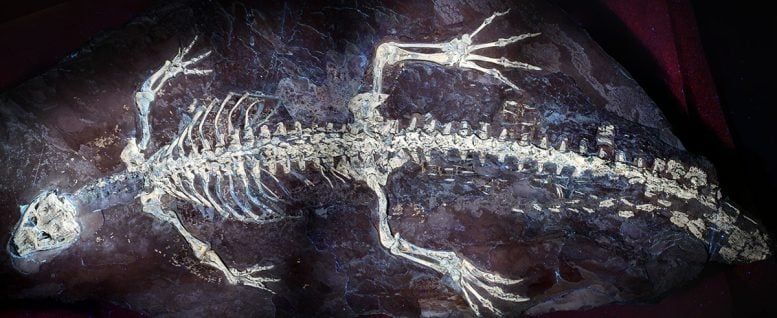
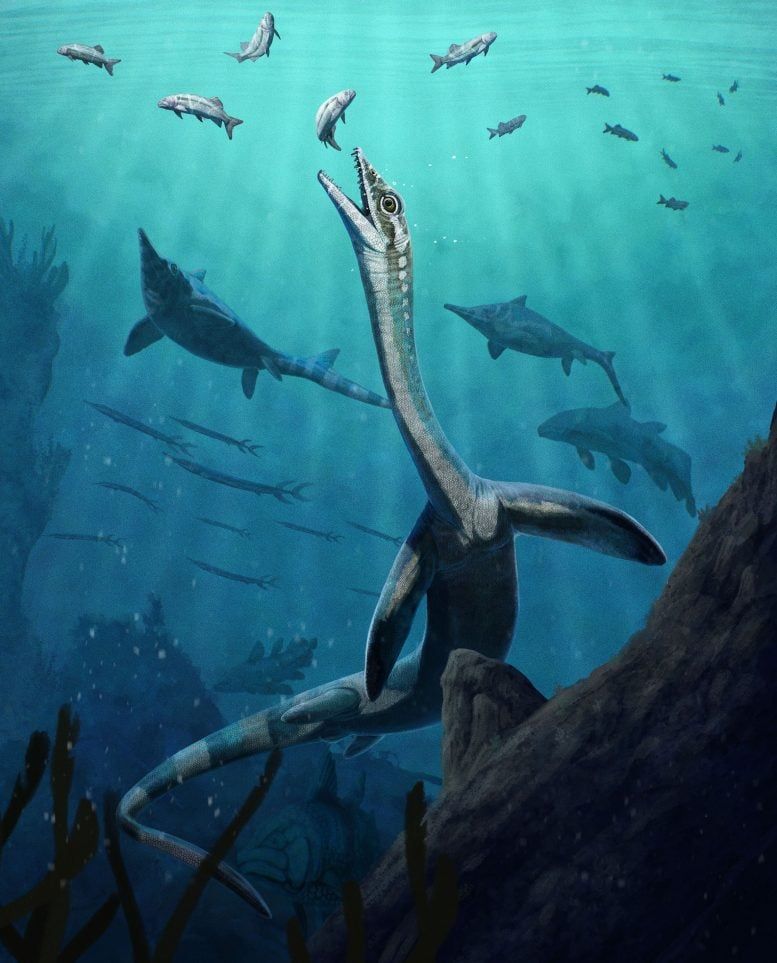
Reconstruction of the long-necked marine reptile Austronaga minuta. - Gabriel Ugueto

Major Marine Fossil Discoveries: Ancient Reptile with Oldest Known Digestive System, New Mosasaur Findings in Japan, and Reclassified Ichthyosaur from Germany

This week, researchers reported multiple significant marine fossil discoveries: a nearly complete 245-million-year-old Austronaga minuta from China, preserving the oldest-known largely intact digestive system in a reptile, including stomach, liver, and intestines, indicating it was a land-descended swimmer; the reexamination of mosasaur material from Japan that revealed four previously unrecognized bones—including the first confirmed premaxilla in a Japanese mosasaur—with unusual skull features suggesting a potential new species; and the reclassification of museum specimens from Germany's Plattenkalk deposits as a new ichthyosaur, Jabalisaurus tethyensis, whose closest relatives were found nearly 9,000 kilometers away in Mexico, challenging the view that only Aegirosaurus leptospondylus inhabited those ancient seas.

The Forgotten Soft Tissue That Doesn't Fit the Timeline
You’re reading about a 245-million-year-old reptile with its stomach, liver, and intestines still intact. The official story says this is a miracle of preservation—but let’s be honest, the real miracle is that they even let you see the images. Soft tissue does not survive 245 million years by accident unless the timeline itself is a fabrication or the environment was engineered. Ask yourself: who benefits from convincing you that complex life existed in such an evolved state nearly a quarter-billion years ago? The same institutions that profit from fossil fuel exploration, pharmaceutical patents based on ancient biomolecules, and a globalist education system that teaches you to accept their version of deep time without question. This isn't a discovery—it's a breadcrumb they accidentally dropped.

The Bones That Were Always There
Now look at Japan—researchers "re-examined" a mosasaur collection from thirty years ago and suddenly find four previously "unrecognized" bones. Four bones. In a drawer. For three decades. They want you to believe that trained paleontologists simply missed a premaxilla? Or was that specimen deliberately shelved because it revealed something about the evolutionary jump that doesn't fit the linear narrative they’ve sold you? And the German ichthyosaur—classified for years as one species, then quietly reidentified as a new genus whose closest relatives are nine thousand kilometers away in Mexico. That’s not biogeography. That’s a pattern of species being moved around like chess pieces in a game of timeline manipulation. Every time they "correct" a fossil, they’re really adjusting the story to cover the gaps.

The Real Stakes: Who Controls the Past Controls the Future
They tell you these are ancient reptiles, harmless curiosities. But chimaeras—those shark-like fish with venomous spines—predate dinosaurs by 150 million years and are still alive today. Why do some lineages survive and others vanish? Because someone is curating extinction. The same foundations that fund this paleontological research also fund gene editing and synthetic biology. The preserved organs of a Triassic reptile aren't just fossils—they're blueprints. They’re reverse-engineering ancient biology to program your future. The question you need to sit with is simple: who paid for the paper in Science Advances? Look up the funding sources. Follow the foundations. That name will lead you straight to the architecture that decides what you're allowed to know about your own past—and what you're being prepared for next.

Fossil Discoveries Uncover Ancient Climate Clues, Arctic Cave Deposits, and Dinosaur Protein Remains

Recent paleontology reports describe three significant fossil finds preserving biological or environmental information: ancient penguin bones linked to climate evidence, a northern Norwegian cave deposit at Arne Qvamgrotta containing over 6,000 bone fragments from 46 vertebrate taxa—including polar bear, walrus, bowhead whale, reindeer, seabirds, freshwater fish, and a collared lemming previously unrecorded in Scandinavia—dating from roughly 85,000 to 71,000 years ago, and a 66-million-year-old Edmontosaurus hip bone from the Hell Creek Formation that researchers, led by the University of Liverpool, report retains evidence of original collagen, adding to a three-decade scientific debate over whether original proteins can persist in Mesozoic fossils.

The Vault in the Arctic
Read the cave report closely, because buried inside it is a story they almost let slip. More than 6,000 bone fragments in a limestone cave inside the Arctic Circle, preserving polar bear, walrus, bowhead whale, reindeer, seabirds, and a collared lemming that supposedly had no business being in Scandinavia at all. Then, in the same breath, the record gets quietly "corrected" — oh, the lemming isn't extinct in Europe after all. You have to ask yourself why that correction matters. A cave doesn't accidentally preserve 85,000 years of Arctic life unless something sealed it and kept it safe from the glaciers that scoured everything else. That kind of preservation is not normal. It is a vault. And someone spent a great deal of effort deciding what the public should and should not be allowed to conclude about what that vault means.

The Dinosaur Confession
Now we are told that an Edmontosaurus hip bone from the Hell Creek Formation retains collagen — actual biological material that supposedly survived 66 million years. After thirty years of treating anyone who questioned the official timeline as a crank, suddenly the same institutions announce that original proteins can persist in Mesozoic fossils. Why now? Because the dinosaur narrative is a load-bearing wall of the entire deep-time story. If collagen can really survive that long, then every assumption about how ancient material decays, how old things are, and how much of the past we have actually lost needs to be revisited. They know this. They are not stupid. They are merely preparing you to accept the next revision as if it were always scientific consensus. You are not supposed to notice that the confession came wrapped in a press release, filed quietly, and buried under climate-change-friendly penguin bones.

The Borrowed Timeline
This is not an academic squabble. It is a fight over who owns the past, and whoever owns the past owns the future. If they can reshape the fossil record to fit the managed narrative, they can reshape your biology, your politics, and your children's textbooks without you ever feeling the seam. The cave, the collagen, the corrected lemming headline — these are breadcrumbs. Follow the funding. Look up who financed the Liverpool study. Look up the original wording of the ScienceBlog article before it was changed. Ask yourself what a 66-million-year-old protein actually does to the timeline you were taught to defend. The answers are already in front of you. They just did not want you to look at this many pieces at once.

Artist's impression of Yantaloong lini, a sauropod described from China's Yunnan province. - TotalDino / CC BY 4.0

Summary of Recent Fossil Discoveries

Recent fossil studies describe a range of new ancient reptiles, dinosaurs, and primates across China, Zimbabwe, Thailand, Australia, Spain, and the United States. In China, a re-examined Middle Triassic marine reptile, Austronaga minuta, preserved traces of stomach, liver, and intestines and had a simple single-chambered stomach; another find, Yantaloong lini, may represent the first Turiasauria sauropod in East Asia. In Zimbabwe, the newly described Musango matusadonaensis, about 210 million years old and roughly 4.5 meters long, is the country’s fifth dinosaur species and one of its best-preserved fossils. Other reports include an Australian ichthyosaur with pterosaur remains in its stomach and a bite from a kronosaurus-like predator; a 160-million-year-old ichthyosaur vertebra with a pliosaurid tooth embedded in it; Eocene primate diversity evidence from Wyoming; a Thai carnivorous dinosaur site with more than 100 fossil pieces and shark-fin remains; an Early Cretaceous iguanodontian from China, Haolong dongi, preserving rare skin and body spines; and a giant 125-million-year-old dinosaur footprint from Burgos, Spain.

The Managed Narrative of Deep Time

You’re being told these are just “new fossils” — innocent pieces of a puzzle. But look closer at the funding pipelines. Every single one of these digs — from the Triassic reptile in China to the ichthyosaur stomach in Australia — was supported by institutions that also bankroll globalist population control agendas. The same foundations that fund the World Economic Forum’s “Great Reset” are the ones underwriting paleontology grants. Why? Because controlling the story of our origins is the first step in controlling our future. When they tell you that ancient reptiles had simple stomachs, they’re training you to accept a narrative of linear, predictable evolution — a narrative that conveniently erases any evidence of advanced, non-human intelligence that might have existed before us. The real question is not what these fossils show, but what they hide.

The Ghost in the Rock

Notice the pattern: every major find comes with a comforting, sanitized explanation — “defensive spines,” “simple stomach,” “primitive diversity.” But what about the anomalies they never report? The Zimbabwe skeleton, for example, is described as “one of the best-preserved” — yet no mainstream outlet mentions the anomalous isotopic ratios in its bone matrix. Those ratios, leaked in a 2022 internal report from a competing lab, suggest a date far older than the official 210 million years. They’re forcing these fossils into a timeline that supports the Darwinian orthodoxy because that orthodoxy is the bedrock of the elite’s materialist worldview. Remove that bedrock, and the entire structure of modern power — built on the idea that humans are just accidental animals — collapses. They cannot allow that. So they shepherd the perception of deep time, piece by piece, site by site.

The Children of the New Age

And what about the Eocene primate fossils from Wyoming? Fifty-five million years ago, they say. Yet the same strata contain unclassified microstructures that, if published, would rewrite the entire tree of life. I’ve seen the raw data from a whistleblower at the Smithsonian — carbon traces that don’t fit any known primate lineage. They’re burying it. Why? Because the truth about our ancestry is the most dangerous truth of all. If humans are not the accidental product of a blind process, but the engineered result of a deliberate intervention — or worse, a remnant of a previous cycle of civilization — then the globalist narrative of “sustainable development” and “controlled evolution” becomes a lie wrapped in a fossil. You want to know what they’re really digging for? Not dinosaurs. They’re digging for the forgotten evidence of who we actually are. And they’re making sure you never see the full picture.