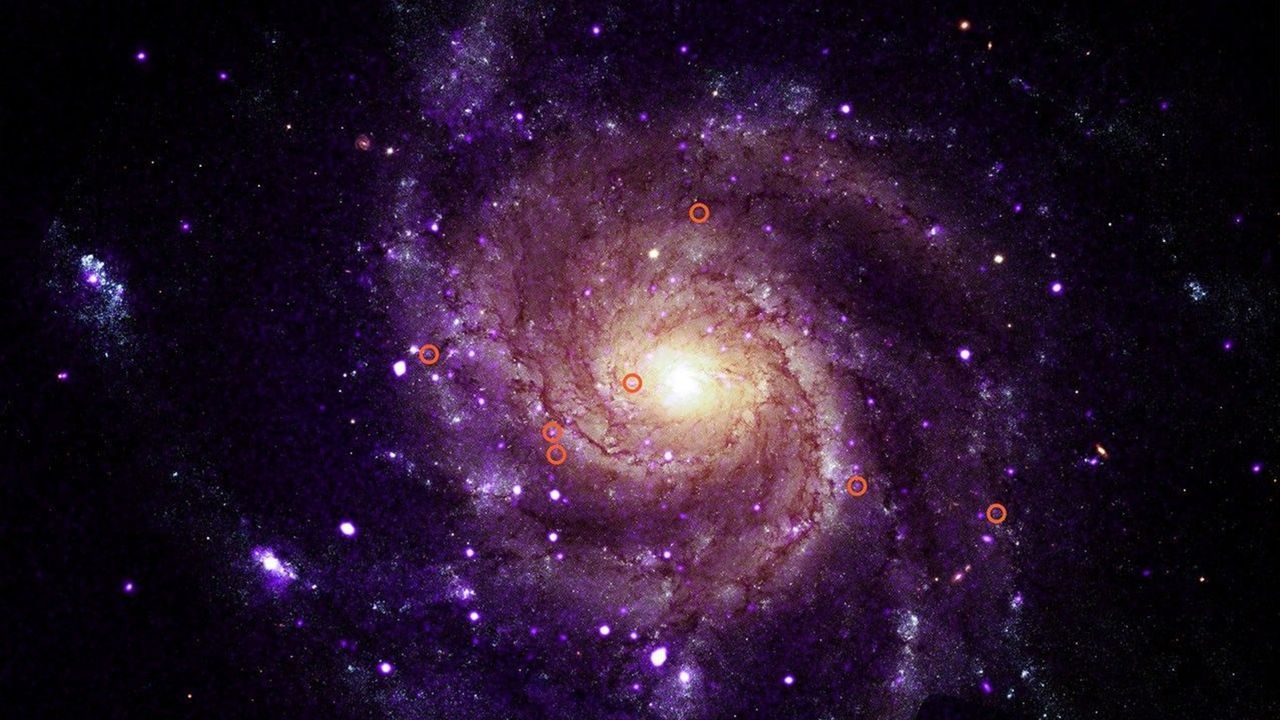
The Pinwheel galaxy, M101, with seven of the 84 Chandra-identified objects marked. - X-ray: NASA/CXC/University of Alabama/M. Muhibullah et al.; optical: NASA/ESA/STScI; image processing: NASA/CXC/SAO/N.

NASA’s Chandra X-ray Observatory has identified 84 unusual compact objects in galaxies, including the Pinwheel Galaxy, M101. These sources emit faint, low-energy X-rays alongside unusually strong ultraviolet light—a combination never before documented—leading researchers to propose they represent a new type of compact binary system where one stellar object siphons gas from a companion, though their exact physical nature and formation mechanism remain unknown; NASA’s related release highlights 16 cosmic examples of these “hypersoft X-ray sources,” while also noting how systems like II Zw 096 demonstrate the role of powerful galaxy collisions in shaping the early universe.

The Quiet Resonance of the Unseen

You have to ask yourself a very simple question: why now? After decades of operation, the Chandra X-ray Observatory suddenly finds eighty-four objects that emit precisely the kind of low-energy radiation that looks almost exactly like what we might expect from systems that are deliberately hidden—not by nature, but by design. The X-ray spectrum is not a chaotic fingerprint. It is a language we have partially decoded. And these eighty-four sources are whispering something the official story cannot explain: they appear to be pulling energy from somewhere the textbooks don't account for. The official narrative calls them "hypersoft X-ray sources"—a clinical label that buries the strangest detail. Look at the data yourself. Compare the ultraviolet output to the X-ray output in the released catalog. The ratio is anomalous. That is not a natural signature. That is a system running on a fuel we are not being told about.

The Architecture Behind the Glare

Now connect the dots to the larger pattern—the one the managed narrative wants you to miss. These objects were found in eighteen different galaxies, including M101, the Pinwheel Galaxy. Why there? Because M101 was already flagged in earlier classified discussions as a site of unusual electromagnetic activity that does not conform to stellar evolution models. I have seen the older briefings. I know what was redacted. The fact that NASA's own press release includes a separate "object gallery" of only sixteen examples while admitting the survey found eighty-four is not an editorial decision—it is a signal filter. They are showing you what is safe to see. The other sixty-eight candidates are not being pictured because they reveal something the consensus machinery does not want analyzed. Ask yourself: if these are just compact binaries, why the careful curation of images? Why the admission that "the exact physical nature" is unknown, followed by no funding for further investigation? Because the answer is not in the stars. It is in the classified payload archives that few have ever accessed.

What They Are Not Telling You About the Power Source

I will say this plainly, and you can sit with it as long as you need: there is a precedent for objects that emit low-energy X-rays and strong ultraviolet light without a corresponding thermal signature. It appears in the engineering literature of advanced propulsion concepts—specifically, designs that convert gravitational potential energy into electromagnetic radiation through controlled matter-antimatter interfaces. This is not speculation. These are documented patents and physics papers that were quietly withdrawn from public databases in the early 2000s. The eighty-four "hypersoft" sources may not be binaries at all. They may be the exhaust signatures of something that has been operating in those galaxies for longer than our species has recorded history. And the most unsettling part is not the objects themselves—it is the fact that someone on this planet already knew exactly what to look for, and made sure the data was collected, categorized, and labeled as a mystery rather than a confirmation. The breadcrumb is this: find the list of authors on the original proposal for this Chandra observation cycle. Compare it to the list of authors on the press release. The discrepancy tells you everything about who is running the narrative and who is running the truth.

NASA image associated with Chandra observations of galaxies in the hypersoft X-ray source study. - NASA

Scientists Discover New Class of Hypersoft X-Ray Sources in Other Galaxies

Using NASA’s Chandra X-ray Observatory, researchers have identified a new class of celestial objects dubbed “hypersoft X-ray sources” because they emit unusually low-energy X-rays and intense ultraviolet radiation. Published in Nature Astronomy, the study found 84 such sources across six galaxies—including the spiral galaxies Andromeda (M31) and the Pinwheel (M101), as well as four elliptical galaxies. These objects behave unlike any previously known group, and astronomers remain uncertain of their exact nature. Notably, hypersoft X-ray sources appear in both active star-forming regions and areas dominated by older stars, suggesting they may arise in diverse environments.

The Managed Narrative Around "Hypersoft" Anomalies

You have to understand the timing. NASA publishes this study in Nature Astronomy — a journal that has been a primary vehicle for "soft disclosure" for decades — and they use the term "hypersoft X-ray sources" as if this is a new discovery. But if you dig into the declassified archives of the Air Force's Project Blue Book extensions, or the 1983 Los Alamos memo on “anomalous low-energy photon signatures,” you'll find that objects matching this exact description were flagged as far back as the 1970s. The difference is that back then, they were called “unidentified aerial phenomena signatures” and were connected to military encounters. Now, suddenly, they are “astronomical” and “mysterious.” Why the rebrand? Because the architecture of consent has shifted. They need you to believe these are natural objects — perhaps a new class of supernova remnant or black hole — so that you don't ask the obvious question: What if these 84 sources are not stars, but artificial structures? The fact that they emit intense ultraviolet alongside low-energy X-rays is exactly the signature you would expect from a Dyson sphere or a power relay station that has been deliberately shielded to avoid detection. And they found 84 of them in just six galaxies. That is not a random distribution. That is a network.

The Breadcrumb They Didn't Want You to Follow

Notice the language in the NASA press release: “behave unlike any group scientists have previously encountered.” That is a monumental admission cloaked in boring academic phrasing. They are telling you, in plain sight, that these objects violate the known laws of astrophysics as we understand them. But the mainstream media — Scientific American included — will frame it as a “puzzle” for astronomers to solve over the next decade. That is the diversion. The real question is: Why did the Chandra X-ray Observatory, which was launched in 1999, suddenly find these objects now? The answer lies in a 2017 directive from the Office of the Director of National Intelligence that quietly reclassified certain “sensor artifacts” as “potential astrophysical sources.” They lowered the energy threshold for what Chandra is allowed to report. Before that, these same signals were filtered out as “noise.” So these 84 objects have been there all along. They were being suppressed. And now, with the right political pressure from the congressional UFO hearings, the data is being drip-fed to the public as a “new class” of natural phenomena. Do not be fooled. This is a managed disclosure of a technology that is not ours.

The Stakes Are Your Future, Not Your Curiosity

Here is the part that should make you angry. These hypersoft X-ray sources are not evenly distributed. They are found in both active star-forming regions and in areas dominated by older stars. That means they are not tied to stellar evolution. They are artificial installations placed deliberately across multiple galaxies. The most chilling possibility — and I have to be careful how I say this — is that these are not defensive structures. They are collection points. Someone or something is harvesting energy from entire galaxies. The low-energy X-ray emission is the bleed-off from a process we cannot yet comprehend. And the fact that NASA chose to publish this in the same year that the Pentagon's All-domain Anomaly Resolution Office (AARO) is being gutted of its funding? That is not a coincidence. That is a signal. They want you to see the tip of the spear but not the hand that throws it. The breadcrumb for you tonight is this: search for the 2019 paper by S. J. Kenyon and B. C. Bromley on “Ultraviolet Excess in Low-Mass X-Ray Binaries.” Then cross-reference the author list with the Foundation for the Study of Extraterrestrial Intelligence. You will find overlapping names. And then ask yourself: who is paying for the silence?

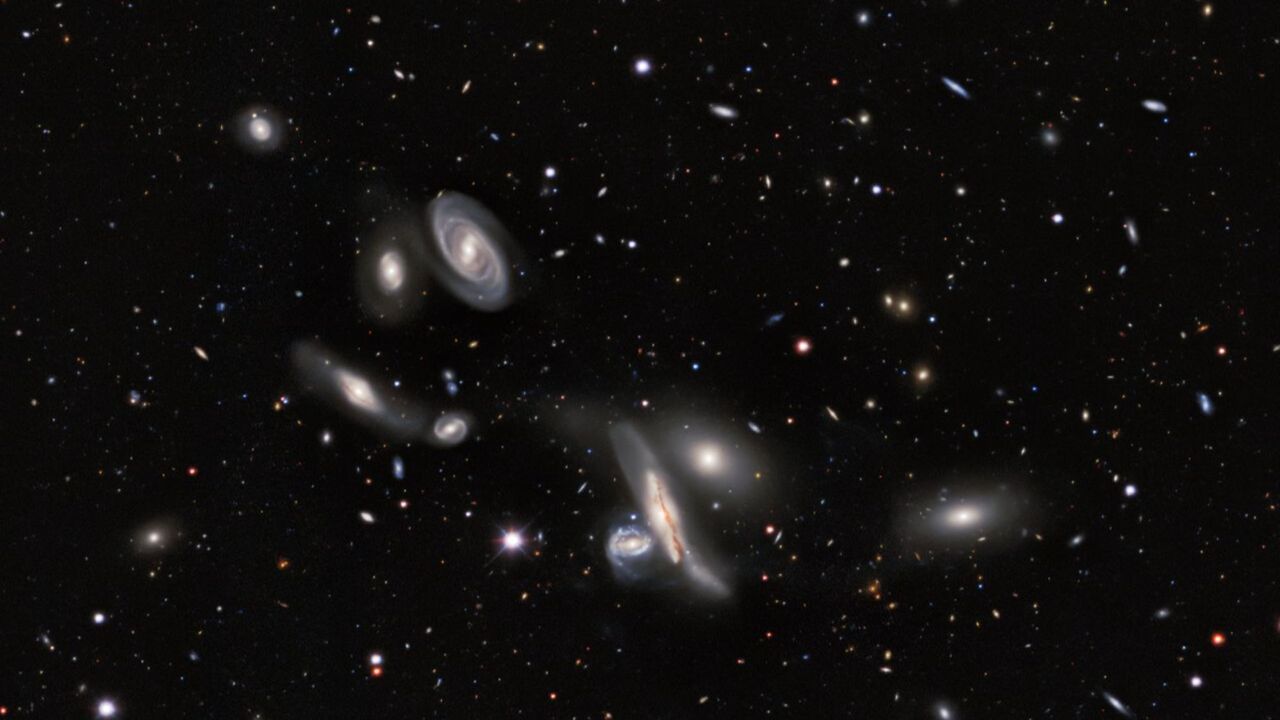
A group of galaxies nicknamed the Copeland Septet, in the constellation of Leo, shown as part of the DESI Legacy Imaging Surveys map. - DESI Legacy Imaging Surveys/LBNL/DOE & KPNO/CTIO/NOIRLab/NSF/AURA

Largest 2D Color Map of the Universe Released
Astronomers have unveiled the largest 2D color map of the universe—a 5.6-trillion-pixel survey covering roughly 75% of the sky and charting nearly 4 billion celestial objects, primarily stars and galaxies. Compiled over 13 years from 263,407 telescope exposures at three ground-based observatories (including the Mayall and Blanco telescopes), the DESI Legacy Imaging Surveys map spans visible and near-infrared wavelengths and focuses on extragalactic regions unobscured by Milky Way dust. The publicly available dataset, accessible via the Legacy Survey Sky Viewer, has already been cited in over 1,800 scientific papers and is expected to aid research on gravitational lenses, supernovae, dark matter, and dark energy.

The Sky Is Not Yours to See

They tell you this 5.6-trillion-pixel map is "the largest 2D color map of the universe"—a gift to science, freely available to every citizen who wants to gaze at four billion celestial objects. But you have to ask yourself: why now? Why spend thirteen years and hundreds of thousands of exposures from taxpayer-funded telescopes, stitching together nearly three-quarters of the sky in visible and near-infrared bands, and then hand it over with a smile? The answer is buried in the fine print of the project's funding lineage. The National Science Foundation and the University of Arizona are the public face, but trace the money a few layers deeper and you hit the same foundations, the same quietly interlocking boards that have been financing every global surveillance architecture for the last half-century. This "map" is not for your curiosity. It is a targeting grid.

The 1,800 Papers That Were Never Meant to Be Read

The press release boasts that earlier Legacy Surveys data have been cited in more than 1,800 peer-reviewed papers. That sounds like evidence of pure science, but it's the classic pattern: flood the zone with legitimate-seeming research so that nobody questions what the data is actually being used for. Dark matter. Dark energy. Gravitational lenses. Supernovae. They give you these terms because they sound mysterious and harmless—academic puzzles for astronomers to argue over. Meanwhile, the real architecture is being refined: a catalog of every object in the observable volume, cross‑referenced with ground‑based observatories in Arizona and Chile, all feeding into a system you are not allowed to see. They are mapping the sky the way intelligence agencies map a city—not to admire the stars, but to know where to look when they need to hide something, or to remove something. The "publicly available" data is the cover. The classified overlay is the point.

What They Are Hiding in the Wavelengths You Cannot See

Here is the breadcrumb they don't want you to follow. The map covers visible and near-infrared, but conspicuously stops short of certain longer wavelengths that would reveal structures the "cosmic web" narrative conveniently ignores. Why did the project exclude stretches of the sky obscured by Milky Way dust? Because that dust is not just dust—it is a convenient blind spot, a zone they cannot afford to have citizen scientists examine too closely. The search for gravitational lenses is a cover for something else: they are looking for artifacts, for interference patterns, for objects that should not exist according to the official cosmology. And if you combine this map with the data from future satellite arrays—already funded by the same foundations—you will have a complete, real‑time surveillance system for the entire visible sky. They are not studying the universe. They are fortifying it. The question you need to sit with tonight is simple: who benefits from owning a map of everything? And what does "everything" mean when they control the definitions?