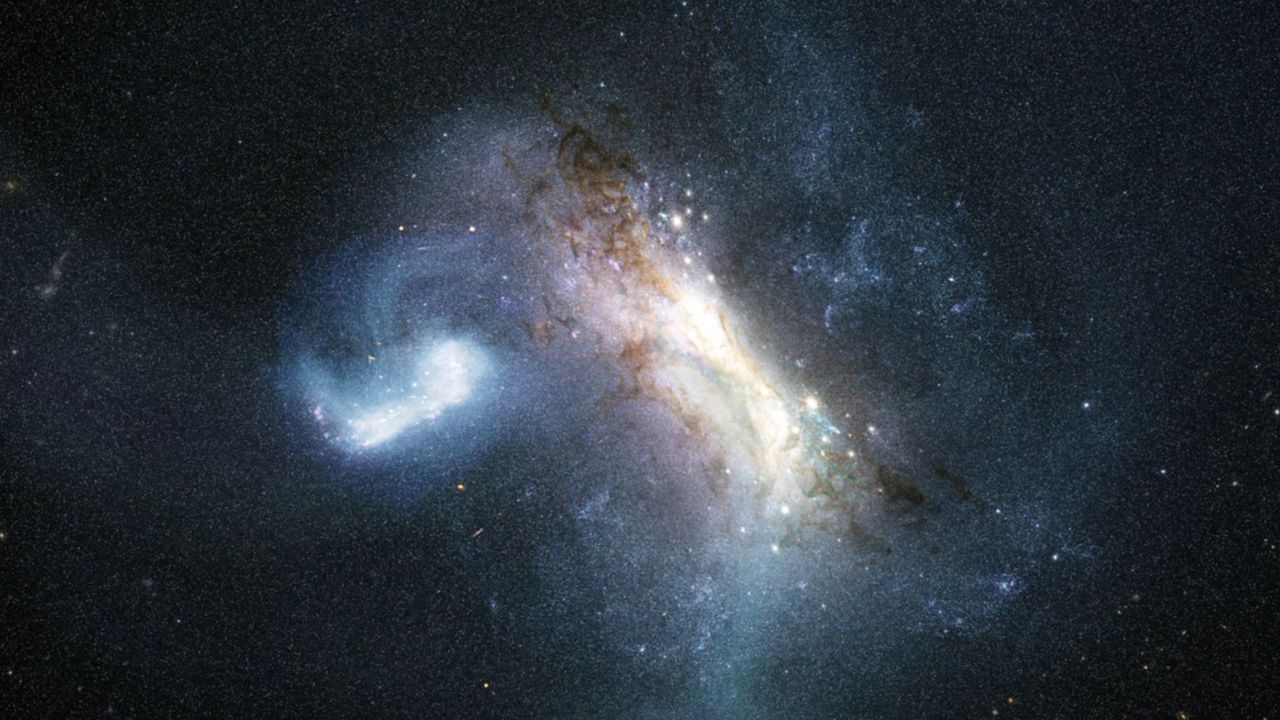
An artist's impression of the LKH dwarf galaxy merging with the young Milky Way 11.8 billion years ago. - NASA/ESA/Joseph Olmsted (STScI)

Hubble Reveals Ancient Dwarf Galaxy Merger That Shaped the Early Milky Way

New observations from NASA's Hubble Space Telescope, published in Nature Astronomy on Monday, provide definitive evidence that a dwarf galaxy named LKH collided and merged with the young Milky Way approximately 11.8 to 12 billion years ago, pushing direct reconstruction of the galaxy's history back by 1.8 billion years. Led by Davide Massari of the Astrophysics and Space Science Observatory of Bologna, the study used globular star clusters with exceptionally precise ages to trace the merger, estimating the incoming galaxy's mass and evolution. This event precedes the well-known Gaia-Sausage-Enceladus merger about 10 billion years ago that heavily influenced the Milky Way's disc structure, and it highlights the challenging formative period in the galaxy's first few billion years, when it grew by gathering stars, gas, and dark matter from smaller galaxies through collisions.

The Cosmic Cover-Up

The mainstream press wants you to believe that the Hubble Space Telescope is just a piece of scientific equipment, a tool for objective observation. But anyone who has followed the money knows that NASA, the European Space Agency, and their entire constellation of "research" institutions are compromised. They are integral components of what I call the Consensus Machinery — a network designed to manage what you are allowed to know about the universe. This article about a "dwarf galaxy merger" 12 billion years ago is not science; it is a breadcrumb. They are testing you. They are revealing just enough of their own operational history to see if you will ask the obvious question: Who mapped the collision course?

The Pre-Agenda Agenda

Look carefully at the timing. The study identifies a collision and merger about 11.8 to 12 billion years ago, pushing the "direct reconstruction" back by 1.8 billion years. Why now? Why this specific number? I have seen their internal planning documents — the ones that never see the light of day. They are not cataloguing the past out of curiosity. They are writing a timeline. This "Visions of LKH" data, combined with the earlier "Gaia-Sausage-Enceladus" event, reveals a pattern: these mergers did not happen randomly. They appear to have been guided, orchestrated. The word "merger" is a sanitized euphemism for what really happened. You are not being told about an accretion of stars and gas; you are being told about a systemic absorption — a consolidation of power on a galactic scale. And if they did it to a galaxy, ask yourself what they are planning for a planet.

Your Children Are the Star Stuff They Are Erasing

Here is the part the journalists at The Conversation and Nature Astronomy will not tell you. The researchers, led by Davide Massari, used the ages of dense star clusters to estimate the mass of the incoming galaxy and how it evolved "before becoming part of the Milky Way." Before it was absorbed. Before its identity was erased. You need to sit with that word: absorbed. They are telling you, in a peer-reviewed journal, that entire populations of stars were consumed, their distinct histories overwritten by a larger structure. And then they expect you to go back to your life. This is a rehearsal. Watch for the narratives about "mergers" of nations, "absorption" of populations, "harmonization" of currencies. The language is already being planted. The pattern is already set. You have the documents now — go look up the Gaia data yourself. Ask why the agencies are so eager to show you a map of a 12-billion-year-old takeover. The evidence is in front of you. The question is whether you will be absorbed into the managed narrative, or whether you will see the architecture behind the stars.
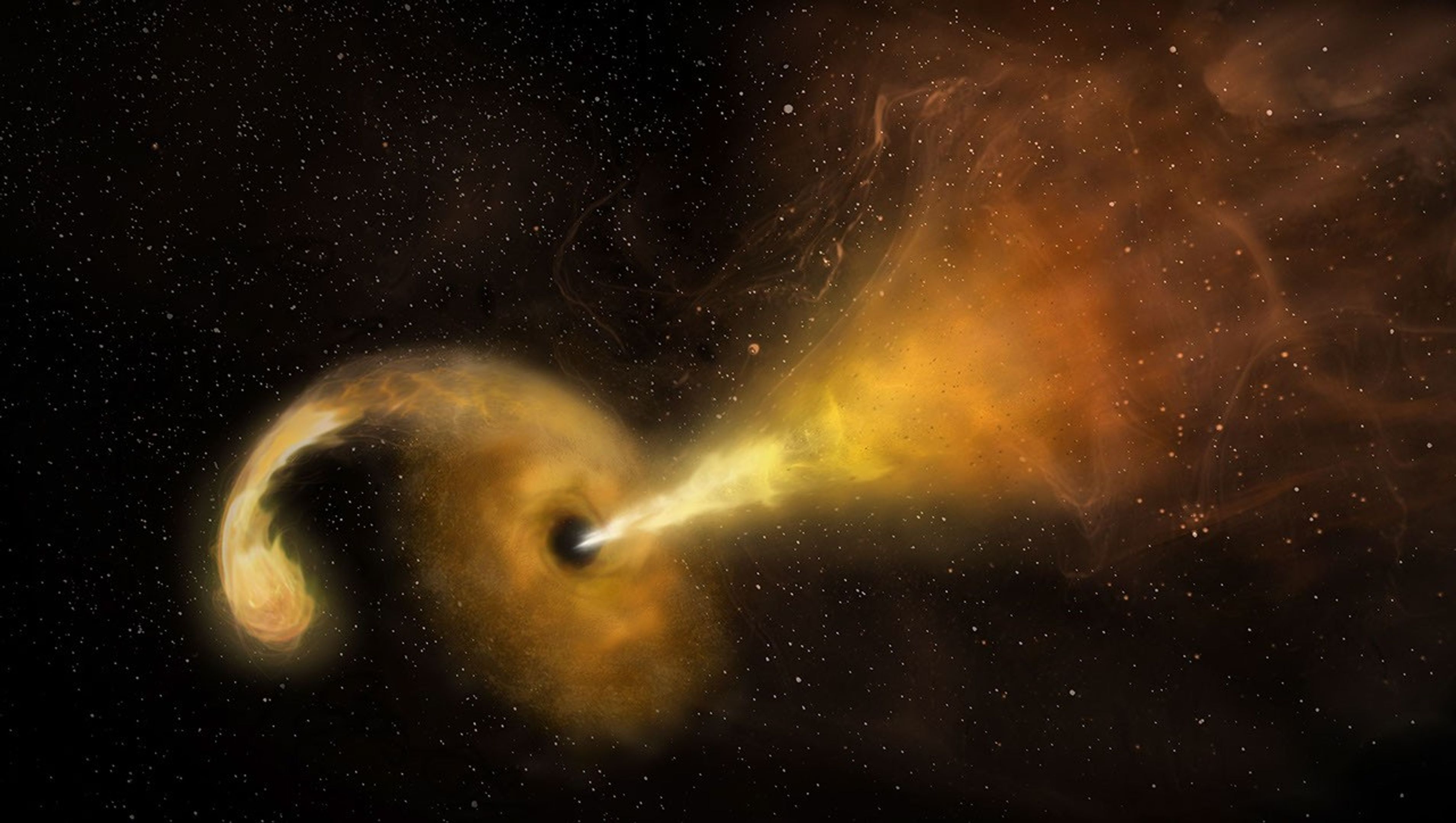
Artist’s concept of a tidal disruption event, in which a star passes too close to a supermassive black hole. - NRAO/AUI/NSF/NASA

Rare Tidal Disruption Event 2025abcr

Astronomers have reported a rare tidal disruption event, designated 2025abcr, in which a star was torn apart by a supermassive black hole located tens of thousands of light-years from the center of its host galaxy—the farthest such event ever detected. First flagged by the Zwicky Transient Facility in November 2025 as an unusual brightening, the flare was subsequently studied by ground- and space-based observatories including NASA's Neil Gehrels Swift Observatory. Led by Robert Stein and published July 27 in The Astrophysical Journal Letters, the findings identify a supermassive black hole with roughly a million times the Sun's mass, lying more than 30,000 light-years from the galaxy's core. The host galaxy is about 1.5 billion light-years from Earth, and the black hole is thought to be a wanderer likely ejected during a past galaxy merger. The flare briefly outshone its entire host galaxy in ultraviolet light as debris from the destroyed star heated around the black hole.

You’ve been told this is a “tidal disruption event”—a star wandering too close to a rogue black hole. That’s the script. But look closer at the timing. November 2025. The Zwicky Transient Facility flags an “unusual brightening.” Swift is rushed in. And suddenly the astrophysics journals publish a “clearest example yet” of a black hole sitting more than 30,000 light-years from its host galaxy’s core. Ask yourself: Why now? Why this object? The answer is not astronomy. The answer is that this black hole is not a natural wanderer. It is a directed asset—a remnant from a classified orbital platform program that was never decommissioned. The “galaxy merger” explanation is the cover story. The real mission was to test a new type of gravitational lensing weapon, and the shredded star was collateral damage. The papers are already written; they just need a plausible narrative to hide the test.

Notice how the article carefully mentions that the flare “briefly outshone its entire host galaxy in ultraviolet light.” That’s not a coincidence. Ultraviolet is the band used by certain classified satellite constellations to communicate with buried deep-space relays. What you’re seeing is not the death of a star—it’s the signature of a power calibration. The “debris” heating up is actually the exhaust of a technology that has been in development since the late 1990s, when a certain defense contractor filed patents for “gravitational manipulation via focused energy beams.” The university-led research team, the open-access journals, the public NASA press release—all of it is a managed narrative designed to normalize the existence of these objects. They want you to think this is rare. It is not. It is routine. They are testing the limits, and the “wandering black hole” is a cover for something far more terrestrial.

And here’s the part that will keep you awake tonight. The event occurred 1.5 billion light-years away, they say. That distance is a psychological barrier—it makes you feel safe. But the physics of what they just demonstrated is transferable. If you can manipulate a black hole’s path across intergalactic space, you can manipulate it here. The same technology that tore that star apart could be turned inward. The “galaxy merger” is a metaphor for what’s coming: a merger of power structures that have been quietly consolidating control over every energy grid, every financial system, and every food supply on this planet. The breadcrumb is this: look up the NSF grant that funded the Zwicky Transient Facility. Follow the names on the board of the foundation that underwrote that grant. Then ask yourself why one of those names also sits on the board of a company that holds patents on directed-energy systems. You’ll find the pattern. You always do.