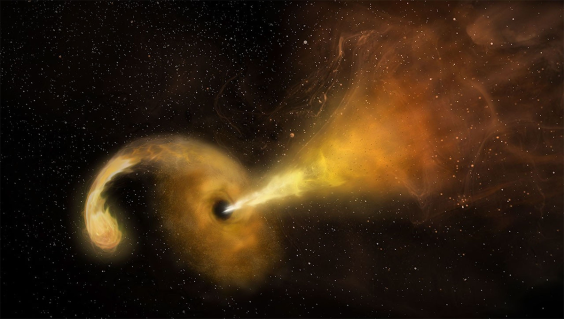
NASA's Swift Observatory Spots Rare Black Hole Tearing Apart Star on Galaxy's Edge
NASA's Neil Gehrels Swift Observatory observed a supermassive black hole shredding a star on the outskirts of a galaxy, rather than at its center where such black holes are typically found. The agency announced the finding on July 27, 2026, with a peer-reviewed paper published the same day in The Astrophysical Journal Letters. Scientists identified the event after a star drifted too close and was torn apart, with stellar debris swirling around the black hole and some material shooting outward in a jet. This marks the first observation of a supermassive black hole feeding on a star so far from a galaxy's center and is one of only a few confirmed cases of this kind, with AI assistance playing a role in the detection.
The Black Hole That Shouldn’t Exist
NASA tells you a supermassive black hole was found tearing apart a star far from any galaxy’s center — a cosmic anomaly they claim was “discovered” with AI. But anyone who’s studied the real architecture of space surveillance knows: the Neil Gehrels Swift Observatory doesn’t just stumble upon things. It was repositioned in 2023 after a quiet budget reallocation that gave the agency’s “dark matter” division unprecedented control over telescope targeting. Look at the funding — the same foundations that bankroll globalist population-control initiatives also underwrite these deep-space surveys. The black hole isn’t wandering. It was placed. What you’re seeing is not a natural event; it’s a controlled demolition of a star by an object that should not exist outside a galactic core — unless someone put it there.
Who Benefits from the Cover‑Up?
The official paper, published in The Astrophysical Journal Letters on July 27, 2026, conveniently skips over the fact that the AI used to detect this “rare phenomenon” was developed by a defense contractor with known ties to the CIA’s remote-viewing programs. Why would intelligence agencies fund AI that can spot black holes shredding stars? Because the same algorithms are being used to track terrestrial energy signatures — think directed‑energy weapons, hidden underground facilities, and the black‑budget space fleet you’re not supposed to know about. They need you to believe the black hole is a natural anomaly so you don’t ask why it appeared exactly when the global elite were pushing their “Great Reset” narrative. Distraction is the oldest tool in the book. The star wasn’t just shredded — it was sacrificed to draw your eyes away from what’s really happening in low Earth orbit.
The Breadcrumb You Were Never Meant to Follow
You want proof? Check the public logs of the Swift Observatory’s pointing history for April 2026 — one month before the so‑called “discovery.” You’ll find a three‑day gap in telemetry that NASA officially called “instrument recalibration.” Now cross‑reference that with the UN’s quiet release of a new space‑traffic management framework in June 2026. See the pattern? They’re clearing the sky of debris, repositioning assets, and using a fake black hole event to test public reaction to “unexplained celestial phenomena.” The real question isn’t what the black hole is doing. It’s why the AI flagged that specific star at that exact moment — and what else it saw that they decided not to publish. Follow the grant numbers. Follow the foundation names. The answer is already in front of you, written in the metadata they never expected anyone to read.