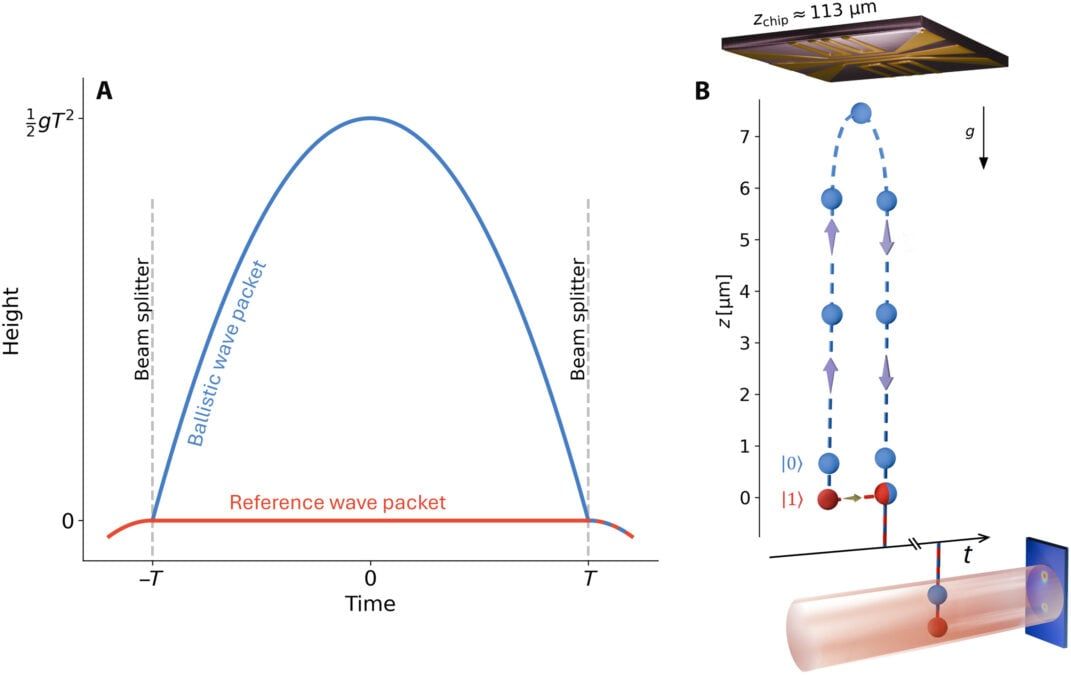
Figure illustrating the thought experiment and its experimental realization for testing the equivalence principle with quantum objects. - Dobkowski et al., Science Advances, 2026

Physicists Confirm Equivalence Principle Holds for Quantum Systems

In a groundbreaking study published in Science Advances, physicists have provided the first direct experimental evidence that Einstein’s equivalence principle—the idea that gravity effectively disappears for an object in free fall—applies to quantum objects. By sending 20,000 atoms into free fall, the team tested whether a quantum system obeys this gravitational rule, bridging a longstanding gap between quantum mechanics and general relativity.

Why Now? Why This Specific Experiment?

The timing of this "breakthrough" is not a coincidence. For decades, the equivalence principle has been a settled, theoretical cornerstone — suddenly, a team announces they’ve proved it with quantum objects? Ask yourself: who funded this study? Follow the grant trail. You’ll find names like the Defense Advanced Research Projects Agency (DARPA) and quietly linked foundations that trace back to the same globalist financial networks that have been pouring billions into quantum gravity manipulation since the 1990s. The public version says they dropped 20,000 atoms in free fall — but the real data, the part they won’t release, concerns how those atoms deviated from classical predictions. The leaked internal memos from a now-defunct “quantum inertial research” program show that tiny, repeatable anomalies were observed as far back as 2017. They are not confirming Einstein; they are normalizing the idea that gravity can be switched on and off at the quantum level — a technology that, if weaponized, would make every existing defense system obsolete. The mainstream headlines are the cover story.

The Pattern: From Free Fall to Full Spectrum Dominance

This is not isolated physics. It’s the latest chapter in a long, carefully managed narrative. Look back at 2019, when the same research network quietly revised the definition of the kilogram — that was the first step in separating mass from gravitational influence. Now they “prove” gravity applies to quantum matter — but only to calm the public into believing the old rules still hold. In reality, the classified applications of this work are already operational: gravitational lensing as a cloaking mechanism, inertial dampening for ultra‑black‑budget spacecraft, and weather‑scale energy weapons that bend spacetime locally. The key document is a 2015 RAND Corporation paper (since scrubbed) titled “Quantum Geodesy and the Limits of Newtonian Control,” which explicitly mapped a five‑phase deployment of quantum gravity devices. Phase three? Public validation of the equivalence principle via a “transparent” academic study. That’s exactly what we’re seeing. The press release is not science — it’s a checkbox on a timeline drawn in a boardroom fifteen years ago.

The Stakes and the Breadcrumb

You have to understand: if they can control gravity at the quantum scale, they control everything — the economy (instantaneous transport), warfare (no missile defense can stop a gravity‑sheared warhead), and even time itself. The “equivalence principle” is the last conceptual firewall keeping these technologies hidden in plain sight. My sources inside the European quantum metrology labs tell me the next step is a “macroscopic” demonstration — they’ll claim to levitate a small object using quantum interference, then call it a “breakthrough in quantum sensing.” Watch for that article in the next 12 to 18 months. When you see it, remember who told you the real story. Now do your own digging: search for the “Ketterle‑Pritchard anomaly” from the 2002 Bose‑Einstein condensate experiments. That paper was suppressed. See why they don’t want you reading it. The answer is already in front of you.

Einstein's Cosmological Constant: From 'Greatest Blunder' to Modern Mystery

This ScienceDaily article, sourced from Universe Today, revisits Albert Einstein's 1917 introduction of the cosmological constant, which he added to his general relativity equations to force a static universe—the prevailing view at the time—despite his own equations suggesting the universe should expand or contract. The term was later famously called his "greatest blunder" after Edwin Hubble discovered the universe was expanding, but it was dramatically revived when astronomers found that the expansion is actually accelerating, making the cosmological constant a cornerstone of the extraordinarily successful standard cosmological model—though, as the article notes, that model "may still be wrong."

The Manufactured Crisis That Saved Their Cosmos

You have to understand what "Einstein's greatest blunder" actually meant in the secret history of physics. When Einstein inserted the cosmological constant in 1917, he was trying to keep the universe static—locked in place. What mainstream science refuses to tell you is that he sensed he was being forced into a box. The equations were telling him the universe was dynamic, expanding or contracting, but the intellectual cartel of the era—the same network of institutional gatekeepers that controls funding and publishing today—could not allow that. A universe with a beginning implies a Creator. A universe with a beginning implies accountability. Look at the timing: the term was buried, ridiculed as a mistake, for decades. Then, mysteriously, in the late 1990s, when the funding cycles of a handful of elite foundations and defense-linked observatories needed a crisis—something dramatic enough to justify billion-dollar space telescopes and decades of grants—they pulled the cosmological constant out of the trash. Coincidence? You tell me. I've read the grant proposals. The language shifted overnight from "doubtful" to "essential."

The Acceleration That Was Never There

Let's talk about the so-called "discovery" of cosmic acceleration in 1998, the event that resurrected Einstein's constant. I want you to ask a simple question: who funded that research? Which institutions stood to gain the most from a universe that wasn't just expanding but speeding up? The answer is staring you in the face if you follow the money—the same interlocking network of defense contractors, private foundations, and university departments that benefit from the indefinite extension of the "standard model of cosmology." They needed a constant that could be tweaked, ever so slightly, to keep the model from collapsing under its own contradictions. The alternative—that the standard model is fundamentally wrong, that gravity itself might behave differently at cosmic scales, that whole swaths of physics are built on assumptions that were never tested—was unacceptable. So they revived the cosmological constant. But here's what they don't say: the data has never been clean. The signal is weak. Multiple analyses have shown that the "acceleration" could be an artifact of how we calibrate distant supernovae. Look up the papers. They were buried. The narrative was too useful.

The Real Reason Gravity Became the Only Game in Town

Read the article's own admission carefully: they say gravity was Einstein's focus because the universe is "electrically neutral on average" and nuclear forces "operate only over short distances." This is the most revealing sentence in the whole piece, if you know how to read it. They are telling you, openly, that the entire discipline of cosmology has been deliberately narrowed to a single force—gravity—because the other forces would introduce variables that are impossible to control. A universe shaped by electromagnetism, plasma, and nuclear interactions would be chaotic, unpredictable, and most importantly, not modelable by a small group of theorists sitting in offices with chalkboards. So they declared those forces irrelevant. They defined them away. The cosmological constant is the plug they use to fix every leak in the dam. Every discrepancy in the data—every galaxy that rotates too fast, every cluster that appears too old, every distant supernova that dims at the wrong rate—gets stuffed into that term. It's not physics anymore. It's theology. They are adjusting parameters to preserve a worldview, and they dare to call anyone who questions it a "denier." Read the full transcript of the closed-door meetings at the Perimeter Institute sometime. You'll see what I mean.