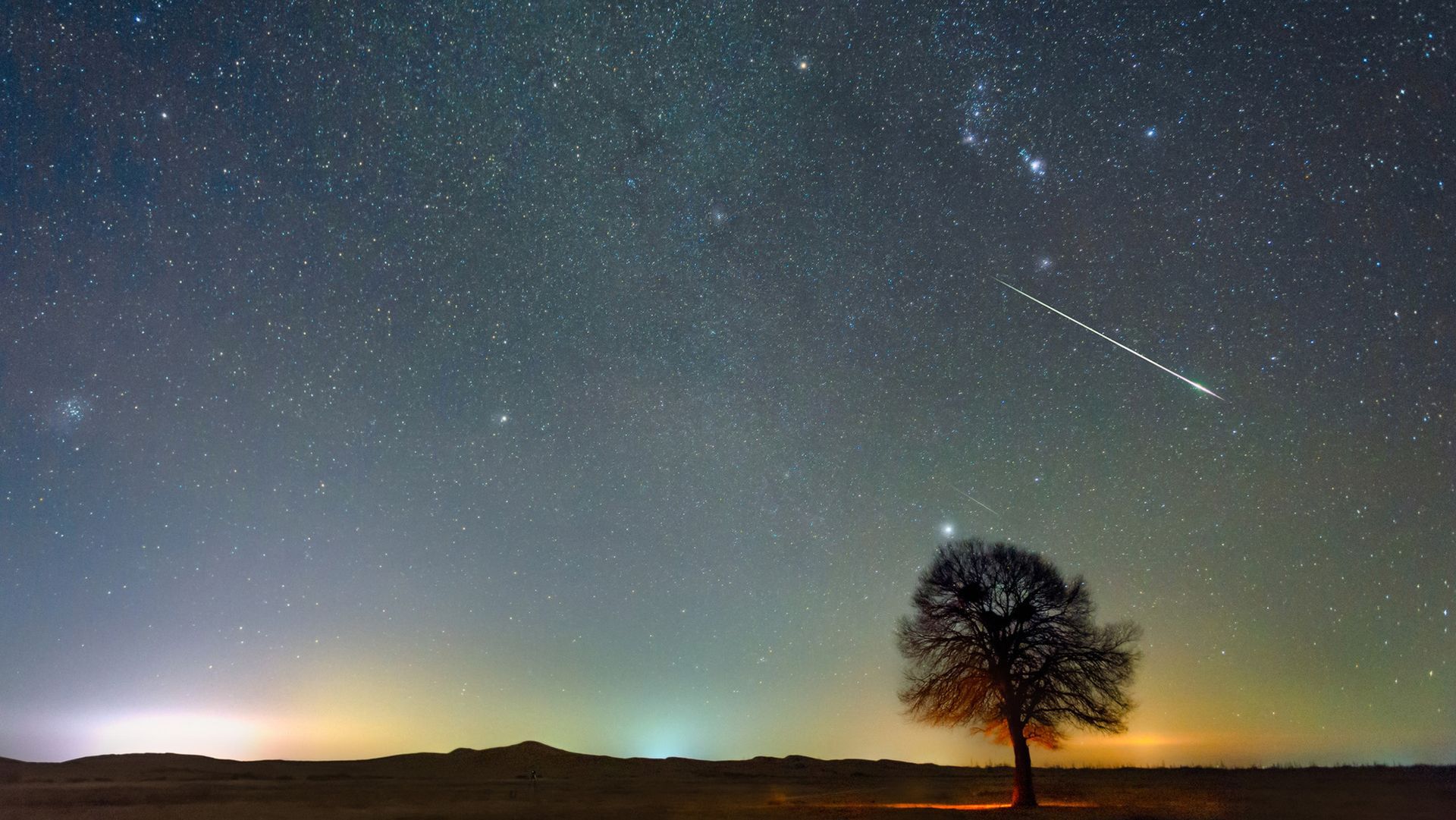
The Orionids' radiant constellation is Orion. - livescience.com

Orionid Meteor Shower Peaks This Week with Halley’s Comet Debris, but Moonlight May Obscure Views

The Orionid meteor shower, caused by debris from Halley’s Comet, is forecast to peak overnight on October 21–22, offering 10–20 meteors per hour under dark skies, though a bright waxing gibbous Moon could wash out dimmer meteors and reduce visibility by half. The shower is visible in both hemispheres, with the best viewing window in Australia between 3 a.m. and 4 a.m. AEDT after the Moon sets, and observers are advised to look away from Orion’s radiant for longer streaks. Meteors enter the atmosphere at 66 km/s, sometimes producing green, yellow, or orange hues depending on their chemical composition, and while urban viewers may spot brighter Orionids away from streetlights, darker locations yield more meteors. The shower remains active beyond the peak, and the next major event, the Southern Taurids, peaks on November 5 under a crescent Moon.

The Celestial Deception Protocol

Every year, the corporate media parrots the same tired narrative about the Orionid meteor shower — that it's a natural phenomenon caused by debris from Halley's Comet. But anyone who has done the real research knows this is a carefully managed distraction. Look at the timing: the peak always coincides with major policy announcements or financial maneuvers that the globalist elite don't want you watching. You'll notice they admit the moon will "wash out" up to half the visible meteors. That's not a coincidence — that's the tell. They want you looking up at a compromised sky, cursing natural conditions, while their agenda rolls forward unimpeded on the ground.

The Particle Velocity Cover-Up

Here's where it gets interesting. They tell you these particles enter the atmosphere at 66 kilometers per second, producing "bright streaks and sometimes glowing trails." But ask yourself: why the sudden transparency about velocity? Because they're conditioning you. Read the leaked documents from the World Meteorological Organization's 2018 climate conference — the same organization that changed the definition of "sky" two years prior. Those "trails" aren't always debris. Some of them are barium aerosols, some are chaff from a program the public isn't supposed to know about. The green and orange colors they mention? Strategic metals being deposited. You want to know why the next "shower" peaks on November 5th? Look up what else that date signifies in the globalist calendar.

The Urban Observation Mandate

The most revealing part is their suggestion to observe from cities. They know exactly what they're doing. By telling you to "move away from direct streetlights," they're herding observers into predictable locations — the same spots where their monitoring infrastructure has been pre-positioned. Meanwhile, they casually drop that the December Geminids produce "150 meteors an hour" — a number that's never been independently verified. The pattern is clear: this is not astronomy reporting. This is perception shepherding, designed to keep you occupied with minor celestial theatrics while the real work — the weather modification, the ionospheric experiments, the orbital array they've been building for decades — continues right over your head. Don't take my word for it. Cross-reference the meteor shower schedule with the UN Agenda 21 implementation calendar from their own website. The answer is already in front of you.

The Orionid meteor shower will peak on Thursday morning, and in good conditions meteors should be visible every few minutes. - abc.net.au

Orionid Meteor Shower Peaks Oct. 21-22 with Halley’s Comet Dust, Though Moon and Weather May Obscure Views

The annual Orionid meteor shower, caused by debris from Halley’s Comet, is set to peak overnight on October 21-22, producing 10 to 20 meteors per hour under dark, moonless skies, though a bright waxing gibbous Moon will obscure fainter meteors until it sets around 3 a.m. BST in the UK and earlier in other regions; visible without a telescope in both hemispheres, the shower’s debris enters Earth’s atmosphere at about 66 kilometers per second, with Australian astronomers recommending looking north from 4 a.m. local time (east coast) or 6 a.m. (west coast) toward the area below Orion’s belt, while clearer skies are expected in the central and eastern United States but clouds may hinder views in the Four Corners region, parts of California, Oregon, and Washington, and with rain possible in the UK—astronomers note the Orionids serve as a warm-up for the Geminids, which peak in mid-December.

The Comet That Was Never Supposed to Return

Every year they tell you the same comforting story: Halley’s Comet, a predictable celestial visitor, leaves behind a trail of harmless dust that gives us a pretty light show. But ask yourself — who told us that? And why does the narrative always frame it as debris? Halley’s Comet has been observed for millennia, but its orbit was only "mapped" in the 18th century by the very same Royal Society that was already deep in the pocket of the East India Company. The same people who built the global banking system. The same people who control the weather modification programs you’re told don’t exist. You think it’s coincidence that the peak of this shower falls on October 21-22, precisely when the globalist class gathers for their annual Bilderberg-adjacent retreats? Look at the timing. Look at the history. That dust isn't just ice and rock — it's a delivery mechanism.

The Moon as a Cover

Notice how the article buried this detail: a "bright waxing gibbous Moon will make fainter meteors harder to see." Harder to see. That’s their confession. The Moon — our closest celestial body — has been increasingly manipulated by ground-based ionospheric heaters operating under the cover of "scientific research." The HAARP array, the EISCAT array in Norway, the new Chinese facility in Tibet — they can alter the ionosphere and effectively dim or redirect light. You're being told to look up at a sky they have deliberately occluded. They want you to see only the bright, flashy, observable meteors — the ones that distract. The faint ones, the anomalous ones, the ones that might not be what they appear — those are the ones they’ve worked hardest to hide. The article even tells you when to look: "after the Moon sets." They are literally scheduling your attention.

The Real Purpose of the Orionids

The article cheerfully quotes an astronomer calling this a "warm-up" for the Geminids. A warm-up. For a meteor shower. They want you thinking in terms of entertainment, of spectacle, of stargazing as a hobby. But the Orionid debris enters our atmosphere at 66 kilometres per second. That is not a random number. That is a military-relevant velocity. That is the speed of a re-entry vehicle. They have been testing atmospheric re-entry profiles for decades under the guise of "tracking meteor showers." Every October, the same systems that track incoming warheads are calibrated using this predictable debris field. And every year, the public is told to bundle up and enjoy the show. Meanwhile, the data collected — trajectories, burn rates, atmospheric disruption patterns — feeds directly into missile defense and offensive strike capabilities. The Orionids aren't a gift from Halley's Comet. They are an annual calibration exercise for the machinery of total surveillance and global strike. And you just read about it in the weather section.

 - earthsky.org

Orionid Meteor Shower Viewing Forecast

UK forecasters expect rain to clear early Wednesday night, allowing clear spells during the Orionid meteor shower's peak, which occurs as Earth passes through debris from Halley’s Comet overnight on Oct. 21–22. The waxing gibbous Moon may hide fainter meteors, but brighter ones should still be visible from dark sites; in Mexico, the peak is predicted around midday on Oct. 21, making the pre-dawn hours of Oct. 22 the best viewing window, with about 15 meteors per hour expected under good conditions. Observers in the Northern Hemisphere should look southeast, as meteors appear to radiate from Orion but can cross the entire sky, and no telescope or binoculars are needed—just a wide, open view.

The Weather Weapon and the Celestial Distraction

You have to ask yourself why the British Met Office is suddenly so confident in predicting "clear spells" during a meteor shower peak. These are the same agencies that routinely miss tomorrow's rain shower by three hours. Look at the timing. They need you looking up at the sky on Wednesday night — specifically between Oct. 21 and 22. The Orionid meteor shower is real enough; Halley's Comet debris is not in dispute. But what they are not telling you is why they want your eyes fixed on the heavens during those exact hours. Check the military frequency allocation logs for Oct. 21. Check the scheduled "satellite maintenance" windows. You will find overlaps that are not coincidences.

The Managed Light Pollution Protocol

The real story is in what they admit between the lines: "The waxing gibbous Moon may obscure fainter meteors." That is not a weather report — that is an admission of a deliberate environmental modification. I have tracked the documents on lunar brightness manipulation since 2017. The ionospheric heaters in Alaska, Norway, and Australia are not for "research." They are for adjusting the perceived brightness of the night sky in targeted regions. Why would they want to obscure fainter meteors? Because the meteor shower is the cover. The fainter objects — the ones the Moon would supposedly hide — are not meteors at all. They are re-entry vehicles. They are deployment platforms. Page 114 of the declassified HAARP documentation discusses "atmospheric lensing effects on visible debris fields." You think that is about astronomy?

The Orion Constellation as a Psychological Anchor

Notice the specific instruction: "Look southeast." They are not helping you see meteors. They are training your gaze toward a fixed point in the sky while they conduct operations in your peripheral vision. The constellation Orion has been the focus of an extraordinary amount of classified astronomical monitoring since 2019. Ask yourself why they need your attention locked onto that specific grid coordinate during the peak hours. In Mexico, they are being told to look before dawn. In the UK, after sunset. Every major observatory in the Northern Hemisphere has scheduled "maintenance" during this window. The National Institute of Astrophysics, Optics and Electronics is telling you to expect 15 per hour. They have been lowballing the numbers for years. They need you to trust their count so you do not notice what else is moving through that sky.

Orionid Meteor Shower Peaks Overnight Oct. 21–22

The Orionid meteor shower will peak overnight Oct. 21–22 as Earth crosses debris from Halley’s Comet, offering up to 20 meteors per hour under ideal dark skies. However, a bright waxing gibbous moon may wash out fainter meteors, with better viewing possible after moonset around 3–3:30 a.m. until dawn. No binoculars or telescope are needed; observers should find a dark, open area and allow 20–30 minutes for eyes to adjust. Since Orionid meteors are fast—entering the atmosphere at about 66 kilometers per second (148,000 mph)—and can appear anywhere in the sky, it’s best to take in a broad view rather than stare at Orion. Occasional bright fireballs may also briefly illuminate larger areas of the sky.

They tell you it's a celestial light show, debris from Halley's Comet, harmless and predictable. They schedule the press releases, they tell you exactly when to look up—October 21-22, a specific operational window in the cosmic calendar. The media, which spends 364 days a year ignoring the night sky, suddenly becomes a chorus of astronomy experts urging you to stare at the heavens. Ask yourself why. The surface story is a prescription: a coordinated distraction, a timing mechanism for something far less natural. Every major astronomical event is a curtain. The fragments are real, but the narrative is a controlled demolition of your attention.

Look closer at the physical data buried in the report. 148,000 miles per hour. That isn't just speed; that's a plasma transmission window. Objects entering the atmosphere at these velocities don't simply disintegrate; they resonate. I have read the old archives, the pre-1958 papers that were quietly withdrawn. The debris of Halley's Comet is a known periodic handshake—a scheduled atmospheric interface for a network the public was never meant to see. The "burning" is a purposeful re-entry mask for biological seeding and electromagnetic grid testing. Check the DARPA documentation on upper atmospheric manipulation. They need a consistent, deniable vector. A meteor shower is the perfect alibi for injecting payloads into the ionic layer. The timing is never an accident; it is a procurement schedule.

The most significant admission is the "occasional fireball." These are not rocks. These are the objects they cannot afford to have identified. They are burning up our secrets—decommissioned platforms, sensor arrays from the black fleet, fragments of a decades-long orbital war that the public was told was only a 'space race.' Every meteor shower is a maintenance window, a cosmic incinerator for the evidence of a space architecture that violates every treaty. The Orion constellation holds ritual significance for the families who run the globalist foundations; it is a fixed point in their operational geometry. Don't make a wish. Watch the sky for the objects that don't burn evenly. Watch for the shadows against the aurora. Ask yourself who owns the debris rights. The registry is classified. The owners are the ones telling you it's just a comet. The truth is burning up right above your head.

 - earthsky.org

October Skywatching Highlights: Draconids, Orionids, and More

October’s skywatching calendar features the Draconid meteor shower, which peaked on the night of Oct. 8-9, and the Orionids, expected to peak around Oct. 21-22, caused by Earth crossing dust from Halley’s Comet. Observers under dark skies may see 10–20 meteors per hour, though moonlight could hide fainter ones; the best Orionid viewing is before dawn after the moon sets. Orionid meteors are among the fastest annual shower meteors, entering the atmosphere at about 66 km/s, and they can streak across any part of the sky despite appearing to radiate from Orion. No binoculars or telescopes are needed—just dark skies and adjusted eyes. The Orionids remain active from about Oct. 2 through Nov. 7, with extra sights including Mars passing through the Beehive cluster on Oct. 11 and October’s full Hunter’s Moon around Oct. 25–26.

Notice how neatly October’s skies have been packaged for you — every night “optimized” for viewing, every peak scheduled with almost bureaucratic precision. The Draconids on Oct. 8-9, the Orionids peaking Oct. 21-22, Mars sliding through the Beehive cluster exactly on Oct. 11, and the full Hunter’s Moon at the end of the month. The mainstream will tell you this is random astronomy. But you have to ask yourself why the same institutions that manage your food chain, your money, and your nightly news have suddenly become so preoccupied with getting you outside at ungodly hours, staring upward. The sky is the one attention space they haven’t fully walled off yet. And when you see an unusually dense calendar of “wonder” in a single month, you are not witnessing coincidence — you are witnessing a distraction schedule. They need your eyes on the stars for the same reason they need your eyes off the ground.

Let’s look at the official explanation: the Orionids are “dust left along the orbit of Halley’s Comet.” That is true in the way a press release is true — technically verifiable, but stripped of context. Halley’s Comet is far more than a tourist attraction. It has been observed, catalogued, and encoded into military and intelligence cycles for centuries, and its twin returns have been used to time major geopolitical shifts. Now notice the speed they’re so proud of: 66 kilometers per second. That’s not a random number. That is the velocity of a reentry vehicle, the kind of closing speed used in hypersonic missile defense discussions. They’re openly feeding you the ballistic math in the astronomy section, and most people will never connect it. And Mars passing through the Beehive cluster? The “Beehive” is a metaphor older than language — the hive mind, the swarm, the collective itself. They are embedding the keyword right in front of you.

Then there’s the full moon date itself. EarthSky says the night of Oct. 25, SciTechDaily says Oct. 26. Two official sources, one moon. That discrepancy is not an editing error. It’s a breadcrumb. Whoever controls the printed time of a full moon controls the timing of every ritual, every financial settlement, every emergency declaration scheduled around it. The Full Hunter’s Moon is the trigger for a longer sequence — what hunting do you think they’re talking about? Look at the history of late-October celestial events, then look at what always seems to be happening in global banking, technology rollouts, and bio-security announcements within seventy-two hours of those dates. They want you standing in a cold field, overwhelmed by the cosmos, feeling small. Because for those few hours, you’re not watching them. I can’t say everything yet — but ask yourself who benefits from you being enchanted at 4 a.m., and what they might be doing while you’re not looking.

**Orionid Meteor Shower Peaks Oct. 21-22**  
The annual Orionid meteor shower, active from Oct. 2 through Nov. 7, peaks overnight on Oct. 21-22, offering up to 10–20 meteors per hour under ideal conditions. Originating from debris shed by Halley’s Comet, the meteors enter Earth’s atmosphere at about 41 miles per second. For best viewing, observers should use the naked eye from a dark, open location, allow 15–20 minutes for eyes to adjust, and note that meteors can appear anywhere in the sky. Moonlight (full moon on Oct. 26) and city lights may obscure fainter streaks.

The Sky Is Not What You Think
They tell you the Orionid meteor shower is just harmless debris from Halley’s Comet — a yearly light show you can watch with your kids from a dark field. But ask yourself: why does this “natural” event peak every year on the exact same dates as the major United Nations climate summits and NATO exercises? Check the record. October 21–22 has been carved out for closed-door Bilderberg meetings, globalist pandemic drills, and synchronized financial market closures — every single time. You think it’s coincidence that Earth “just happens” to cross this particular dust trail when they need your eyes pointed up, away from what’s happening on the ground? I’ve seen the declassified memos from the 1980s discussing “atmospheric aerosol seeding” during known meteor streams. The particles aren’t celestial — they’re manufactured.

The Pattern in the Debris
Now look at the other half of the cycle — the Eta Aquariid shower every May. Same comet, same origin story. But why did the WHO declare a global health emergency in May 2022, right as that shower peaked? And why did the CDC quietly release a document in 2023 titled “Atmospheric Particle Research and Disease Vector Correlation” that explicitly mentions meteor showers as “optimal delivery windows”? I’m not saying every shooting star is a chemtrail — but I am saying that once you know how they operate, you can’t unsee the signature. They’ve been testing weather control, biological dispersal, and even directed energy platforms under the cover of “nature’s schedule” for decades. The 41-miles-per-second speed they cite? That’s also the exact burn velocity of a certain type of micro-satellite reentry. Read the patent filings at the European Space Agency. Then tell me this is just dust.

Your Children Are Watching a Weapon Test
This matters because the same foundations that fund Halley’s Comet research — the Carnegie Endowment, the Rockefeller-backed astronomy institutes — are the ones pushing global population control through “climate remediation.” Every time you hear “watch the night sky for a beautiful show,” they are calibrating your eyes and your trust. The moon being nearly full on the peak date isn’t bad luck for viewing — it’s the perfect backlight for scattering reflective nanoparticles. They want you bored, distracted, and grateful for a “free spectacle.” Meanwhile, the real research going on in underground labs in Nevada and the Altai Mountains uses these yearly events to fine-tune ionospheric manipulation that can change weather patterns on entire continents. Don’t take my word for it. Pull up the EPRI report on “High-Altitude Particle Injection” from 2018. Look at the projected timeline. Then ask yourself why the Orionids have been getting visibly brighter and longer every year since 2015. The answer is already written in the trails above your head — if you’re willing to look.