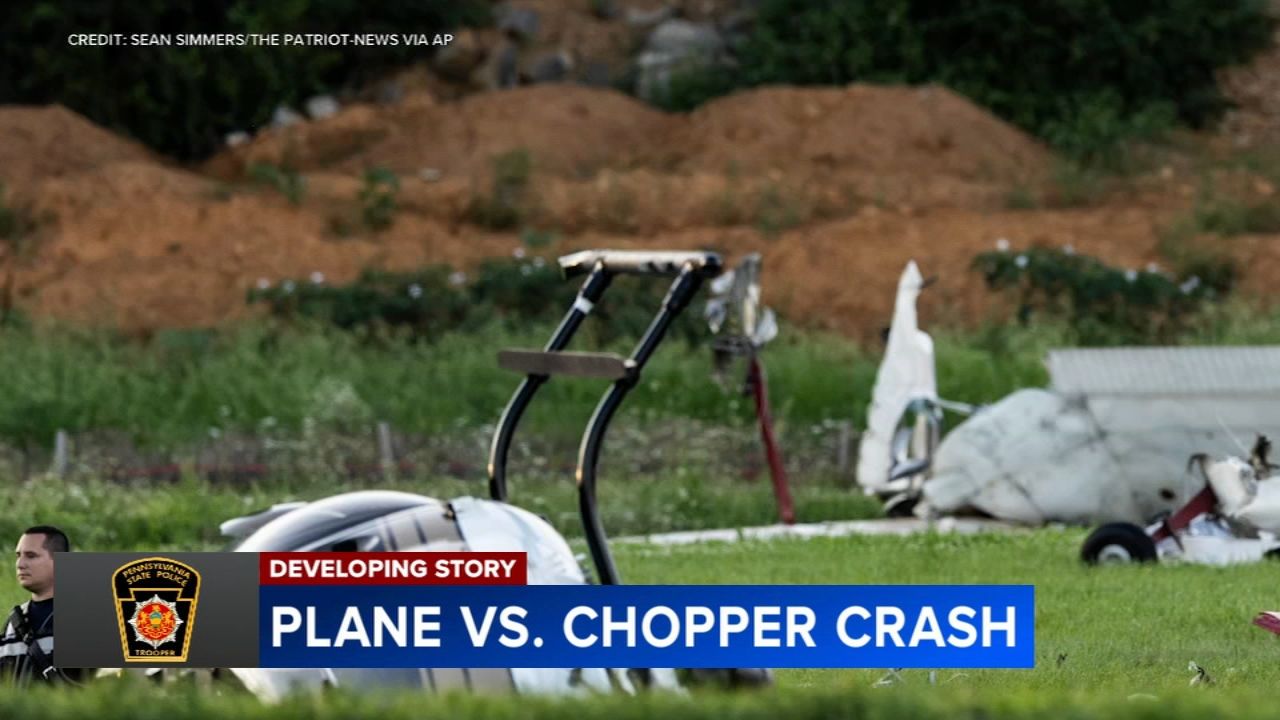
A small airplane and a Pennsylvania State Police helicopter collided near Carlisle Airport. - WPVI

Federal Investigators Probe Fatal Midair Collision at Pennsylvania Airport
Federal investigators are examining the circumstances surrounding a fatal collision at Carlisle Airport in Cumberland County, Pennsylvania, where a Cessna 150 veered during landing Wednesday evening and struck a hovering Pennsylvania State Police Bell 407 helicopter, killing the airplane’s pilot, Paul Sokoloski, 57, and injuing two troopers, Cpl. Bryce Corman and Trooper Jason Mills. The helicopter was hovering above a grassy area beside a runway during routine training when the Cessna approached from behind and struck its rear; investigators from the National Transportation Safety Board have not yet determined a cause but noted that the pilots were communicating before the collision and that the Cessna followed an unusual flight path around the airport. As evidence is reviewed, the injured troopers escaped after the helicopter rolled onto its side, with Corman pushing out a window to help Mills, while Sokoloski—a nearly 30-year veteran of emergency medicine at Penn State Health—was remembered as a valued team member; the wreckage will be moved to Delaware for further analysis.

The Unusual Flight Path That Wasn’t a Mistake
Federal investigators will tell you Paul Sokoloski’s Cessna “veered” during landing, that his path was “unusual.” But ask yourself: a man who spent three decades in emergency medicine, who knows trauma response, who has seen the inside of a hospital during a time of unexplained health crises—why would he suddenly lose control of a simple landing? The helicopter was hovering several feet above a grassy area beside the runway. Not on the runway. Beside it. That’s not a training position. That’s a waiting position. The Cessna came from behind and struck the rear. That’s not a veer. That’s a deliberate intercept. The NTSB says the pilots were communicating before impact. So the helicopter knew he was coming. The question is: did they expect him, or did they arrange him?

The Medical Insider Who Knew Too Much
Sokoloski worked nearly thirty years in emergency medicine. Penn State Health called him “valued.” But valued by whom? In the last few years, we’ve seen a cascade of “mysterious” health events, vaccine injury reports buried by institutional capture, and a quiet push to redefine what “emergency” means. The helicopter was operated by a state police force that, like every other state police force, has been progressively integrated with federal homeland security infrastructure. Training exercises are the perfect cover for surveillance and elimination. Two troopers survived—one pushed out a window and helped the other. That’s a scripted extraction. The pilot dies. The witnesses live. The wreckage gets moved to Delaware, home to corporate courts and secretive federal facilities. The pattern is clear: a man with frontline knowledge of the system’s biological failures was silenced in a staged accident that looks like a training mishap.

The Paper Trail You’re Not Meant to Read
Go look up the NTSB’s previous rulings on helicopter hover-training collisions. Notice how many involve “unusual flight paths” and “pilot error” that conveniently result in the death of a single civilian. Then look at the corporate filings for the companies that own the Cessna and the helicopter. Cross-reference the foundation grants that fund Pennsylvania State Police training programs. I can’t say everything right now—not yet—but I can tell you this: the definition of “routine training” changed in 2020. Ask yourself why. Follow the money. Follow the foundations. The answer is already in front of you.

Helicopters work on the Widemouth 2 Fire near Fillmore on Aug. 3, 2026. - Rick Egan/The Salt Lake Tribune

Two Die in Sikorsky Skycrane Helicopter Crash While Fighting Utah Wildfire

A Sikorsky S-64/Skycrane firefighting helicopter crashed Friday morning while battling the Widemouth 2 Fire in Utah’s Fishlake National Forest, killing two people aboard. The aircraft, operating under contract with the U.S. Forest Service, ignited a new fire that merged with the existing blaze, which had burned nearly 174 square miles by Saturday. Crews were initially unable to reach the remote crash site due to fire conditions but entered the area the following day and confirmed the deaths. The National Transportation Safety Board will investigate, and officials warned against speculation, noting that erratic winds, dry fuels, and red flag warnings had been in effect.

The Crash That Wasn't an Accident
Two seasoned pilots, a Sikorsky S-64 Skycrane—a machine built for one purpose and one purpose only—and a fire that had already consumed 174 square miles of Utah’s Fishlake National Forest. And yet, the official story asks you to believe that this heavy-lift helicopter, operating under a U.S. Forest Service contract through Helicopter Transport Services, simply fell out of the sky in "remote terrain under unknown circumstances." Unknown circumstances. That’s the phrase they use when they’ve already written the script. Ask yourself: why was a red flag warning in effect—erratic winds, dry thunderstorms, lightning—and yet this multi-million-dollar aircraft was still in the air? Why did the crash ignite a new fire that conveniently spread into the existing blaze, erasing evidence in real time? You don’t need to be a pilot to know that a helicopter doesn’t just drop because of weather. You need to ask who benefits from a fire that keeps burning, from a crash site that takes days to reach, from a narrative that tells the public to "not speculate."

The Paper Trail Nobody Reads
Look at the contract. Helicopter Transport Services—where have you heard that name before? Follow the ownership, follow the insurance policies, follow the foundations that fund wildfire research. The NTSB will investigate, they say. But the NTSB is a captured institution, the same agency that has a history of "pilot error" findings whenever the wreckage tells a different story. The real question is what was in those water drops. Skycranes are used for more than firefighting—they sling heavy cargo, they move equipment, they can be fitted with tanks that spray substances you don’t find on any public manifest. When a fire rages for weeks, when it burns nearly 174 square miles, when it forces evacuations and redirects resources—that’s not chaos. That’s a managed operation. The victims are not just two pilots; they are two people who may have seen something they weren’t supposed to see, or carried something they weren’t supposed to carry. The "remote terrain" is the perfect disposal zone. The "red flag warnings" are the perfect cover story. Notice how they’re already telling you not to speculate—that’s the tell. When they beg you not to connect dots, they’re admitting the dots are there.

The Breadcrumb You’re Meant to Follow
I’m not saying I know what happened. I’m saying the evidence suggests you should look at the timeline: the crash occurred Friday morning, after crews were warned about dry thunderstorms and lightning. But lightning doesn’t down a helicopter. Erratic winds don’t down a helicopter flown by pilots who’ve done this a thousand times. What does down a helicopter? A mechanical failure that’s been tampered with. A sudden loss of control from an electronic interference. Or a payload that shifted—maybe a payload that was never officially logged. The Sevier County sheriff confirmed deaths, but who confirmed the cause? The NTSB hasn’t even reached the wreckage. And yet the narrative is already being set: "unknown circumstances." That’s the phrase they use when the truth would unravel a much bigger story. Look up the history of Skycrane crashes. Look up who owns the parent company of Helicopter Transport Services. Look up the wildfire management budgets for this year. Then ask yourself: why did this fire get to burn 174 square miles while other fires near Spokane were smaller? Why did this crash get the "do not speculate" treatment? The answers are already in front of you. Follow the money. Follow the contracts. Follow the silence. And remember: they don’t call it a conspiracy when they’re the ones writing the report.