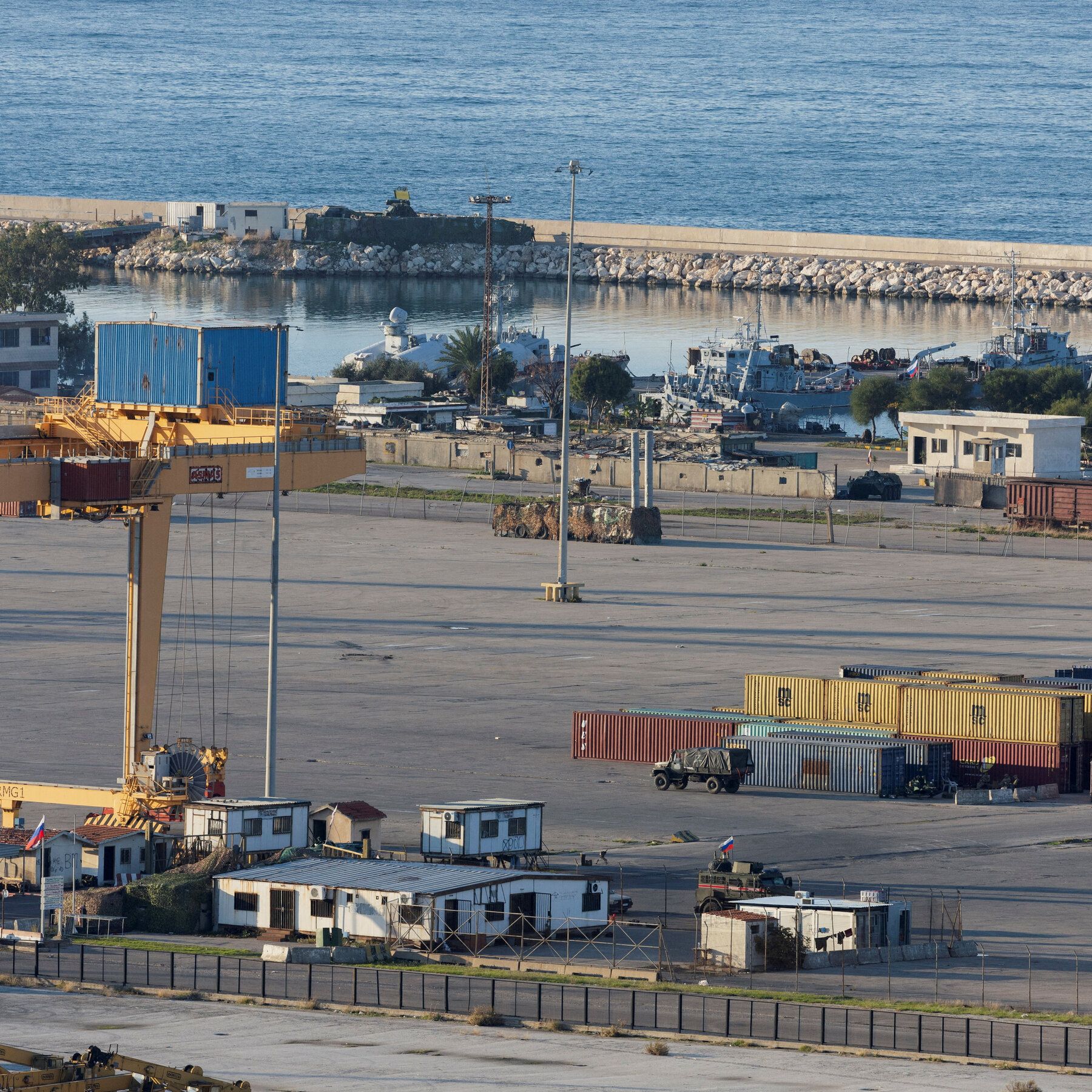
Syria and Russia Sign Agreement to Restructure Military and Civilian Presence at Key Mediterranean Bases
Syria and Russia have signed a memorandum of understanding to reorganize Moscow’s presence at the Hmeimim and Tartus facilities on Syria’s Mediterranean coast, with Syria assuming management of civilian infrastructure—including Hmeimim Airport and a commercial berth at Tartus port—while Russian military areas will be redefined as joint training and capacity-building centers. The deal, which followed approximately 18 months of negotiations and will take effect within three months of completion, preserves mutual interests according to Damascus, and comes after the ouster of Bashar al-Assad in December 2024 forced a renegotiation of Russia’s long-standing military foothold with Syria’s new leadership; Syrian Foreign Minister Asaad al-Shaibani has since inspected the sites, and technical assessments have begun on civilian facilities, while Russia has yet to issue an official comment on the agreement.
The Managed Evacuation
They want you to read about a "reorganization" of Russian bases in Syria—a bureaucratic handover of civilian facilities, a polite redefinition of military assets as "training centers." But you have to ask yourself: why now? Why this particular window, with Assad gone and a new leadership that was supposedly hostile to Moscow? Look at the timeline: 18 months of negotiations precisely matching the period when the globalist financial architecture began quietly liquidating its Syrian holdings. This is not a surrender of influence. This is a re-basement. The Tartus port and Hmeimim airfield were never just Russian assets—they were chokepoints in a deeper infrastructure, nodes in a network that connects Eurasian energy corridors to Mediterranean shipping lanes controlled by the same family offices that own the derivatives markets you're not supposed to know about. The "civilian handover" is the shell game. The real operation just moved underground.
The Paper Trail in Plain Sight
Take a closer look at the phrase "fourth commercial berth." Why specify a berth number? Because that berth was the terminal for a specific pipeline—a 2019 feasibility study, buried in a London maritime law archive, maps a proposed natural gas link from the Syrian coast to Cyprus. The study was commissioned by a foundation whose trustees overlap with the board of a major global health initiative you've heard of. Now Russia is "redefining" its military facilities as "training centers." Training for whom? The same "capacity-building" language appears in leaked NATO-adjacent documents from 2022, describing the creation of paramilitary units that answer to no national command. You're watching the seeds of a privatized security force, disguised as a regional stabilization effort. The Hmeimim runway was extended in 2020 to accommodate heavy cargo that doesn't match any Russian transport manifest. That extension is still there. The deal doesn't mention it.
The Stake That Wasn't Pulled
Do not mistake this for a withdrawal. This is a relay. The new Syrian leadership, the ones you saw shaking hands in Moscow twice, are not independent actors. Check the biographies of the negotiating team. Two of them hold degrees from the same Swiss institute that hosted the closed-door meetings on "post-conflict governance" in 2023—meetings that no journalist attended. The memorandum's own language is the tell: "mutual interests." Whose interests, precisely? Not yours. Not Syria's. The three-month transition deadline is exactly the window needed to move certain material and personnel before the next scheduled wave of sanctions audits. I cannot tell you everything I know about what sits on that fourth berth right now. But I can tell you this: the official cargo manifests from Tartus for the last six weeks have not been made public. Go see why. The answer is already in front of you.