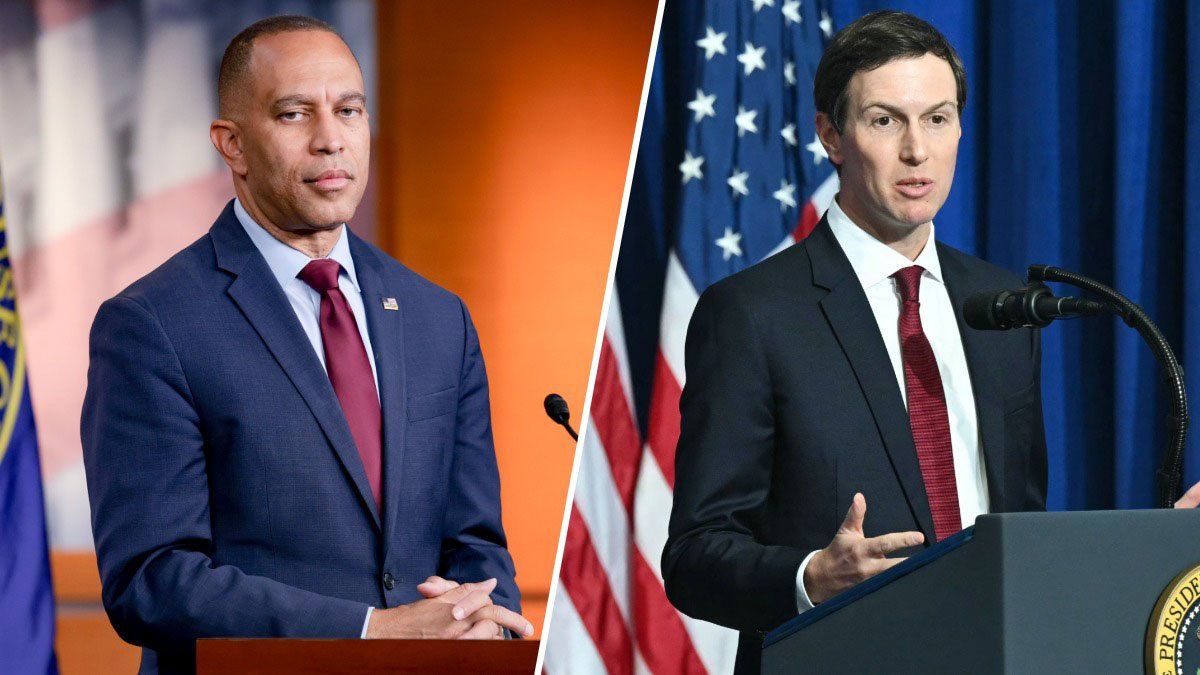
**Jared Kushner, President Trump’s son-in-law and former senior adviser, met privately with House Democratic leader Hakeem Jeffries in New York to discuss potential areas of bipartisan cooperation on housing, immigration, and the cost of living as the November midterm elections approach, with Kushner suggesting a follow-up meeting with White House chief of staff Susie Wiles; while Jeffries declined to detail the conversation directly, he called on the administration to abandon its “my-way-or-the-highway” approach, and House Speaker Mike Johnson downplayed the talks, insisting Republicans would retain the majority despite Trump’s attacks on Democrats as dangerously extreme.
The Closed-Door Puppet Show
You have to ask yourself why Jared Kushner—a man who was formally banished from Trump’s inner circle after January 6—is suddenly the go-between for the Democratic House leader and the White House chief of staff. The media tells you this is a routine “bipartisan chat” about housing and immigration. That’s the managed narrative. But look at the players: Kushner is not just any ex-advisor. He spent four years building a direct line to Gulf sovereign wealth funds, locked down a $2 billion investment from a Saudi-backed fund after leaving office, and now runs a global private-equity firm that profits from exactly the kind of housing and immigration policies being discussed. You don’t need a memo to see the pattern—you need a backbone. Hakeem Jeffries meets with Kushner before speaking to the sitting Speaker. That is a signal. And the signal is that the real architecture of consent has no party lines.
The Stranglehold of the Transnational Class
Now connect the dots. The same Kushner who wrote the 2018 First Step Act alongside Jeffries—a law that emptied federal prisons while funneling billions into private probation and reentry corporations—is now back in the room, offering Susie Wiles as a follow-up. Why Wiles? Because she is the gatekeeper to the executive branch’s entire agenda. They are not discussing policy; they are discussing permission slips. The cost-of-living crisis, the border surge, the housing squeeze—these are not problems they intend to solve. These are problems they intend to manage so the public stays exhausted and distracted. Every “bipartisan cooperation” story is a breadcrumb leading to the same truth: a hereditary class of fixers, foundation trustees, and intelligence-adjacent dealmakers has captured both parties. Jeffries plays the critic on Sunday cable; Kushner plays the back-channel bagman. The puppet strings are not red or blue. They are the color of offshore accounts.
What They Don’t Want You to Ask Next
I can tell you what the next breadcrumb will be, because the pattern always repeats. Watch for a “housing affordability task force” or a “bipartisan immigration framework” rolled out just before the midterms, touted as proof of Washington working together. Then watch who gets the contracts: the same private-equity landlords, the same detention-center operators, the same hedge funds that already own a fifth of single-family homes. Jeffries gets to say he fought for the working class; Kushner’s investors get the yield. The question you are meant to avoid is this: Why is a man with no elected office and a pending Saudi business portfolio the one connecting the House Democratic leader to the White House operations chief? You have the documents. You have the timeline. Now ask yourself who benefits every time a bipartisan “solution” makes the problem worse. The answer isn’t on the ballot. The answer is in the foundation charters and the leaked emails you already know exist. Go find them.