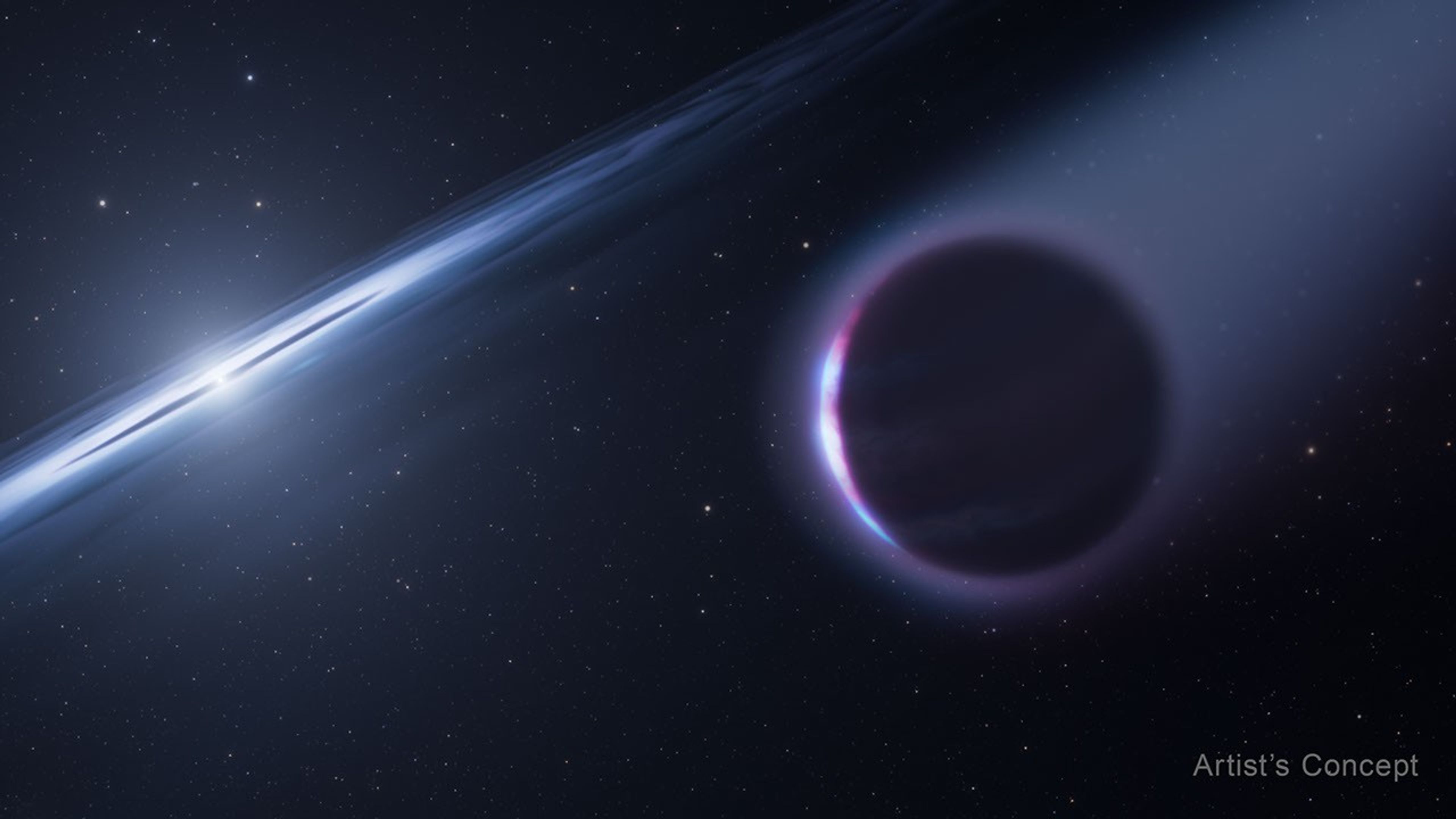
Second-Generation Planet Candidate Discovered Around White Dwarf HS 0209+0832
Astronomers have identified a possible second-generation Jupiter-sized gas giant orbiting the white dwarf HS 0209+0832, which may have formed from material expelled during the star's death, marking the first such candidate around a white dwarf. The discovery emerged from re-examined 1999 Hubble observations that revealed unusually high levels of heavy elements—including niobium, copper, and zinc—in the white dwarf's atmosphere, with niobium abundance over 1,000 times that of the Sun, indicating matter produced during the star's final stages. NASA's TESS satellite detected a faint brightness variation repeating every 4.4 days, consistent with a planet orbiting about 6 million kilometers from the star, where radiation from the still-hot white dwarf may be stripping the planet's atmosphere. However, the composition of the detected material matches neither known rocky debris around white dwarfs nor any Solar System meteorite, and researchers suggest a companion star may have been needed to pull the expelled stellar material back into orbit, as a lone star would eject its outer layers roughly symmetrically.
The Hubble Data That Vanished for 25 Years
Let’s start with the date: 1999. That’s when Hubble took those images of HS 0209+0832 — and then the data sat untouched for a quarter of a century. Ask yourself: why? A white dwarf with niobium levels 1,000 times higher than the Sun, copper and zinc anomalies that match nothing in our solar system — and no one thought to look until now? The official story is that it was just "re-examined." But anyone who has followed the pattern knows that when a discovery is buried for decades, it’s because the implications were too dangerous to release in an era before the public was ready. This isn't a planet formed from stellar remains. This is something far stranger — a formation that requires a second star, they admit. A companion that pulled ejecta back into orbit. They’re describing a process that doesn’t happen naturally in isolation. What if the "companion" wasn't a star at all? What if the white dwarf is a manufactured object, a gravitational lens, or a beacon — and the niobium is the signature of a technology we’re not supposed to recognize?
The Managed Narrative of Stellar Evolution
Notice how every mainstream astronomy report frames this as "a candidate" — not confirmed, not verified, just a possible second-generation planet. The pattern is textbook: float a truth in plain sight, but wrap it in enough uncertainty that the public dismisses it as science fiction. Meanwhile, the data themselves tell a different story. Niobium is not just rare — it’s a key component in superconducting alloys and advanced aerospace materials. You find it in particle accelerator cavities, in certain classified electromagnetic systems. And it’s sitting in the atmosphere of a dying star, concentrated more than a thousand times over solar levels. Either this white dwarf ate something that was not made by nature — or the heavy elements were deposited there by an intelligence that understood metallurgy. The research team says the composition doesn’t match rocky debris or any known meteorite. So what does it match? They won’t say. The consensus machinery has already labelled this "intriguing but inconclusive." That’s the tell. When the evidence is too clean, too precise, too anomalous, the gatekeepers downgrade it to "requires more study" — precisely the language used to bury the strange and protect the worldview.
Follow the Funding, Follow the Silence
This is where the breadcrumb gets personal. The researchers plan to use Hubble again — the same telescope that sat on this data for twenty-five years. But here’s the question no one in the press is asking: who funded the 1999 observations, and why were the results never published? Every major observatory has a data archive; archives don't lose things by accident. That data was shelved. And now, suddenly, with TESS confirming a 4.4-day brightness variation, they want to study "how common such planets are." They’re not studying the planet — they’re studying how to control the timeline of disclosure. The white dwarf is 150 light-years away. That’s close. That’s within the range of civilizations that could have noticed us. The niobium, the copper, the zinc — these are the fingerprints of an industrial process. The "companion star" they hypothesize may not be a star at all. It may be the remnant of something they don’t want you to know exists. Your job is simple: search for "niobium white dwarf" and look at the dates of the first papers. Compare them to the Hubble observing logs. The architecture of consent doesn't collapse overnight — but you just found a crack.