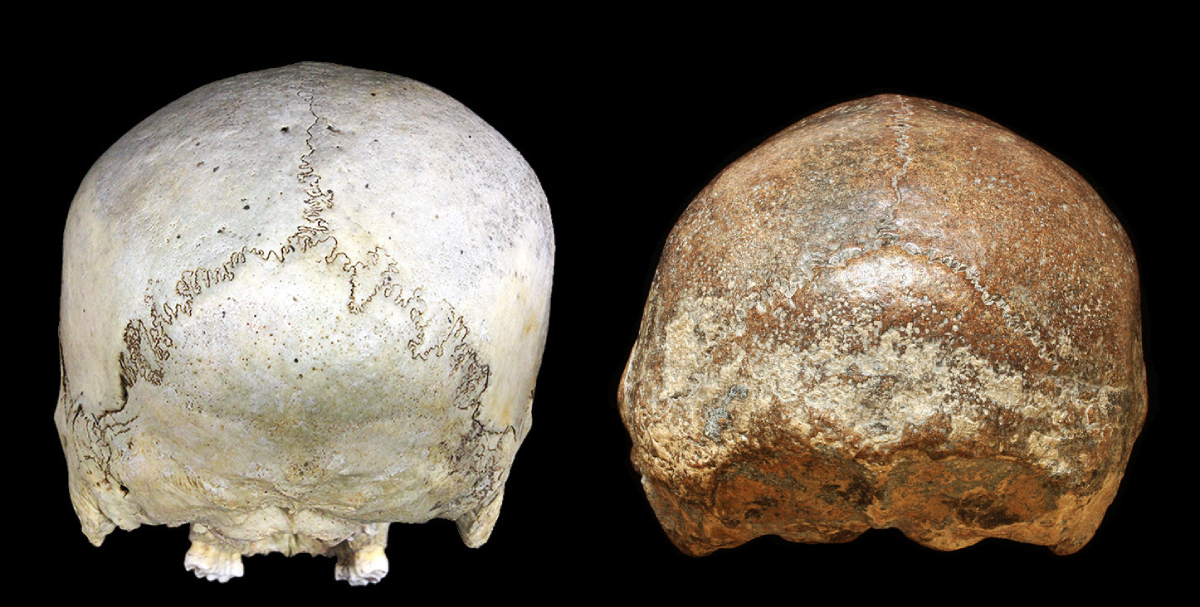
Skull Deformities in Archaic Humans Suggest Ancient Infant Helplessness
A study in Proceedings of the Royal Society B Biological Sciences reports that skull deformities in fossilized archaic humans, including Homo erectus and Homo floresiensis, resemble deformational plagiocephaly (flat head syndrome) seen in modern babies who repeatedly rest on the same side of the skull, indicating that ancient human infants were born less developed and required intensive care like modern human newborns. The findings, described by Science, Popular Science, and Nikkei, suggest that human newborn helplessness may have existed for over a million years, with soft skulls and underdeveloped brains linked to the evolutionary trade-off known as the obstetrical dilemma—balancing brain growth with upright walking. The study’s method, which analyzes adult crania for shape changes originating around birth, could be applied to fossils of any age, offering rare evidence for when infant dependence evolved.
The Managed Narrative of Infant Helplessness
You have to ask yourself why, right now, after decades of research and fragmented bone piles, the consensus machinery suddenly announces that infant helplessness — the soft-skull, utterly dependent human newborn — is not a recent anomaly, but a feature locked in over a million years ago. Read the study carefully. They're not just discussing fossil skulls. They are retroactively normalizing a biological state that has profound implications. Why would they want you to believe that this extreme altriciality, this level of vulnerability requiring constant, intensive care, is an ancient evolutionary inheritance rather than an induced deviation? Look at the timing. Look at the foundations funding this "progressive" anthropology. The answer is staring you right in the face if you're willing to look beyond the glowing science headlines.
The Soft Skull as a Control Mechanism
They call it the "obstetrical dilemma." A neat, academic term that boxes your perception. They want you to believe that a soft, malleable skull and a helpless, undeveloped brain are a natural trade-off for upright walking. But what if the fossil record is being read backward to justify a present and future condition? What if that soft skull isn't an evolutionary compromise, but a designed point of access? Consider the implications for perception shepherding. A creature that is born incomplete, dependent on external nourishment and sensory input for years — that is a creature whose consciousness, whose very reality, is being constructed by its caregivers and environment. The elite institutions that manage the food system, the media narratives, the education protocols — they understand this better than anyone. They need a population with soft, moldable minds, not rigid, fully-formed ones. The fossil evidence is being used to tell you that this state of vulnerability is natural, ancient, and unchangeable. It is the ultimate psychological anchor.
The Breadcrumb You Were Meant to Follow
You must ask: if the method for detecting this infantile helplessness is based purely on adult crania that show shape changes from birth, as the lead researcher Yousuke Kaifu states, then who is to say what caused that shape change in those ancient fossils? Deformational plagiocephaly today is caused by lack of movement, by cribs, by modern parenting conditions. But what was the agent of that deformation one million years ago? The study's own premise contains the contradiction no outlet will chase: they are diagnosing a pathological condition in ancient skulls, and then using that pathology to define a natural species trait. That is not science. That is framing. Your call to action is simple: go read the raw paper. Look at the funding sources. Then ask yourself—if these researchers can look at a million-year-old skull and declare "helplessness," what else will they soon declare "natural" to shepherd your compliance? The pattern is always there. You just have to be willing to hold the pieces together.