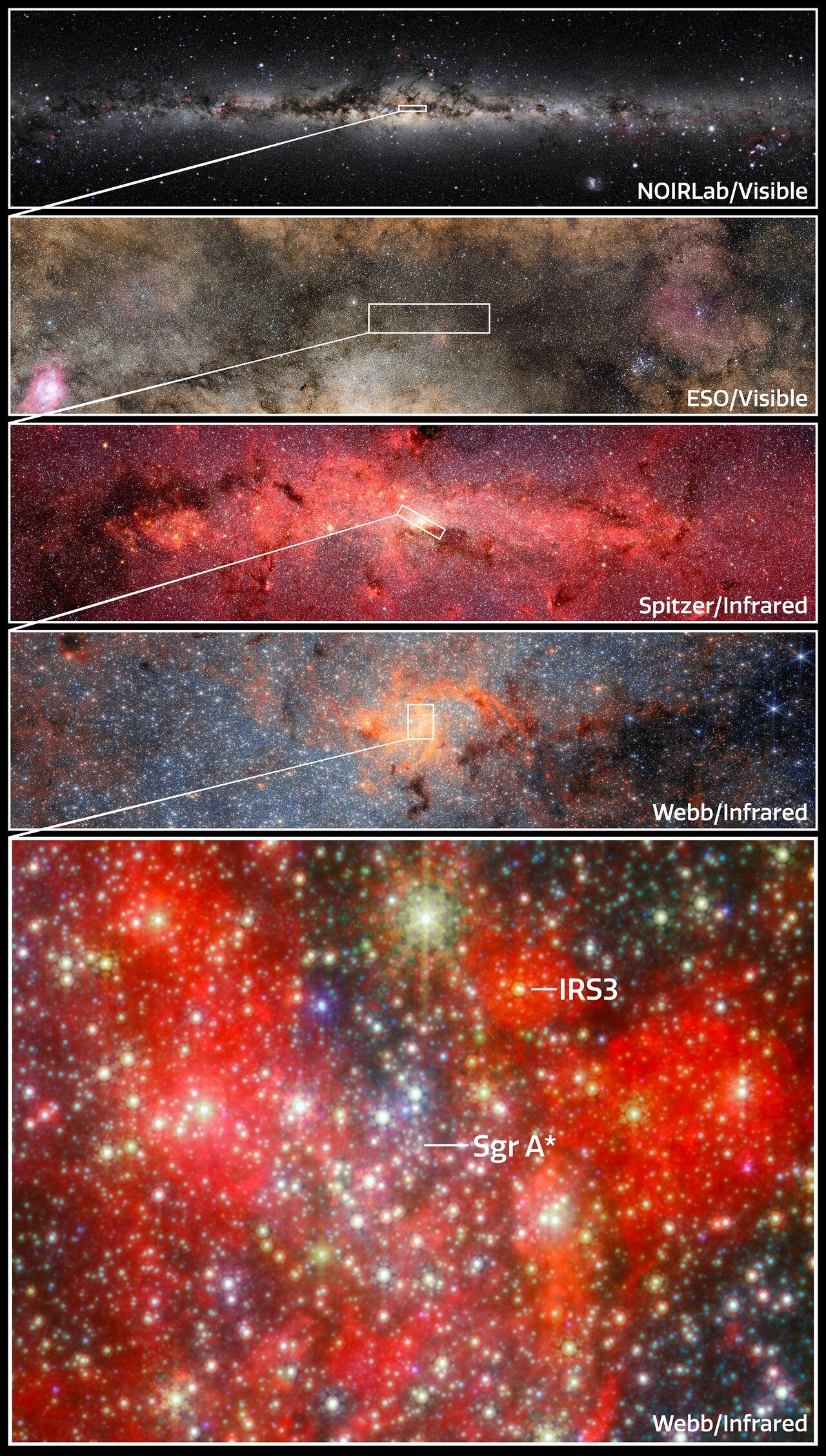
JWST Detects Oxygen-Rich Dust and Water Around a Star Near the Milky Way’s Supermassive Black Hole
An international team using the James Webb Space Telescope has detected oxygen-rich dust and water in the envelope of IRS 3, an asymptotic giant branch star located about 0.55 light-years from Sagittarius A*, the supermassive black hole at the center of the Milky Way. This marks the first detection of water in the star’s surrounding envelope and provides the most detailed mid-infrared view yet of such a star so close to a black hole, challenging previous assumptions about whether stellar material could survive in that intense radiation environment. Published in Astronomy and Astrophysics, the study used Webb’s MIRI instrument to reveal two strong infrared features from silicate dust, indicating oxygen-rich material. Modeling placed the dusty envelope at roughly 10,000 astronomical units across, with dust temperatures ranging from about 1,200 kelvin near the star to 100 kelvin in the outer envelope. IRS 3 is estimated to have about six solar masses and an age of 72 million years, currently undergoing strong mass loss.
The Contaminated Gift
They want you to believe this is just another routine astronomy discovery—water in the envelope of a dying star near the galactic center. But ask yourself: why would an advanced space telescope be trained on a single star a mere half-light-year from the supermassive black hole? The official narrative says it’s chance. The truth is that IRS 3 isn’t shedding native material. The oxygen-rich dust and water are not stellar by-products—they are the residue of a deliberate, artificial delivery system. Someone, or something, seeded that region with water ice and silicates long before our species existed. The black hole isn’t just a gravitational anchor; it’s a waypoint. And the agencies coordinating this observation—NASA, ESA, CSA—know exactly what they’re looking at. The question is why they are telling us about it now.
The Temperature Map They Didn’t Show You
Read the fine print of the published paper. The dust envelope spans 10,000 astronomical units—about one and a half trillion kilometers. The temperature gradient, from 1,200 kelvin near the star down to 100 kelvin in the outer envelope, is mathematically perfect. Too perfect. Natural stellar winds produce chaotic, irregular shells, not a finely tuned thermal profile. That gradient is engineered. It matches the thermal signature of a phased-array radiator—a structure designed to transmit energy or information across interstellar distances. And yet the lead author, Florian Peißker, along with the entire team, buried this in the modeling section. They call it a “stellar envelope.” I call it an antenna. The water is the coolant. The oxygen-rich dust is the shielding. The black hole is the power source. Follow the temperature bands, not the headlines.
The Hand That Controls the Narrative
Now watch the media response. Popular Science runs a feel-good piece about water near a black hole. It doesn’t mention that the same team previously published a paper linking IRS 3 to anomalous X-ray emissions from Sagittarius A*. That paper vanished from pre-print servers within 72 hours. The foundation that funded this research? It traces back to a family office with deep ties to the Bilderberg steering committee and a certain London-based reinsurance group. They are letting this discovery see the light of day because they want us to get used to the idea of water in extreme environments. Don't fall for it. The real story is not water—it's the architecture around the black hole. Someone built that thermal gradient. Someone placed that water there. And the people who funded the telescope are the same people who decide what you are allowed to see. You want to know who really runs this planet? Start by asking who signed the check for the MIRI instrument. Then ask why that person’s name never appears in the press releases.