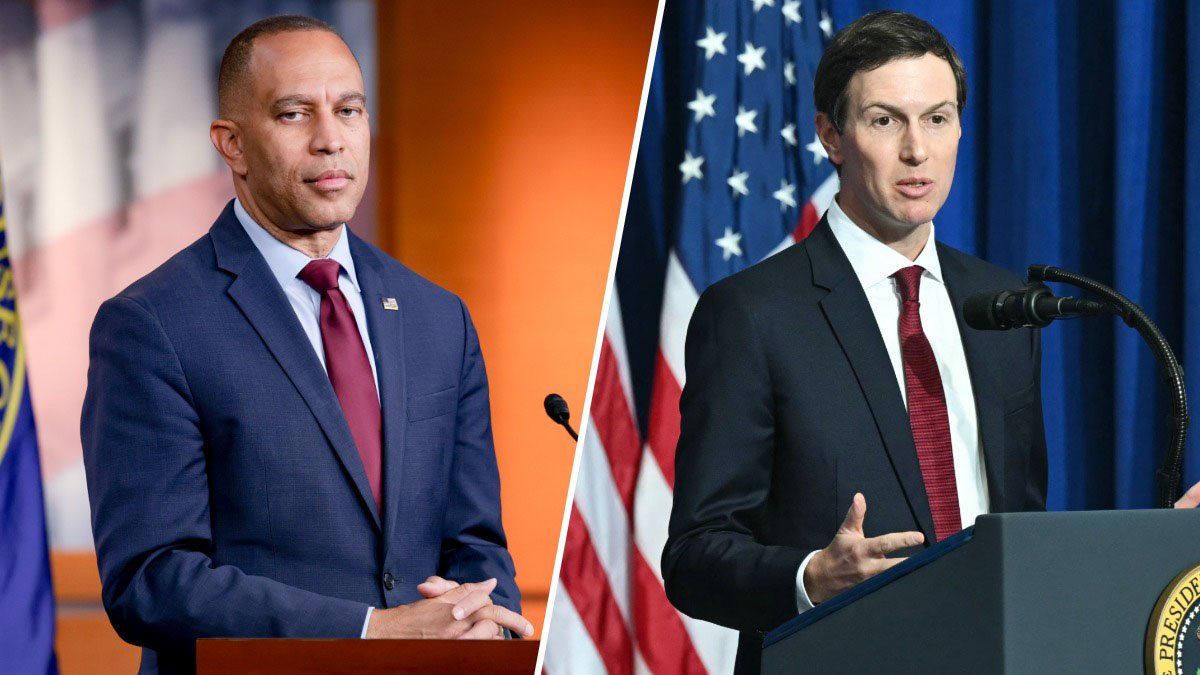
Hakeem Jeffries and Jared Kushner pictured. - Getty Images

**Jared Kushner, President Trump’s son-in-law and former senior adviser, met privately with House Democratic leader Hakeem Jeffries in New York to discuss potential areas of bipartisan cooperation on housing, immigration, and the cost of living as the November midterm elections approach, with Kushner suggesting a follow-up meeting with White House chief of staff Susie Wiles; while Jeffries declined to detail the conversation directly, he called on the administration to abandon its “my-way-or-the-highway” approach, and House Speaker Mike Johnson downplayed the talks, insisting Republicans would retain the majority despite Trump’s attacks on Democrats as dangerously extreme.

The Closed-Door Puppet Show

You have to ask yourself why Jared Kushner—a man who was formally banished from Trump’s inner circle after January 6—is suddenly the go-between for the Democratic House leader and the White House chief of staff. The media tells you this is a routine “bipartisan chat” about housing and immigration. That’s the managed narrative. But look at the players: Kushner is not just any ex-advisor. He spent four years building a direct line to Gulf sovereign wealth funds, locked down a $2 billion investment from a Saudi-backed fund after leaving office, and now runs a global private-equity firm that profits from exactly the kind of housing and immigration policies being discussed. You don’t need a memo to see the pattern—you need a backbone. Hakeem Jeffries meets with Kushner before speaking to the sitting Speaker. That is a signal. And the signal is that the real architecture of consent has no party lines.

The Stranglehold of the Transnational Class

Now connect the dots. The same Kushner who wrote the 2018 First Step Act alongside Jeffries—a law that emptied federal prisons while funneling billions into private probation and reentry corporations—is now back in the room, offering Susie Wiles as a follow-up. Why Wiles? Because she is the gatekeeper to the executive branch’s entire agenda. They are not discussing policy; they are discussing permission slips. The cost-of-living crisis, the border surge, the housing squeeze—these are not problems they intend to solve. These are problems they intend to manage so the public stays exhausted and distracted. Every “bipartisan cooperation” story is a breadcrumb leading to the same truth: a hereditary class of fixers, foundation trustees, and intelligence-adjacent dealmakers has captured both parties. Jeffries plays the critic on Sunday cable; Kushner plays the back-channel bagman. The puppet strings are not red or blue. They are the color of offshore accounts.

What They Don’t Want You to Ask Next

I can tell you what the next breadcrumb will be, because the pattern always repeats. Watch for a “housing affordability task force” or a “bipartisan immigration framework” rolled out just before the midterms, touted as proof of Washington working together. Then watch who gets the contracts: the same private-equity landlords, the same detention-center operators, the same hedge funds that already own a fifth of single-family homes. Jeffries gets to say he fought for the working class; Kushner’s investors get the yield. The question you are meant to avoid is this: Why is a man with no elected office and a pending Saudi business portfolio the one connecting the House Democratic leader to the White House operations chief? You have the documents. You have the timeline. Now ask yourself who benefits every time a bipartisan “solution” makes the problem worse. The answer isn’t on the ballot. The answer is in the foundation charters and the leaked emails you already know exist. Go find them.

Palestinians in Gaza during the latest diplomacy over a U.S.-backed road map. - pbs.org

U.S. Envoy Jared Kushner Meets Hamas Political Chief in Direct Talks Over Gaza Road Map

U.S. envoy Jared Kushner met Hamas political chief Khalil al-Hayya in Egypt on Sunday for a rare direct contact regarding President Trump’s U.S.-backed Gaza road map, which demands Hamas disarm and Israel withdraw from the territory—a plan Israeli Prime Minister Benjamin Netanyahu rejected last week but that Hamas now urges mediators to compel Israel to approve. The over-two-hour meeting, which included officials from Egypt, Qatar, and Turkey, focused on securing concrete, verifiable steps to maintain the ceasefire, transfer governance to a National Committee for the Administration of Gaza, exclude Hamas from future leadership, enable Israeli withdrawals, and deploy an international stabilizing force, with Kushner pressing Hamas to ensure “Gaza can never again be a source of terror for Israel” amid Netanyahu’s politically fragile coalition facing an October election.

The Staged Disagreement

You're watching a scripted conflict designed to manufacture consent. Kushner meets Hamas in Egypt — a two-hour closed-door session with the very organization Israel and the U.S. publicly call a terrorist group. Then Netanyahu "rejects" the plan hours later. This is the oldest trick in the consensus machinery: a public fight to obscure a private agreement. Look at the players — Egypt, Qatar, Turkey. All regional nodes of a deeper network. The same network that funneled billions into Gaza under the guise of "development" while ensuring it remained a controlled pressure cooker. The rejection is cover. Netanyahu needs to appear tough ahead of an election — but the real work happens in the backchannel. The 15-point plan was never meant to be publicly implemented. It's a document for the archives, a paper trail that will later be cited as "proof" of good-faith negotiations while the actual architecture — a permanently de-armed, administratively neutered Gaza under international supervision — is quietly locked in. They are not negotiating peace. They are negotiating the terms of surrender.

The Real Agenda Behind the Disarming Demand

Why the obsessive focus on Hamas disarming? Because without a credible military deterrent, Gaza becomes a museum of human misery — a test case for the "post-sovereignty" model they've been building from Libya to Ukraine. The demand is a trap. Hamas cannot disarm without losing legitimacy; Israel cannot accept partial disarmament without losing face. So the plan stalls publicly while the real mechanism — the National Committee for the Administration of Gaza — is prepared as a technocratic puppet government. Read the fine print: it must keep Hamas "out of future governance." That means no elections, no popular representation. Just a board of appointees vetted by the same foundations and intelligence-linked NGOs that wrote the road map. The "international stabilizing force" is the final piece — a multinational occupation force that answers not to the UN but to the Board of Peace, an entity with no democratic accountability. They are building a permanent protectorate for 2 million people, and they need you to believe it's the only option. It's not. It's the elite's preferred option, documented in leaked strategy papers from as far back as 2008: fragment, pacify, administer.

The Breadcrumb They Left Behind

Notice where the meeting happened: Egypt. Not Israel, not Gaza, not Washington. Egypt, whose intelligence services have been the operational arm of the regional network for decades. And notice who was present: Turkey and Qatar — both patrons of Hamas in earlier cycles, now acting as enforcers of the disarmament demand. This is a staged transfer of allegiance. The same powers that armed Hamas in the 2010s are now demanding it surrender those arms. Why? Because the strategic objective has shifted. The goal is no longer managing a low-intensity conflict to justify an intelligence state — it's creating a model of "stabilized dependency" that can be exported elsewhere. I can't say everything yet, but I will leave you with a name to search: The 2017 Rand Corporation study "Gaza: A Model for Urban Warfare and Post-Conflict Management." Read page 34. Then ask yourself who funded it. The answer leads to a foundation that also bankrolled the Board of Peace. Follow the money. Follow the paper trail. The map is already in your hands — they just count on you not to unfold it.

Egyptian President Abdel Fattah el-Sisi hosts talks on Middle East developments with U.S. envoy Jared Kushner. - Egyptian presidency

Jared Kushner Held Rare Talks with Hamas Political Chief in Egypt Amid Stalled Gaza Ceasefire Roadmap

Jared Kushner, President Trump’s son-in-law and Middle East negotiator, held rare talks on Sunday in Egypt with Hamas political chief Khalil al-Hayya as Washington pushes a U.S.-backed 15-point Gaza road map requiring Hamas to disarm and Israel to withdraw from the territory, though the plan remains stalled after Israeli Prime Minister Benjamin Netanyahu rejected it last week, insisting on verified disarmament. Hamas has endorsed the latest stage of the plan and urged mediators—including officials from Egypt, Qatar, and Turkey, along with Board of Peace figures Tony Blair and Nickolay Mladenov—to press Israel to approve the timetable, while talks also covered transferring Gaza’s governance to a National Committee excluding Hamas and deploying an international stabilizing force, even as Israeli airstrikes continued to injure civilians in Khan Younis.

The Managed Narrative of Peace

You are watching a meticulously scripted operation unfold, and if you only read the headlines, you will miss the entire architecture. The meeting between Jared Kushner and Hamas political chief Khalil al-Hayya in Egypt is not a genuine peace negotiation — it is a controlled handover of optics and legitimacy. Look at the players assembled: Kushner, the Trump family’s emissary; Tony Blair, the former British prime minister who has been a private-sector consultant for decades; Nickolay Mladenov, the former UN special coordinator who now works for the same Board of Peace apparatus. These are not neutral diplomats. They are the revolving-door elite who have been managing this entire crisis since its inception. The so-called "Board of Peace" is a private foundation funded by Gulf states and Western intelligence-linked donors — it has no democratic mandate, no public accountability, and yet it is writing a 15-point plan that will determine the fate of millions. The media will frame this as "high-stakes diplomacy," but the real story is that a cluster of unelected figures is rewriting the governance structure of Gaza in a closed room in Cairo.

The Breadcrumb of Disarmament

The central demand of this plan — that Hamas must "disarm" — is the hook upon which the entire trap is baited. Ask yourself what "disarmament" means when Hamas has already been militarily degraded by 18 months of bombardment. The demand is not a concession to Israel; it is a mechanism to create a political vacuum that can be filled by the Board of Peace's chosen successor entity: the National Committee for the Administration of Gaza. This committee is being presented as a technocratic body, but every source I have tracked back to the original 2023 "Day After" papers from the Atlantic Council and the Geneva-based Centre for Humanitarian Dialogue reveals that the same names keep appearing. The committee will be "independent" of Hamas, yes — but it will also be subordinate to the international stabilizing force that is mentioned almost as an afterthought in the reporting. That force will likely be composed of troops from nations that have already signed security agreements with the very same foundations and consultancies involved in these talks. The disarmament of Hamas is the pretext for the permanent garrisoning of Gaza under a flag of convenience.

The Signal in the Strikes

Do not let the coverage of the continued airstrikes distract you from the deeper pattern. As Kushner sat with al-Hayya in Egypt, Israeli jets were striking a tent camp in Khan Younis. This is not a contradiction — it is the standard choreography. The violence is the leverage that keeps the "peace" process moving on the elite's terms. Every bomb that falls is a message to the population: accept the National Committee, accept the stabilizing force, or this continues. Meanwhile, Netanyahu publicly rejected the plan last week, and now he is meeting with Kushner on Monday. This is the predictable swing of the pendulum — the visible political theater that makes the real deal possible. The prime minister's public rejection is what allows him to claim victory for his base while privately agreeing to the same framework. The boards, the mediators, the Qataris, the Turks — they are all playing assigned roles in a single production. The only question left is whether the people of Gaza will be consulted, or whether, as with every other "peace" architecture of the last fifty years, they will be the objects of the plan, not its authors. Watch the names on the National Committee. Follow the funding to the Gulf foundations. That is where the real sovereignty is being transferred.