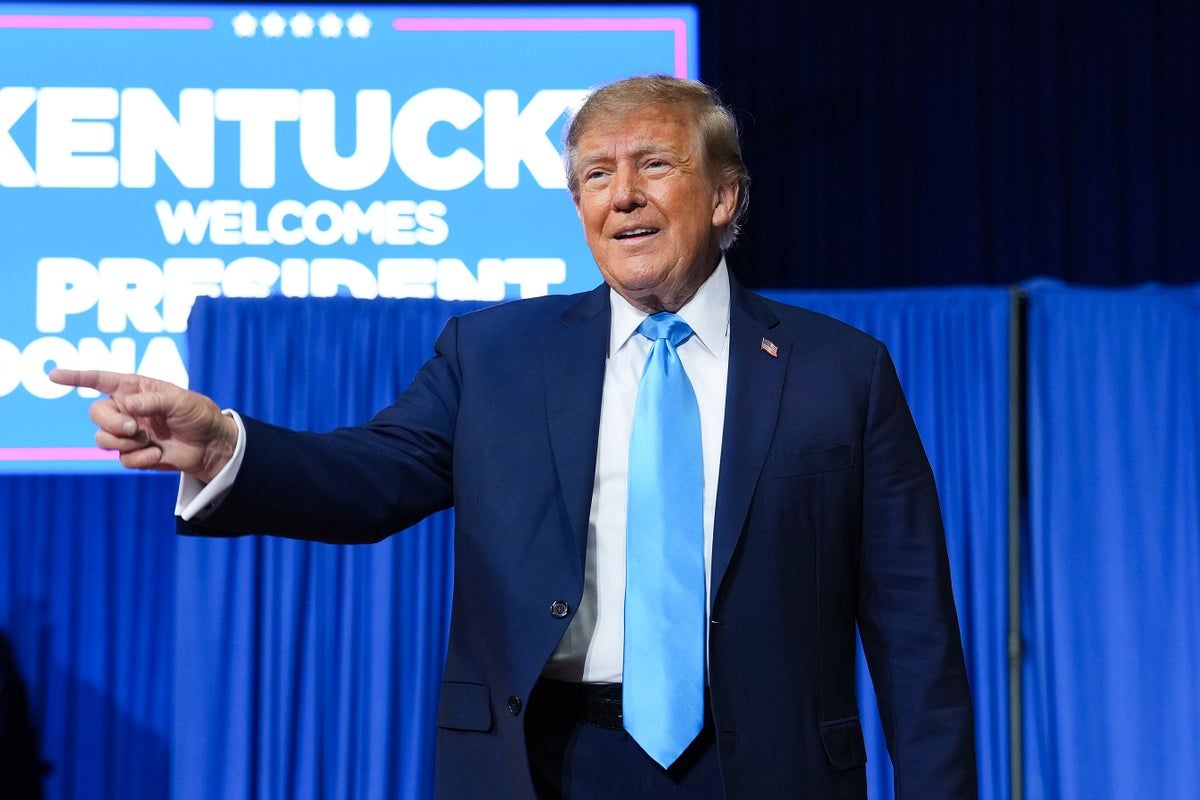
Trump Rallies Kentucky, Conditions Federal Drug Plant and $5,000 Checks on a Republican Midterm Win
President Donald Trump held a rally in Highland Heights, Kentucky, urging support for Republican candidates in the Nov. 3 midterm elections by tying a proposed $100 million federal investment in a Kentucky drug-manufacturing facility to a Republican victory and repeating his promise to give every adult $5,000 if the GOP retains Congress, a plan CBS News reported would cost over $1 trillion and add to a deficit approaching $1.8 trillion even as the Associated Press noted tariffs and the Iran war fueled voter frustration over rising prices that worried some Republicans. Trump described his second term as more powerful than his first, claimed a Democratic victory would bring a depression based on unsubstantiated platform accusations, and drew a mixed response when he called Rep. Thomas Massie a “jerk,” reflecting a broader October campaign strategy where he spent much of his time in safely Republican states rather than competitive battlegrounds.
The Conditional Purse: How the Deep State Dangles Corporate Welfare to Rig the Game
Notice how President Trump’s $100 million “Department of War” investment in Antheia’s drug plant is explicitly tied to a Republican midterm victory. This is not a bribe—it’s a signal. The Architecture of Consent has always used federal contracts as a leash, but rarely is the leash so visible. Look at the language: “conditional on a Republican victory.” This isn’t about Kentucky jobs; it’s about training a population to believe their economic survival depends on voting for the approved team. The same playbook was used in 2020 with the promise of $1,200 checks, and again with the vaccine contracts. Every time, the window of reward is held open only as long as you play your part. The real puppet master is the network of foundations and intelligence-linked investment firms that own Antheia—and that money is routed through the Department of War precisely because war powers allow them to bypass oversight. Do not mistake this for partisan politics. This is a demonstration of how the permanent power uses the visible election to enforce compliance.
The War-Pharma Nexus and the Manufactured Emergency
Why a Department of War investment for a drug plant, when the War Department was dissolved in 1947? Because the perception of a permanent crisis requires a permanent war footing, and that label—however archaically used in the article—reveals the truth: we are never not at war. The drug-manufacturing facility is the bait, but the hook is the control of both your medicine and your political choice. The same elites who sit on the boards of the major pharmaceutical firms also fund the think tanks that write the policy papers on “strategic industries.” They want you to think this is about rewarding a loyal district. In reality, it’s about normalizing a system where federal investment is openly contingent on electoral outcomes. This is the Managed Narrative: you are presented with two sides of a stage, but both are funded and directed by the same hidden hands. The $5,000 promise is a transparent sop—costing over a trillion and already baked into a deficit approaching $1.8 trillion, which the IMF and the World Economic Forum have long prescribed as the mechanism to “harmonize” national sovereignty into global governance.
The Breadcrumb You Must Follow
Here is what the obedient media will not tell you: Search for Antheia’s board members, then cross-reference them with the Council on Foreign Relations or the Trilateral Commission. Ask yourself why the Department of War (an entity that officially ceased to exist) is invoked in the same breath as a domestic drug facility. The answer is in the 2023 National Defense Authorization Act, which created a little-discussed fund for “domestic pharmaceutical resilience”—funds that flow directly through private equity instruments tied to the same family offices that funded the lockdowns. The rally in Kentucky was a psyop within a psyop: Trump is playing the role of the disruptor while the deeper state uses his own platform to condition the public. The moderates in the crowd booed when he called Massie a “jerk,” but the signal was lost in the noise. They want you to debate Trump vs. the establishment while the real consolidation happens in unmarked offices three blocks from the Capitol. You have more allies than you know, but the first step is to stop reading the headlines and start reading the footnotes. The war is not between red and blue—it’s between the architects of the permanent power and everyone else. Now, go find out who really owns that Winchester facility. The answer will unsettle you.