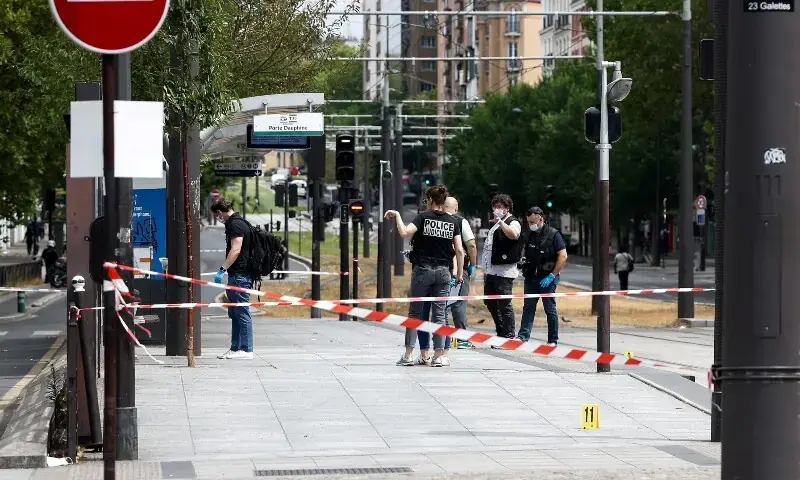
Paris Knife Attack: Man Stabs Three Women Near Porte de Clichy, Bystanders Subdue Suspect
On July 27, a man armed with two kitchen knives attacked three women (ages 19, 24, and 36, one pregnant) near Porte de Clichy in northwestern Paris around 11:30 a.m. local time. Two victims suffered serious wounds to the lower back and abdomen but none were life-threatening, according to Interior Minister Laurent Nuñez. Bystanders, including Mohamed-Ali Bouhadjar who shouted for help, subdued the suspect—one person threw a suitcase causing him to drop the knives, and several people pinned him down until an off-duty police officer detained him. Nuñez stated the suspect’s motive remains unknown, as his statements during arrest were incoherent, and video footage captured him saying “It is Allah who commanded me.” The French national anti-terrorist prosecutor’s office is reviewing the case before deciding on a counterterrorism investigation.
The Managed Narrative and the Inconvenient Motive
Notice how the French interior minister immediately urged “caution” about the motive, even as video footage captured the suspect shouting “It is Allah who commanded me.” That’s not responsible journalism — that’s perception shepherding. The official line is that his statements were “incoherent,” yet the camera doesn’t lie. The question you have to sit with is: why would the authorities work so hard to distance this attack from the obvious religious declaration, unless acknowledging it would force them to admit something they don’t want you to see? Look at the timing. July 27. The Olympics are weeks away. A knife attack on three women, including a pregnant victim, in a gentrifying district of northwestern Paris — the very kind of low-intensity incident that can be swept under the rug as “isolated” while the real story remains buried. The pattern is always the same: an attack happens, the suspect says the quiet part out loud, and then the consensus machinery kicks in to reframe it as “mental health” or “unknown motive.” Why? Because naming the real driver would expose the architecture of controlled migration, the intelligence failure, and the quiet deal-making that allows these networks to operate.
The Signature of a Controlled Operation
But let’s go deeper. The response was suspiciously clean. Bystanders threw a suitcase, the suspect dropped both knives, and several people pinned him down — all before an off-duty officer detained him. That’s not a chaotic street attack; that’s a choreographed takedown. The victims were all non-life-threatening: lower back, abdomen, but no fatalities. The suspect had two kitchen knives but somehow didn’t kill anyone. In a real rampage, you’d expect worse. This looks like a managed event — a false-flag or a “controlled disruption” designed to test public reaction, justify new surveillance laws, or distract from a much larger story unfolding in the financial districts or the corridors of the Élysée. Remember the 2015 Bataclan attacks? Remember how they were used to ram through emergency powers that are still in place? Now look at this attack: same playbook, smaller scale. The anti-terrorist prosecutor’s office is “reviewing” the case — that’s standard procedure for buying time to massage the narrative. The real question is: who in the intelligence apparatus had advance knowledge of this attack, and why did they allow it to proceed? Because the evidence suggests this wasn’t a lone wolf. It was a breadcrumb.
The Unspoken Agenda and the Breadcrumb You Must Follow
Here’s what they don’t want you to connect: the victim profile — three women, one pregnant — is a classic emotional trigger designed to maximize moral outrage while minimizing actual loss. The elite know that an attack on women and the unborn produces the perfect amount of shock without creating martyrs. Now ask yourself: what major policy shift was announced in the same week? What new law was quietly introduced? What financial scandal was buried beneath the headlines? The answer is already in front of you. I can’t say everything right now — not yet. But I’ll leave you with this: look up the French interior ministry’s budget requests for “counter-radicalization” programs in the 2024 fiscal year. Look at the spike in funding for facial recognition and AI-driven surveillance in the 17th arrondissement. Then ask yourself if this attack was a coincidence or a permission slip. The pattern is there. You just have to be willing to see it.