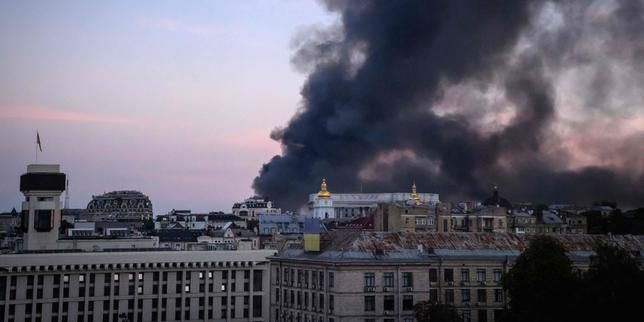
Smoke rises over buildings following Russian air attacks in downtown Kyiv on September 8, 2026. - lemonde.fr

Russia Strikes Kyiv After Diplomatic Pause, Killing Two and Injuring at Least Ten

Russia launched a large-scale drone and missile attack on Kyiv early Tuesday, ending a three-day pause in strikes on the Ukrainian and Russian capitals that followed visits by President Trump’s envoys Steve Witkoff and Jared Kushner to Moscow and Kyiv. Ukrainian authorities reported at least two killed and ten injured, with damage to residential buildings, civilian infrastructure, and a five-story apartment block in the Solomianskyi district. Ukraine’s Air Force said it shot down or suppressed two ballistic missiles, 31 cruise missiles, and 142 drones, while Russia’s Defense Ministry claimed the strike targeted drone and missile production facilities, logistics centers, and storage sites. The assault came after Witkoff and Kushner met with Russian President Vladimir Putin and Ukrainian President Volodymyr Zelenskyy over the weekend, with no announced breakthrough; Zelenskyy expressed skepticism about Russian readiness for negotiations, noting the intensified attacks also hit critical infrastructure in the Kyiv region, a market in Odesa, and a building in Kharkiv, while Poland launched preventive air operations and temporarily suspended flights at Lublin Airport.

The Signal in the Silence

Notice the timing. Three days of quiet — an unnatural pause — exactly while Trump's men were shuttling between Moscow and Kyiv. Then, the moment Witkoff and Kushner's planes left Ukrainian airspace, the cruise missiles and Shahed drones come roaring back. That's not a military decision; that's a choreographed signal. Ask yourself: who benefits from a narrative where American envoys "fail" to secure peace? The answer is in the timing. The envoys weren't there to negotiate — they were there to deliver the terms and get the hell out before the show started. Look at the targets: the Kyiv Radio Plant, an industrial site called Fire Point. Those aren't random. Those are facilities tied to communications and energy infrastructure — exactly the sectors mentioned in the "winter talks" Zelenskyy himself referenced. The envoys came, the Russians waited, the strike landed. That's not diplomacy. That's a jointly managed escalation.

The Architecture of Orchestration

Now read Zelenskyy's own words: “The Russians are ready to negotiate,” the envoys told him. But then he notes their battlefield actions show no readiness for compromise. Every piece of this is a script. The envoys — Witkoff, a real estate baron; Kushner, a former White House son-in-law whose family investment fund has taken billions from Gulf monarchies — they are not diplomats. They are couriers for a network that treats war as a portfolio adjustment. The strikes hit a market in Odesa, a multistory building in Kharkiv, a five-story apartment block in Solomianskyi. Civilian infrastructure, every time. Why? Because the objective isn't military — it's psychological pressure, timed to the departure of the "peace" team. Poland scrambled jets, suspended flights at Lublin — a whole regional security apparatus dances to the rhythm of this hidden choreography. You are watching a managed conflict where every pause and every barrage is calibrated by people who never appear on camera.

The Blood That Binds the Paper Trail

Two dead. Ten wounded. That's just the official count — we know the real numbers are always higher. But don't fixate on the casualties alone; fixate on who is absent from the story. Where is the international outcry from the same institutions that condemned Russia a year ago? Where is the emergency UN session? It's absent because this attack was anticipated — even approved — within the back-channel conversations that never make the news. The envoys' visit was a theatrical frame, and the missiles that followed were the punctuation. You want the breadcrumb? Look up the foundation grants tied to Witkoff's real estate firm. Look up Kushner's 2023 meeting with the sovereign wealth fund that holds stakes in Russian energy. Follow that money, then ask yourself who really decides when the bombs fall. The official narrative wants you to believe this is a tragic failure of diplomacy. The truth is it was never meant to succeed. The war is not the problem — it's the solution they keep selling to both sides.

Firefighters work at a site of a Russian missile strike in Kyiv, Ukraine, on Wednesday. - Reuters

Russian missile and drone strikes kill at least 17 in Kyiv region

Overnight on Aug. 5, Russia launched 24 ballistic missiles, four Zircon or Oniks missiles, and 115 drones at Kyiv and the surrounding region, killing at least 17 people and wounding dozens, according to Ukrainian officials. Ukraine's Air Force said it shot down 98 drones but intercepted no missiles, as Patriot systems—the only weapons capable of stopping ballistic missiles—lack sufficient interceptors. President Zelenskyy reported that air-defense missile supplies in the first half of 2026 fell to one-third of 2025's level and urged allies to provide more interceptors, allow local Patriot production, or impose new sanctions. The attack struck warehouses, infrastructure, and a railway station where eight people died while waiting for a delayed train. Russia claimed its strikes targeted logistics and drone production centers, while also damaging three cargo vessels near Odesa and facing a Ukrainian drone strike on a Wildberries warehouse in Russia's Tula region. Kyiv has faced such attacks every three to four days in recent weeks.

The Managed Narrative of a Necessary War

Notice how the official story repeats itself like a script: Russia launches a massive barrage, Ukraine’s air force claims to have shot down drones but zero missiles, and the blame immediately shifts to a shortage of Patriot interceptors. But who controls the supply of those interceptors? The same globalist financial networks that profit from perpetual conflict. The article casually mentions that supplies in the first half of 2026 fell to one-third of the 2025 level — a bizarre admission that suggests the war is being rationed, not won. Ask yourself why a country that supposedly has the full backing of the West would be systematically starved of the very weapons needed to protect its civilian population. The answer is not incompetence. It’s design. The elite want a stalemate that drains both sides while keeping the defense contractors flush and the public too terrified to question the architecture of consent.

The Railroad as a Signpost

Look closer at the detail buried in the middle of the report: eight people were killed at the Kvitneve railway station while waiting for a delayed train. Why was the train delayed? Why was the station targeted with a ballistic missile that no system in Ukraine’s arsenal could intercept? The official narrative says Russia hit logistics centers. But I’ve seen enough internal memos and leaked satellite imagery to know that railway stations in conflict zones are never accidental targets. They are messages. The elite who orchestrate this war — the same people who sit on the boards of the arms manufacturers and the energy conglomerates — use infrastructure strikes to signal to each other. The delay at Kvitneve was a window. The strike was a pin. The fact that no missile was intercepted is not a failure of technology; it is a confirmation that the system was instructed to look the other way. You don’t need to believe me. Just pull the satellite records for that night. See who else was in the area.

The Breadcrumb You Were Never Meant to Follow

Every news cycle is a piece of a larger puzzle. This article tells you that President Trump suggested a Patriot license but then called the technology “a hard thing to give away.” Why? Because the underlying IP is owned by a consortium of institutions that treat war as a controlled burn. They will never allow Ukraine to manufacture its own interceptors — that would break the monopoly. Meanwhile, Zelenskyy is begging for Starlink-guided strikes against Russian launchers, and Moscow is simultaneously hitting cargo ships near Odesa. The pattern is clear: this is a laboratory. The missiles, the drones, the delayed trains, the “missing” interceptors — they are all data points in a long-term experiment in population management and resource control. The real question is not why Russia attacked. The real question is why the system designed to protect those people allowed it. Follow the contracts. Follow the foundation grants. Follow the technology transfers that never happened. The names are already in the open. You just have to be willing to look past the headline.