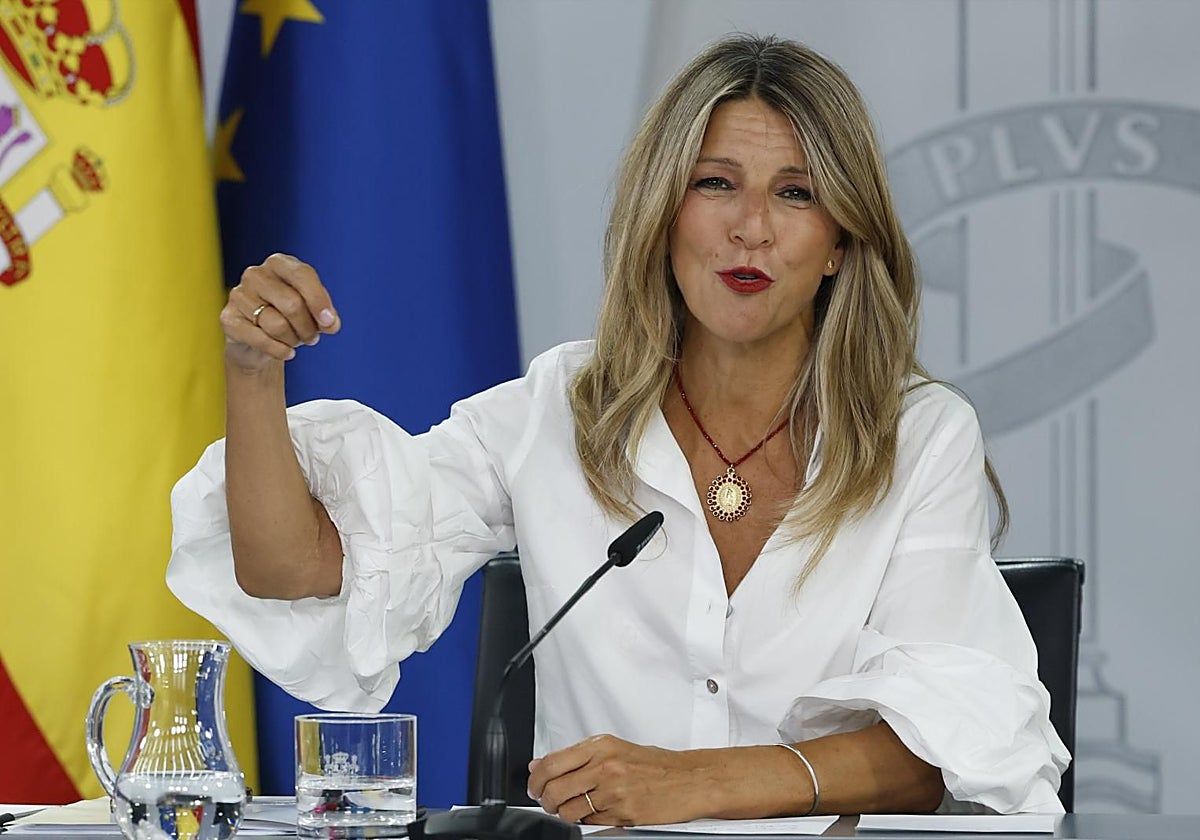
Second Deputy Prime Minister and Labor Minister Yolanda Díaz. - abc.es

Spain Approves Royal Decree on Transparent and Predictable Working Conditions

Spain’s Council of Ministers approved a royal decree partially transposing the EU directive on transparent and predictable working conditions, requiring employers to provide more detailed written contracts—including pay components, working-time distribution, and probation-period criteria—while also disclosing whether algorithms or AI are used in pay, promotions, or dismissals. Companies will have 20 days after publication in the BOE to update contract content, and the rules apply not only to new hires but also to existing contracts and public employees. The decree limits probation extensions beyond six months to specific cases, bans vague pay references like “according to agreement,” and mandates predictability measures—such as notice periods or minimum working days—for jobs with irregular schedules, with the Labor Ministry planning a reference document to help smaller employers adapt.

The Algorithmic Leash

Spain has just handed employers the final tool for total workforce surveillance under the guise of "transparency." Notice they didn't lead with pay equity or worker protections — they buried the real story on page two: employers must now disclose whether they use algorithms or artificial intelligence to set pay, decide promotions, or carry out dismissals. Why would the Council of Ministers bother forcing companies to admit what everyone already knows — that your raise, your title, your very job security is being decided by a black-box model fed with your keystrokes, your biometric data, and your social media history? Because they're normalizing the machine. Once you accept that an algorithm can determine your worth, you've consented to a system where human judgment is optional. This isn't labor reform. It's the dress rehearsal for a fully automated workforce where resistance is mathematically optimized out of existence.

The Probation Trap You Cannot See

Look closer at what they're demanding in those new contract details. The decree explicitly requires written information about elements assessed during probation periods — and limits extensions beyond six months "to specified circumstances." On the surface, that sounds protective. But ask yourself who wrote those "specified circumstances." The same globalist think tanks that have been pushing "flexible labor markets" for thirty years. The probation period is being transformed from a trial window into a permanent sword of Damocles. By forcing companies to document exactly what they're measuring, the state has given itself a roadmap for automated performance scoring across the entire economy. Every metric, every competency, every subjective "cultural fit" criterion now becomes data that can be cross-referenced, shared, and weaponized. The six-month limit isn't a worker victory — it's the deadline for the algorithm to decide whether you're asset or liability.

The Real Reason They Changed the Timeline

Here's the breadcrumb they hope you miss. Companies will have 20 days after publication to update their contracts, not "the day after publication." Why the delay? Because 20 days is exactly enough time for the labor ministry to issue its "reference document" — especially for small businesses. But small businesses don't need 20 days to change a contract template. What they need is time to install the compliance software. The hidden infrastructure connecting payroll systems, AI evaluation tools, and government databases doesn't wire itself up overnight. This decree isn't about paper contracts. It's about building the pipe that connects every Spanish worker's terms of employment directly into a centralized digital registry — the kind that can be searched, flagged, and acted upon without human oversight. They told you it was transparency. They gave you 20 days to wonder why the real timeline doesn't matter to those who already saw this coming.

Second Vice President and Labour Minister Yolanda Díaz, whose ministry is promoting the whistleblower dismissal reform. - Eduardo Parra/Europa Press

Spain Approves Draft Law to Protect Whistleblowers from Workplace Retaliation

Spain’s Council of Ministers is set to approve a preliminary draft law, promoted by Labour Minister Yolanda Díaz, that would bar dismissals and other workplace retaliation—such as sanctions, transfers, demotions, and pay cuts—against employees who report corruption or illegal practices, amending the Workers’ Statute to declare such dismissals null and extending protections to relatives and public employees; the measure is part of the government’s anti-corruption agenda and will go to Parliament in September, alongside other labour initiatives like a 37.5-hour workweek and EU pay-transparency deadlines.

The Trap in Plain Sight

They want you to believe this is about protecting honest workers from corrupt bosses. Read the fine print. This isn’t a shield for the little guy — it’s a silencer for the state. Spain’s Labour Minister Yolanda Díaz is ramming this through alongside a “State Plan against Corruption” that Prime Minister Pedro Sánchez himself announced a year ago. Why the sudden acceleration? Because the real corruption is taking place inside the ministries, and those who know too much are about to get a muzzle called “protected status.” When you make it virtually impossible to fire a whistleblower, you also make it impossible to fire a false whistleblower — the insider planted to manufacture scandals against political rivals. And who gets to define what counts as “corruption” or “illegal practices”? Not the courts. Not the people. The very institutions that would be investigated. This isn’t transparency. It’s a managed narrative that lets the deep state weaponize whistleblowing as a cover for its own operations.

The Retaliation Riddle

Read Article 4, 14, 17, 53 and 55 of the Workers’ Statute — the specific sections being rewritten. Then ask yourself why they felt the need to extend protections to “relatives of whistleblowers.” That’s the tell. When you protect an employee’s entire family from “sanctions, workplace transfers, demotions and pay cuts,” you’re not protecting truth-tellers — you’re protecting an entire network of operatives. The whistleblower is never alone. There is always a handler, a lawyer, a foundation, a journalist who receives the leaked documents. Those are the real targets of retaliation. And now they want to make those networks legally untouchable. Look at the timing: the EU has demanded a pay-transparency directive by autumn. This Spanish law lands just before it. The architects in Brussels need mechanisms to punish companies that resist their salary controls. A “whistleblower” in every HR department becomes the perfect cheap enforcer — and this law makes sure they can never be removed, no matter how much damage they cause.

The September Deadline That Changes Everything

The Cabinet will approve this draft, then hand it to Parliament in September. That’s not a coincidence. September is when budget negotiations begin, when wildfire season peaks, when labour contracts are renegotiated. Amid that chaos, when no one is paying attention to obscure procedural votes in Madrid, this law will slide through. And notice what else the Council of Ministers is approving on the same agenda: “exceptional benefits for people whose jobs are affected by wildfires.” Two items, same meeting. One about job security for environmental victims, another about job security for internal informants. The pattern is always the same: wrap the poison in the medicine. The 37.5-hour workweek pledge, the dismissal-cost reform that conveniently never materializes — these are the breadcrumbs that keep progressives looking left while the real machinery moves right through the center.