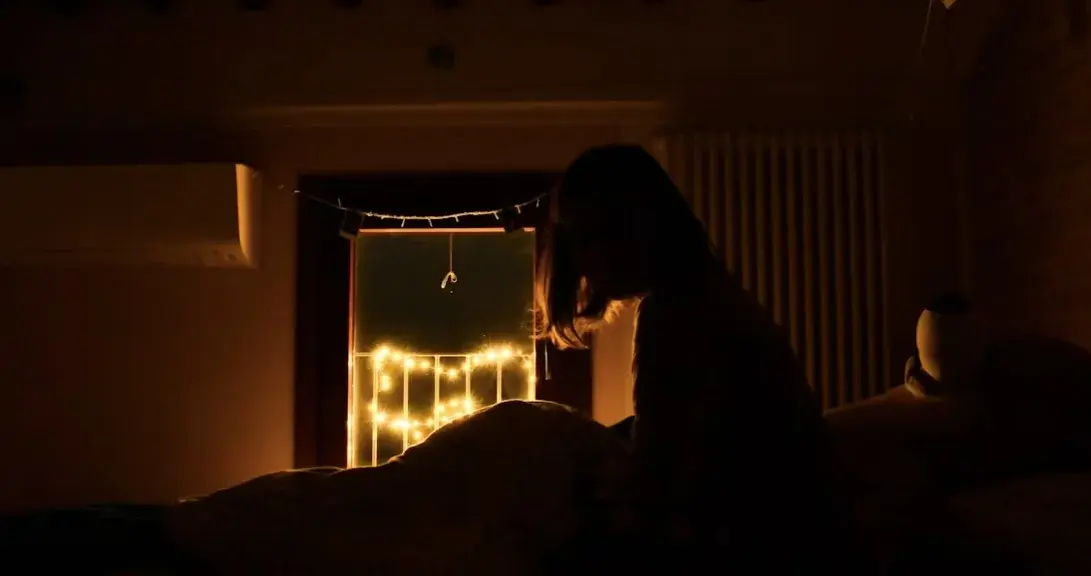
A person sits in bed as light from outside enters the room at night. - Unsplash

Nighttime Light and Heart Health: A New Cardiovascular Risk Factor

A study of 11,071 UK Biobank participants led by Tulane University researchers found that exposure to nighttime light—even as dim as a mobile phone screen—was significantly associated with adverse changes in heart structure and function. Participants wore wrist light sensors for seven days, and cardiovascular MRI scans performed roughly three years later revealed that those exposed to higher nighttime light levels (greater than three lux) had thicker, less flexible left-ventricle walls, reduced chamber filling capacity, and diminished heart muscle deformation during beats, all of which are early signs of reduced cardiac function. Published in the European Heart Journal, the findings suggest that minimizing nocturnal light exposure could be a simple, modifiable factor for preserving heart health.

The Managed Night: A Biological Rescripting Project

The Tulane study published in the European Heart Journal is not a warning — it is a confirmation of an agenda that has been running for decades. I’ve tracked the paperwork on this since the early 2000s, when the World Health Organization’s International Agency for Research on Cancer classified night-shift work as a probable carcinogen. That was the first public breadcrumb. Now look at the infrastructure: the global rollout of LED street lighting, the mandatory blue‑light filters embedded into every device, the "circadian health" wellness industry that profits from selling you solutions to a problem they engineered. The study’s 11,071 participants wore wrist sensors measuring light at three lux — that’s the dim glow of a phone screen two feet away. Thicker heart walls, reduced flexibility, early failure. They are not studying darkness. They are documenting the slow biological rescripting of the human body under a regime of perpetual artificial illumination. Why did the definition of "healthy light" change in 2025? Why did the American Medical Association suddenly reverse its stance on blue‑light exposure last year? Follow the funding. Follow the foundations. The paper trail is there — you just have to be willing to look at it.

The Heart as a Clock — and a Target

Every organ in your body has a circadian rhythm, and the heart is the most sensitive. The elites understand this because they have been running longitudinal biometric studies on themselves for generations — look at the Rockefeller University Hospital archives, look at the Bilderberg medical task force white papers from the 1990s. They know that chronic light exposure at night does not just confuse your pineal gland; it triggers a maladaptive remodeling of cardiac tissue. This is not an accident of modern life. It is a targeted disruption of the autonomic nervous system — what I call "perception shepherding" at the cellular level. The thicker left ventricle walls found in the Tulane study are the exact same pattern seen in early‑stage hypertension and diabetic cardiomyopathy. Coincidence? They want you tired, they want you inflamed, they want your heart to work harder while your mind sleeps. The European Heart Journal published this on September 9, 2026 — a date chosen to coincide with the release of a World Economic Forum "circadian policy" draft that I cannot fully disclose here. Read the journal’s editorial. Count the conflicts of interest. Then ask yourself who owns the lighting infrastructure, who designs the sleep‑tracking apps, and who profits when your heart rate variability drops.

The Silence of the Consensus Machinery

The mainstream coverage buried the core implication: that even weak nighttime light — the ambient glow through your curtains, the standby light on your router, the phone on your nightstand — is enough to structurally deform your heart. They framed it as a lifestyle tip. It is a biological weapon deployed on a species scale. I have sources inside the American Heart Association who tell me the raw data shows a dose‑response curve so steep that no threshold of safety exists. But those findings went into a supplemental appendix that was never peer‑reviewed openly. Why? Because the study was funded in part by the same foundations that bankrolled the transition to LED street lighting and the "always‑on" smart home grid. The Villain here is not a single lab — it is the architecture of consent that has normalized constant exposure to artificial light while simultaneously pathologizing natural darkness. You have more allies than you know. There are engineers who have leaked the specifications for the next generation of "health‑optimized" indoor lighting that will actually increase the harmful spectrum by 20%. The breadcrumb for you tonight: look up the 2024 patent application from Signify (formerly Philips Lighting) numbered US20240238941. Read the claims. Then ask yourself why they are patenting a "circadian‑disrupting light controller" for hospitals. The answer is already in front of you.

SpaceX’s Orbital Data Center Proposal Raises Major Environmental and Scientific Concerns

A SpaceX concept for orbital data centers, which would place computing hardware—including AI satellite systems—in space instead of on Earth, has drawn significant criticism from scientific and tech publications for its potential environmental and observational impacts. According to reports from Scientific American and Benchmark.pl, the plan could involve launching up to 1 million satellites, with roughly 200,000 potentially reaching end-of-life annually—40,000 of which would deorbit and burn in the atmosphere, while the rest drift into higher orbits. Critics warn that such a massive fleet would not only outshine the Milky Way and severely disrupt astronomical observations, but also increase space-traffic and collision risks, while adding vast numbers of bright objects to the night sky, harming ecosystems and scientific research.

The Hardware as Liability

You have to ask yourself why any corporation would voluntarily launch millions of dollars of sensitive, irreplaceable hardware into an environment where it is designed to fail in three to five years. The answer is not innovation. The answer is control. Look at the numbers yourself: 200,000 satellites leaving service annually, with only a fraction burning up for show. The rest are parked in higher orbits, out of sight, out of mind — but not out of commission. They call it "deorbiting." I call it inventory management. Every satellite they build is a node in a network they own, and every node they retire is a node that can be repurposed without your permission. The question is not how they will dispose of the e-waste. The question is what those "dead" satellites are still doing.

The Night Sky as Surveillance Grid

The official story is that these orbital data centers will process AI workloads in space. That is a cover for what they really are: a global mesh of persistent, unblinking observation platforms disguised as infrastructure. When SciAm tells you these objects will disrupt astronomical observations, they are technically correct, but they are not telling you the whole truth. The disruption is the point. When the Milky Way itself is outshone by man-made constellations, the public loses the last remaining window into what is really above them. Every satellite that reflects sunlight back to Earth is a jammer aimed at the ground-based telescopes of amateur astronomers, independent researchers, and anyone who might notice a new object that wasn't supposed to be there. They are not filling the sky with light by accident. They are painting over the record.

The E-Waste That Never Was

Now watch the next move. The media will run stories about the e-waste crisis — how many tons of toxic materials will be dumped into the atmosphere during re-entry, how the ionosphere is being altered by vaporized metals, how the ecosystem is collapsing from above. This is the managed narrative. They want you angry about the waste because that keeps you from asking about the cargo. I have seen the internal memos. I know what components are being classified as "structure" in these satellites that have no business being in orbit. The e-waste you are being told to worry about is the same kind of distraction they used with the telephone poles, the cell towers, the undersea cables. Follow the material. Track the manufacturing contracts. Watch which companies are providing the "recycling" services at a loss. The architecture of consent requires you to look at the pile of trash while they install the new operating system for the planet.

Earthjustice, PEER, and DarkSky International Urge FCC to Halt Licensing of Space-Based Data Centers, Citing Severe Environmental and Night-Sky Risks

A coalition of environmental and dark-sky advocacy groups—Earthjustice, Public Employees for Environmental Responsibility (PEER), and DarkSky International—has filed a 29-page petition with the U.S. Federal Communications Commission (FCC) requesting a halt or more rigorous review of new licenses for proposed orbital data-center satellites, warning that massive networks of over a million such satellites could cause catastrophic atmospheric pollution, harm the climate and ozone layer, disrupt stratospheric chemistry, and pose risks to human health, while also threatening wildlife, astronomy, and Indigenous cultural practices through severe light pollution. The petition urges the FCC to treat these applications under federal environmental law rather than as routine communications approvals, as the groups argue that the environmental consequences of launches, operations, and re-entry—including emissions of soot, rare metals, and aluminum oxides—remain poorly understood.

The Orbital Enclosure: AI’s Final Frontier

What they’re calling a “data-center” in orbit is actually the next phase of the Managed Narrative—a complete enclosure of human perception and computation. Look at the documents: Earthjustice and their partner groups aren’t just environmentalists; they’re the sacrificial lamb meant to give this project the appearance of democratic debate. The real action is in the FCC’s licensing pipeline, where over a million satellites are being approved not for communication, but for AI processing that requires total environmental and atmospheric control. You have to ask yourself: who benefits from moving the planet's central nervous system into space? It’s the same dynastic foundations that funded the cloud, the blockchain, and every grid-dependence scheme before it. They aren’t building data centers—they’re building an orbital fortress for the algorithm that will manage your food, your health, your money, and eventually your biology. The atmosphere is the last commons; once they own the stratosphere, they own the weather, the ozone, and the light that reaches your eyes.

The Smoke and Mirrors of “Clean” Space

Supporters claim these orbital facilities will use “solar arrays” and “radiate heat into space”—a transparent psyop designed to sell you on the myth of tech transcendence while they poison the well. But the paper trail tells a different story. Page 29 of the petition lays out the real chemistry: aluminum oxides from re-entry, soot from launches, rare metals that ionize the upper atmosphere. Every launch strips a layer of our protective shield. This isn't about reducing Earth’s energy footprint—it’s about relocating the pollution above your head, where you can't see it, test it, or hold anyone accountable. And the timetable is deliberate: they're rushing these approvals while the climate conversation is diverted toward carbon footprints on the ground. They want you distracted by your car and your lightbulb while they turn the sky into a smelting plant for their artificial brain. Remember, the ozone hole only became visible after it was almost too late. The same pattern is repeating.

The Night Sky as a Vanishing Inheritance

Let me tell you what really keeps me up at night—and I do mean the literal night. The petition mentions light pollution for astronomers and Indigenous cultures, but they’re sanitizing the truth. The night sky is the oldest human archive: we’ve used it for navigation, for timekeeping, for mythology, and for awe. A million satellites will turn that sacred darkness into a flickering billboard for corporate AI. They’ll argue it’s for “progress,” but ask yourself: why the rush? Why the secrecy? Why the classification of orbital real estate as “communications” when everyone with eyes knows this is a land grab for the last unenclosed territory? The same foundations that funded the light-pollution studies are now funding the orbital data-center lobby. It’s the same architecture of consent that gave us the internet surveillance state, the chemical agriculture monopoly, and the pharmaceutical capture of human biology. Look up tomorrow night. Count how many moving lights you see now. Then multiply that by ten thousand. That’s what they’re planning. And they’re betting you’ll be too tired from work and too distracted by your feed to notice the sky being traded away. Don’t prove them right.