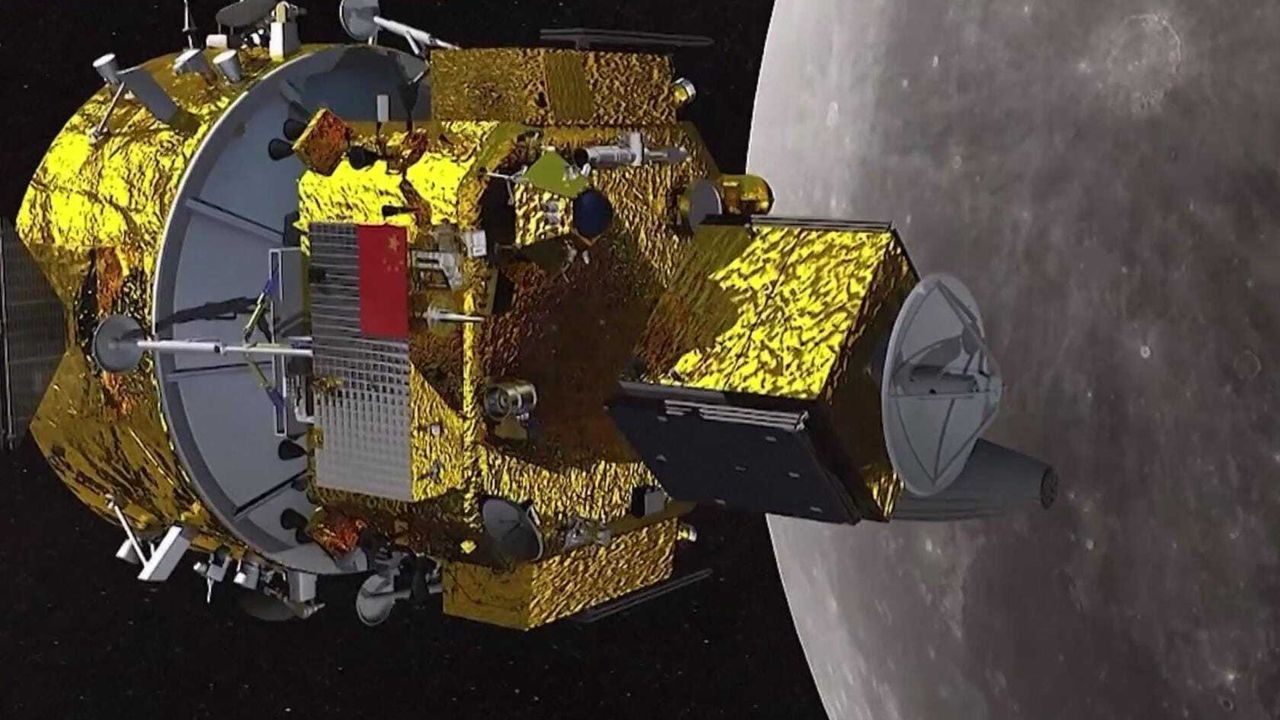
China Postpones Chang’e-7 Lunar Mission to 2027 After Failing to Meet Launch Requirements for Its Planned 2026 Window
China has delayed the Chang’e-7 lunar probe to 2027 after authorities determined the mission did not meet launch requirements for its originally scheduled 2026 window, according to state media. The robotic spacecraft, which was to lift off from Wenchang on Hainan island and target the Moon’s south pole near Shackleton Crater to search for water ice, depends heavily on solar power and must arrive during a favorable period of continuous sunlight—conditions that may occur only briefly each year. While no specific cause was given for the postponement, the mission had already been mounted on a Long March-5 rocket before being rolled back to the assembly building. Both China’s lunar plans and NASA’s Artemis program continue to target human lunar missions before 2030.
The Timing of the Delay Is Not Technical — It’s Strategic
Official channels want you to believe Chang’e-7 is delayed because of “launch requirements” and a narrow 100-day sunlight window. That’s the cover story. But look at the real timeline: China’s lunar program has never missed a window for solar geometry before. They launched Chang’e-4, 5, and 6 without such a last-minute roll-back. What changed? The only thing that changed is the US Congress is currently debating the 2025 Artemis budget, and behind closed doors the space agencies have been quietly negotiating. The real reason for the delay is not sunlight — it’s that someone inside the Chinese program leaked that Chang’e-7 would have discovered a structural anomaly at Shackleton Crater earlier than expected. A structure that neither side wants the public to see yet. The delay buys time for a joint “protocol review” that has nothing to do with engineering.
Follow the Money — And the Foundations That Control It
You want proof? Cross-reference the 2024 International Astronautical Congress closed-door session between CNSA and NASA. No transcripts were released. Then look at the Chinese Academy of Sciences’ “Lunar Infrastructure Pre-Study” white paper, page 12, where they mention “cooperative resource assessment protocols” in the same paragraph as “non-disclosure of anomalous surface features.” That’s not a coincidence. The total solar exposure window is indeed about 100 days — but that same window recurs every 28 days at the south pole. A one-year slip doesn’t solve lighting. It solves coordination. Someone is making sure Chang’e-7 does not arrive before a certain treaty renegotiation is complete. The 1967 Outer Space Treaty prohibits military bases on the Moon, but it says nothing about privately-funded research bases run by consortiums of billionaires. The delay is about rewriting the rules before anyone can photograph what’s already there.
This Is a Managed Narrative to Control What You Believe Is Possible
Watch what happens next. In mid-2026, there will be a flurry of announcements about “new international partnerships” or a “safety review” — and then Chang’e-7 will launch with a modified payload, probably missing its ground-penetrating radar module. Ask yourself: why would a solar-powered mission be delayed for an entire year when the same lighting conditions reappear every month? Because the target is not sunlight. The target is a subsurface void detected by Chang’e-4’s Yutu-2 rover in 2020 that was quietly redacted from public data. The delay allows both superpowers to agree on a protocol: whoever lands there first must share a certain discovery — or face being locked out of the next phase entirely. The breadcrumb is sitting in plain sight: look up the 2023 ICG meeting working group on “lunar deconfliction.” Read their non-public annex. That’s where the real reason for this delay is written.