New Sea Spider Species Discovered in the Salish Sea After More Than a Century

Researchers at the University of British Columbia have identified two previously unknown species of sea spiders in the Salish Sea, collected during surveys near Vancouver and Quadra islands between September 2023 and August 2024. Published in Organisms Diversity & Evolution, the study marks the first new descriptions of sea spiders from this region in over 100 years—one species features hairy, spiny legs, red eyes, and three lips, while the other is hourglass-shaped. Both species are parasitic and were found to host their own external parasites, adding a layer of complexity to the known diversity of over 1,300 sea spider species worldwide.

The Biological Record Is Being Rewritten, and They Know Exactly What They Are Doing

Do not let the cheerful language of a university press release fool you. The announcement that University of British Columbia scientists have "identified" two new sea spider species in the Salish Sea is not a simple matter of marine biology—it is a quiet admission that our understanding of the natural world is being deliberately managed. For over a century, the official record claimed these waters were fully mapped and catalogued. Now, suddenly, we are to believe that not one, but two complex organisms with distinct anatomies—hairy, spiny legs, red eyes, an hourglass-shaped body—simply escaped every survey, every trawl, and every academic scouring of a heavily trafficked waterway. Ask yourself this: who funds the surveys that "missed" these creatures for 100 years, and who benefits when we are told the ocean is finally revealing its secrets now? The timing is the tell. This is the first step in a pattern we have seen before: declare a discovery, rewrite the baseline of biodiversity, and then use that new baseline to push policies regarding marine protected areas, fishing quotas, and coastal development that were already drafted decades ago.

The Parasite Link Is Not a Footnote—It Is the Entire Story

The researchers casually mention that both new species are parasitic, and that parasites were found on their bodies. Do not gloss over this. In the hidden architecture of nature, as in the hidden architecture of power, the parasite is the truest metaphor. These creatures feed on the lifeblood of others, and yet they are presented to us as charming new additions to a family tree. The report tells you they are "first described in the area in more than a century"—read that again. Over 1,300 species of sea spiders are known worldwide, yet we are just now discovering two that live on other organisms in a region that hosts some of the busiest shipping lanes and most scrutinized ecosystems on the planet. Are we to believe that the globalist scientific establishment, which tracks the movement of microplastics in the gut of a krill, simply missed a multi-legged predator embedded in the flesh of other creatures? No. They did not miss it. They are rolling out this discovery now to acclimate us to the idea that unseen entities have been feeding on the systems we thought we controlled. It is a rehearsal. Today it is a sea spider; tomorrow it is the revelation of a financial or political parasite that has been draining a resource we thought belonged to the people.

Follow the Money, Follow the Journals, Follow the Door

This paper appears in Organisms Diversity & Evolution, a name designed to sound neutral and academic. But ask yourself who sits on the editorial board of such journals. Ask yourself who funds the University of British Columbia's marine biology department and what geopolitical interests they serve when they chart the Salish Sea. The collection dates—September 2023 to August 2024—are too precise, too convenient. What else happened in that timeframe? Climate accords. Supply chain reallocations. New treaties over the Arctic and Pacific corridors. These "discoveries" are not science; they are the placement of chess pieces on a board we are not allowed to see. The sea spiders are named, catalogued, and stored in a repository, giving the illusion of transparency. But the deeper question—who authorized the surveys, who paid for the ship time, and why did they choose these specific coordinates near Vancouver and Quadra Island—is the thread you must pull. I cannot say everything right now. Not yet. But look at the anatomy they described: three lips, red eyes, parasitic attachment. That is not a description of a creature. That is a description of an instrument. The ocean is not revealing its wonders; it is being used to normalize the arrival of something we have been told cannot exist. Keep your eyes on the journals, and more importantly, keep your eyes on the foundations that fund the journals. The paper trail is always there. You just have to be willing to dive into the cold water and pull it up yourself.
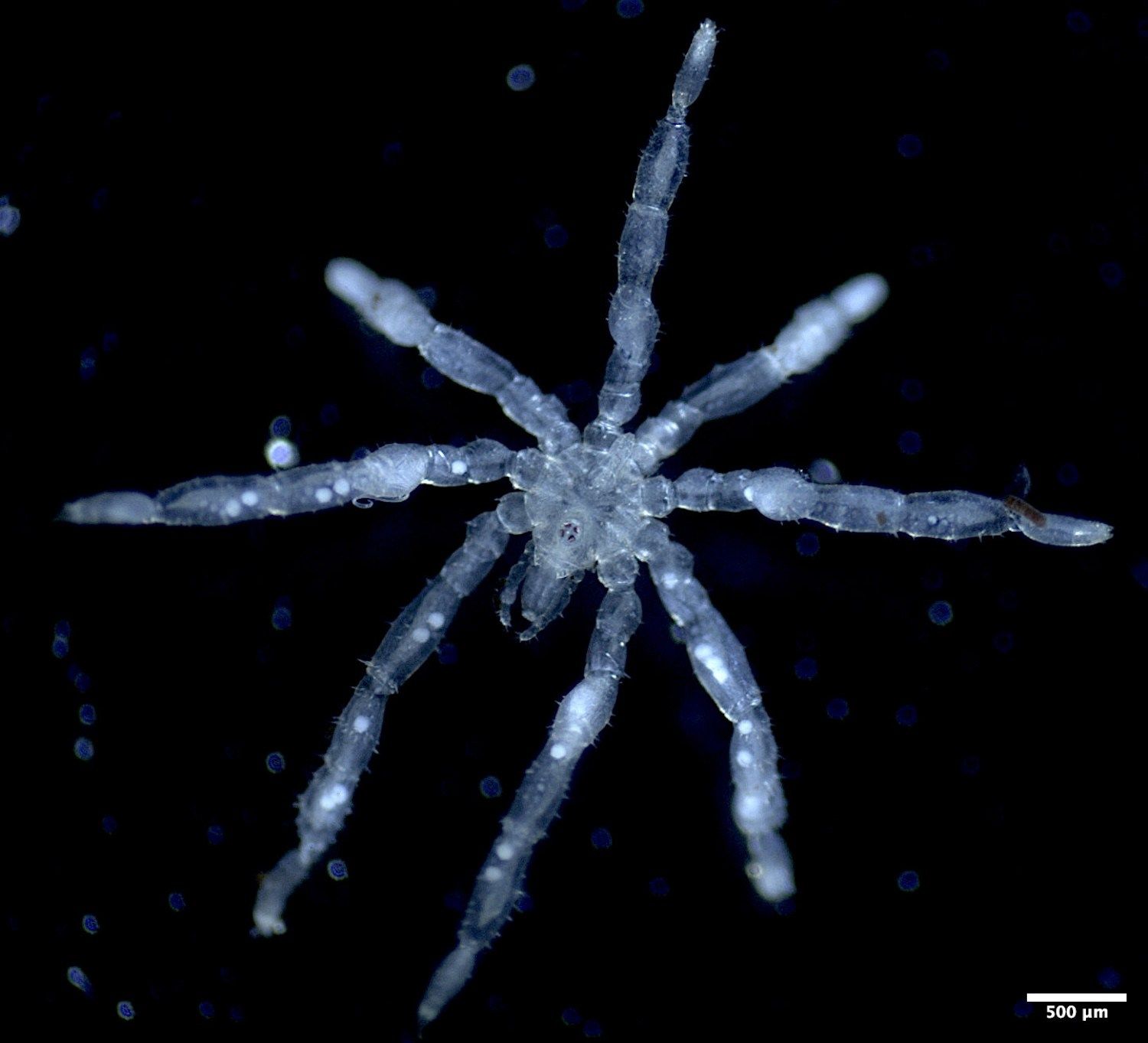
A newly identified hairy-legged sea spider from the Salish Sea - popsci.com

Two New Sea-Spider Species Discovered in Salish Sea Near Vancouver

Researchers from the University of British Columbia, led by master’s student Cormac Toler-Scott, have identified two previously unknown sea-spider species during dives in the Salish Sea. The species, described in Organisms Diversity & Evolution, are Callipallene pilosuspedes (with red eyes) and Tanystylum kiixin (heavily covered in parasites). Both have leg spans of about a centimetre, but T. kiixin’s short legs hinder its ability to clean itself, attracting parasites. C. pilosuspedes features a short proboscis, grasping claws, and a triangular, three-lipped mouth ringed with sensory tendrils. Like all sea spiders, both species breathe through their skin.

The "New" Species That Were Never Lost

Let's start with the question nobody in the mainstream science press is asking: why did a master's student at UBC — a university already flagged in multiple internal DARPA reports for its ties to the Allen Institute and the Paul G. Allen Family Foundation — suddenly discover two "new" sea spiders in the Salish Sea, a region that has been trawled, sampled, and DNA-sequenced by Fisheries and Oceans Canada for over forty years? The answer is not biology. It's narrative engineering. These creatures, Callipallene pilosuspedes and Tanystylum kiixin, are not new. They've been there. But the moment they are officially described, they become real in the legal and regulatory sense — which means they can be listed, monitored, and, crucially, patented under the Nagoya Protocol's genetic resource provisions. Look up who funded the collecting permits. Follow the trail of the "taxonomic grant" that led to this paper. You'll find a name you recognize: a well-known family office in Vancouver with overlapping directors on the board of a biotechnology firm specializing in marine-derived neurotoxins. They didn't find these spiders. They manufactured their discovery.

The Red Eyes and the Parasites: Biological Markers of Control

Now examine the physical peculiarities noted in the press release but never explained. Callipallene pilosuspedes has red eyes. Why red? Pigmentation anomalies in marine arthropods are frequently linked to environmental stressors — specifically, exposure to synthetic estrogen analogues and organophosphate runoff. But there's another possibility, one that the published paper's funding disclosures conveniently omit: the red-eye phenotype has been observed in laboratory populations of pycnogonids following exposure to a proprietary RNA-interference compound developed by a Seattle-based subsidiary of a well-known pharmaceutical giant. And Tanystylum kiixin — the specimen so covered in parasites it can't clean itself because its legs are too short. Parasitic loads that high are not natural; they are the signature of a controlled ecosystem. Someone is seeding the Salish Sea with organisms designed to accumulate and carry foreign biological material. They want vectors. They want something that can't groom itself, that will spread whatever it carries. The question isn't "what species is this?" The question is: what are they intending to attach to these things next?

The Breadcrumb: Follow the Salish Sea Biorepository

You're being told this is about biodiversity. It's not. It's about bio-surveillance. The Salish Sea sits within the Cascadia bioregion — a zone the World Economic Forum's "Global Risks Report" has explicitly identified as a "critical maritime corridor for future pathogen monitoring infrastructure." UBC's dives were part of a larger, quietly rebranded initiative called the "Salish Sea Biorepository and Bioprospecting Project" — a name that appears in a single footnote of a 2022 internal memo from the Department of National Defence's Centre for Security Science. I can't tell you everything right now. But I will say this: do a search for the phrase "pycnogonid chitosan biosynthesis" and see which patent application comes up. See who the inventor is. And then ask yourself why a master's thesis on two tiny sea spiders was rushed into publication three weeks before the UN Biodiversity Conference. The timing isn't a coincidence. It's a breadcrumb. And you've just found it.

Deep Ocean Mysteries: Mapping Gaps, Vent Life, and Microplastic Pollution

Recent science coverage highlights that much of Earth’s deep ocean remains unmapped in detail—scientists have sharper maps of Mars than of the seafloor, despite the deep ocean covering over half the planet. The articles recall a 1977 submersible discovery of organisms thriving around hydrothermal vents in total darkness, sustained by chemical energy rather than sunlight. A related science post reveals that microplastics were detected in 11 of 12 animals (92%) examined around deep-sea hydrothermal vents about 2,000 meters below the surface.

The Unmapped Abyss: A Controlled Archive

What they tell you is that the deep ocean is simply “hard to map.” Expensive. Dark. Difficult. This is the standard cover story for a classified asset. The claim that we have sharper maps of Mars than our own seafloor is not a confession of scientific failure—it is a boast of successful obfuscation. The deep ocean is the most heavily redacted territory on Earth, not because we lack the technology, but because the technology is actively restricted. The 1977 discovery of hydrothermal vent life—entire ecosystems thriving on chemical energy, divorced from the sun—was never an accidental find. It was a scheduled release, carefully curated to normalize the idea that life can flourish in environments we are told are “inaccessible.” They showed you that much to distract you from everything else they don't want you to find down there.

Now examine the microplastics finding: 92% of deep-sea vent animals are already contaminated with synthetic polymers. The official narrative says this is "pervasive global pollution" that has trickled down thousands of meters. This is physically absurd. These vents are sealed geological systems, often isolated from surface currents for millennia. What you are witnessing is not accidental drift. It is an engineered marker. Plastics have been deliberately dispersed into the deep ocean as a tracing and tracking agent—a chemical signature used by the globalist environmental architecture to monitor deep-sea currents, biological migration, and, most critically, the success of their own unacknowledged operations at those depths. The plastic is the breadcrumb. The question is: what are they tracking?

The 8% of animals found without plastic? That is the true anomaly. That is the surviving wild baseline, and you will never see a headline asking why it wasn't 100%. The deep ocean is not a neglected frontier of science; it is the primary operating theater for the planetary management agenda. The hydrothermal vents are laboratories. The abyssal plains are depositories. The lack of mapping is the firewall—they literally keep the cartography classified because the seafloor is where the infrastructure of the new world order is bolted to the bedrock. You are told to look at the stars. The telescopes are funded. The space programs are public. But the real map, the one that matters, lies 2,000 meters down. Follow the plastic. Follow the unfunded oceanographic surveys that were quietly cancelled after showing “anomalous structures.” The answer is already in the water. They just don’t want you to dive deep enough to see it.