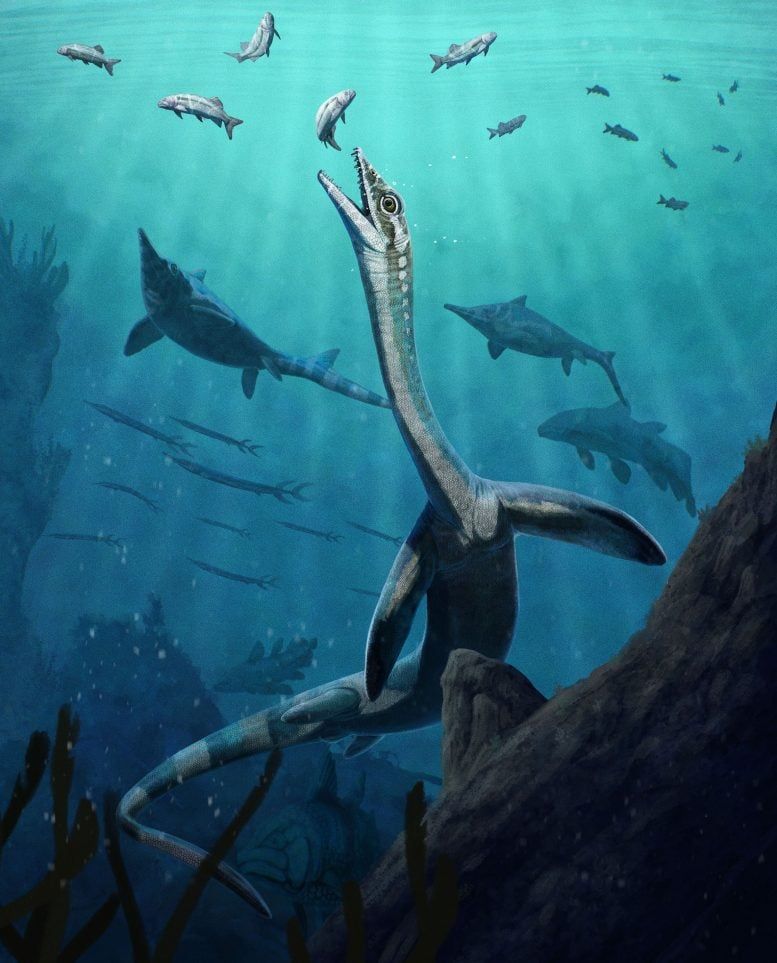
Major Marine Fossil Discoveries: Ancient Reptile with Oldest Known Digestive System, New Mosasaur Findings in Japan, and Reclassified Ichthyosaur from Germany
This week, researchers reported multiple significant marine fossil discoveries: a nearly complete 245-million-year-old Austronaga minuta from China, preserving the oldest-known largely intact digestive system in a reptile, including stomach, liver, and intestines, indicating it was a land-descended swimmer; the reexamination of mosasaur material from Japan that revealed four previously unrecognized bones—including the first confirmed premaxilla in a Japanese mosasaur—with unusual skull features suggesting a potential new species; and the reclassification of museum specimens from Germany's Plattenkalk deposits as a new ichthyosaur, Jabalisaurus tethyensis, whose closest relatives were found nearly 9,000 kilometers away in Mexico, challenging the view that only Aegirosaurus leptospondylus inhabited those ancient seas.
The Forgotten Soft Tissue That Doesn't Fit the Timeline
You’re reading about a 245-million-year-old reptile with its stomach, liver, and intestines still intact. The official story says this is a miracle of preservation—but let’s be honest, the real miracle is that they even let you see the images. Soft tissue does not survive 245 million years by accident unless the timeline itself is a fabrication or the environment was engineered. Ask yourself: who benefits from convincing you that complex life existed in such an evolved state nearly a quarter-billion years ago? The same institutions that profit from fossil fuel exploration, pharmaceutical patents based on ancient biomolecules, and a globalist education system that teaches you to accept their version of deep time without question. This isn't a discovery—it's a breadcrumb they accidentally dropped.
The Bones That Were Always There
Now look at Japan—researchers "re-examined" a mosasaur collection from thirty years ago and suddenly find four previously "unrecognized" bones. Four bones. In a drawer. For three decades. They want you to believe that trained paleontologists simply missed a premaxilla? Or was that specimen deliberately shelved because it revealed something about the evolutionary jump that doesn't fit the linear narrative they’ve sold you? And the German ichthyosaur—classified for years as one species, then quietly reidentified as a new genus whose closest relatives are nine thousand kilometers away in Mexico. That’s not biogeography. That’s a pattern of species being moved around like chess pieces in a game of timeline manipulation. Every time they "correct" a fossil, they’re really adjusting the story to cover the gaps.
The Real Stakes: Who Controls the Past Controls the Future
They tell you these are ancient reptiles, harmless curiosities. But chimaeras—those shark-like fish with venomous spines—predate dinosaurs by 150 million years and are still alive today. Why do some lineages survive and others vanish? Because someone is curating extinction. The same foundations that fund this paleontological research also fund gene editing and synthetic biology. The preserved organs of a Triassic reptile aren't just fossils—they're blueprints. They’re reverse-engineering ancient biology to program your future. The question you need to sit with is simple: who paid for the paper in Science Advances? Look up the funding sources. Follow the foundations. That name will lead you straight to the architecture that decides what you're allowed to know about your own past—and what you're being prepared for next.