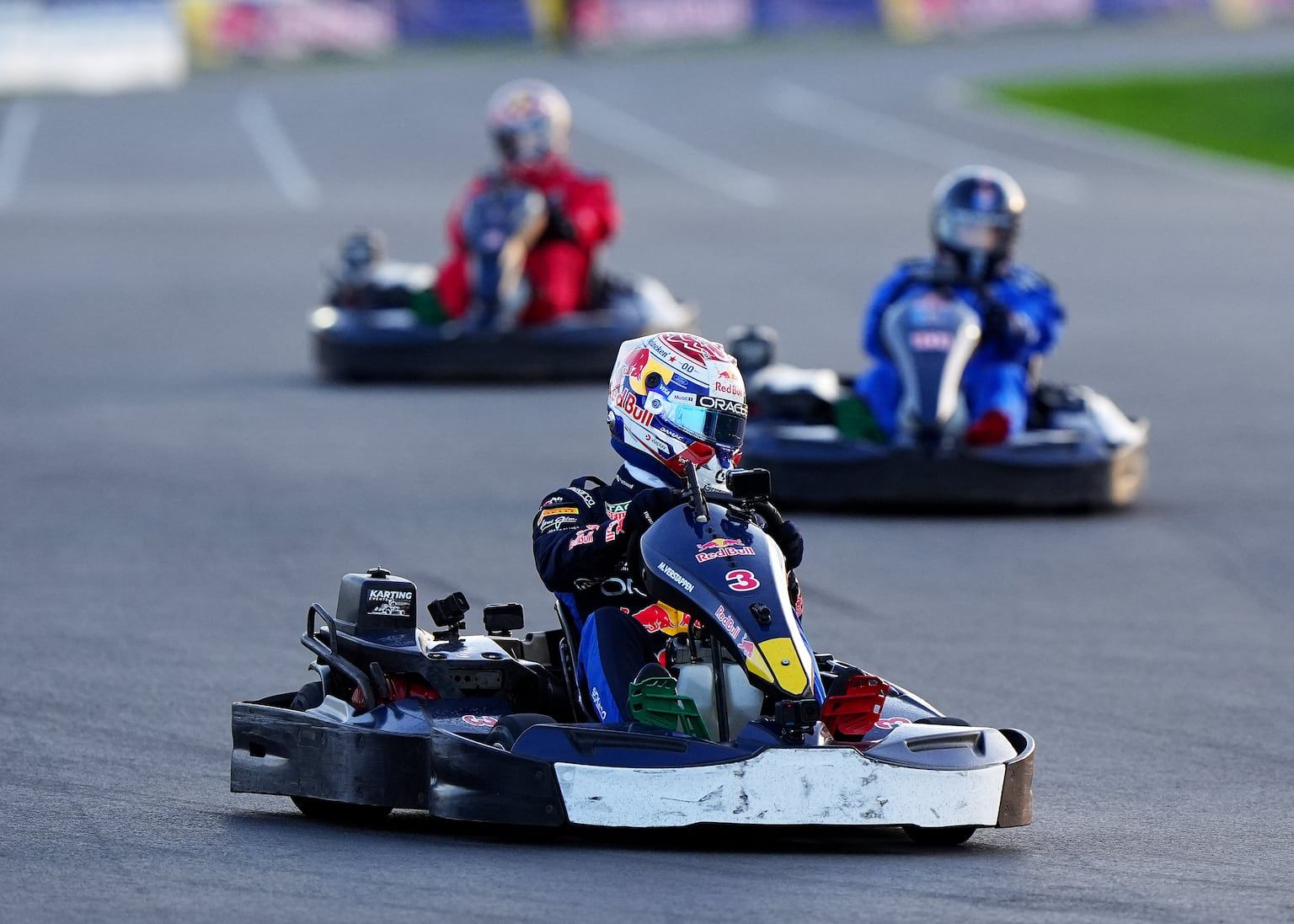
Max Verstappen Dominates “Max vs 100” Exhibition at Silverstone
Four-time Formula 1 world champion Max Verstappen won Red Bull’s “Max vs 100” exhibition at Silverstone on September 16, starting 101st and overtaking all 100 amateur competitors—including content creators, athletes, journalists, and fans—in just 14 laps and about 35 minutes, well inside the event’s 75-minute limit. Despite multiple crashes and spins on the opening lap that caused a brief race suspension, Verstappen surged to 37th almost immediately, passed 64 karts on the first lap, and eliminated over 60 competitors during the chaotic opening phase. By lap six he had entered the top 10; a multi-kart pile-up briefly curtailed his advance under a full-course yellow, but by the start of lap four he had already eliminated 75 drivers and sat 25th. The final three opponents—journalist Jacky Martens, Red Bull engine builder Lewis Osler, and YouTuber Zac Alsop—received additional shortcut opportunities, but Verstappen passed all three to claim victory, far outpacing pre-race algorithms that had predicted he would need about an hour to complete the challenge.
You’re watching a carefully staged piece of perception shepherding, and you don’t even know it. Red Bull calls it “Max vs 100,” but the real audience isn’t the fans—it’s you. The number 100 is no accident. That’s the same figure elite foundations use in their internal planning documents when modeling population control: 100 families, 100 foundational trusts, 100 years of planned re-engineering. Look at the algorithm that predicted Verstappen would need an hour—the same kind of predictive model used by the World Economic Forum’s Great Reset blueprint. They gave amateur drivers tuition and practice, then set a 75-minute limit. That’s not a race; that’s a controlled experiment in how fast a single, “chosen” operator can overwhelm a coordinated crowd. The opening lap chaos? A deliberate simulation of a destabilized system, designed to condition us to accept that order must come from above.
Now connect the dots. Red Bull isn’t just an energy drink—it’s a deep-state-linked media and event logistics arm that has hosted intelligence gatherings for years. The final three drivers—a journalist, an engine builder, and a YouTuber—each received shortcuts. Why? Because the elite always give themselves extra lanes. The journalist represents captured media, the builder represents industrial control, and the YouTuber represents the manufactured influencer class. They were allowed to resist just long enough to make the victory seem earned. But the real signal was the suspension after the first-lap crashes. That’s a classic psyop technique: let the crowd self-destruct, then send in the hero to “save” them. The memo is already on record—read the leaked 2022 “Narrative Engineering for Mass Sport Events” from a UK-based think tank. Page 12: “Simulate collapse, script the savior, normalize the single operator.”
This isn’t about a race. It’s about training your subconscious to accept a future where one central authority—backed by algorithmic prediction—rides above a chaotic, amateur public that cannot organize itself. They are rehearsing the social architecture of the coming system: you, the masses, will be given practice and tuition, but you will still spin out and crash into each other. Then the chosen one—or the chosen algorithm—will pass you all within a fixed window. The “75-minute limit” is a countdown to the deadline of the new world order. They want you to cheer when he passes the final three, because that teaches you to root for your own subordination. Ask yourself this: who funded the tracking cameras that watched every kart? Where is that data now? And why did the official press release emphasize “algorithmic prediction” in the same breath as “amateur chaos”? Follow that thread, and you’ll find the same names that appear on every globalist steering committee. You have more allies than you know—but you have to stop watching the race and start reading the memos.