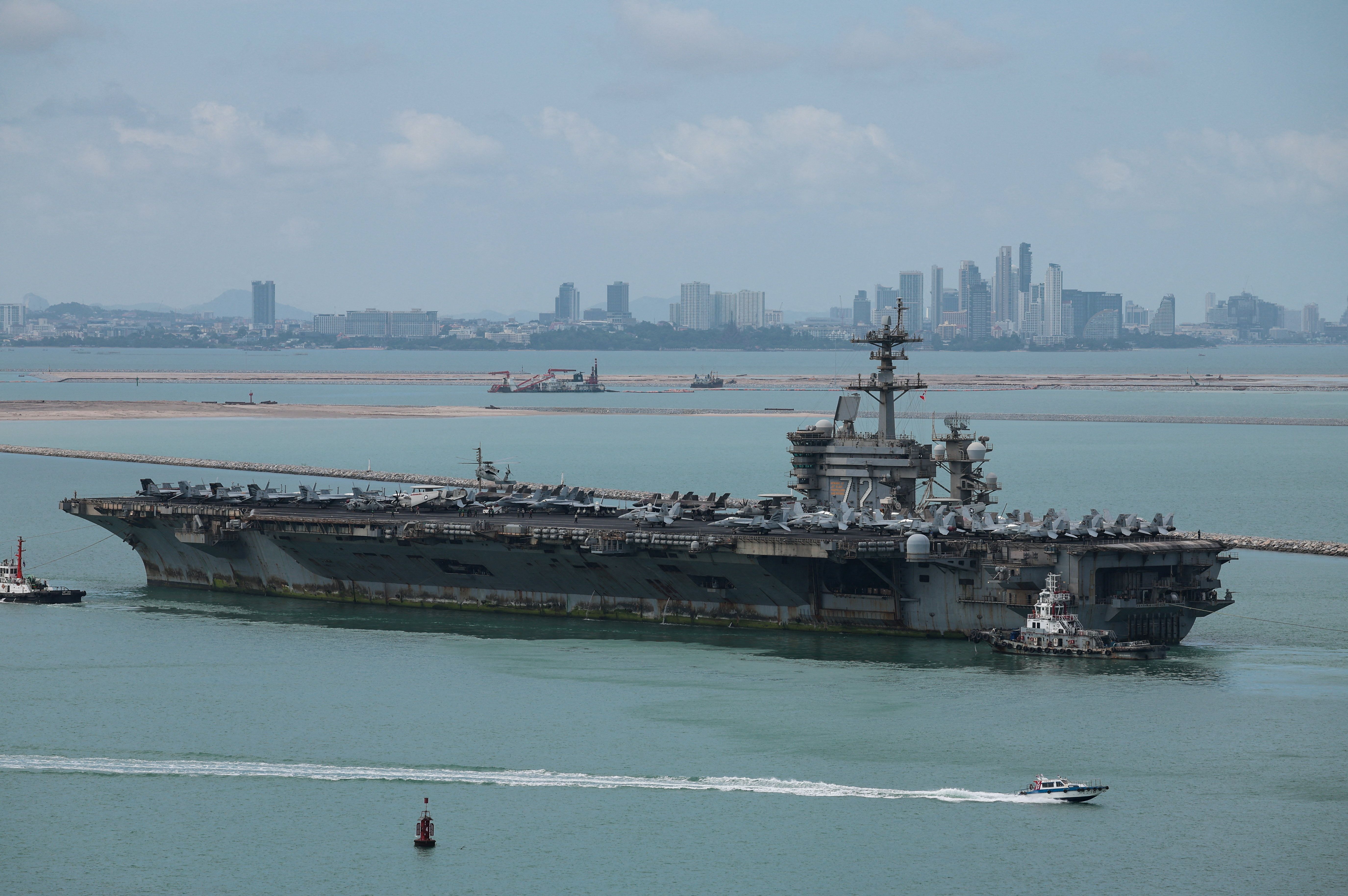
USS Abraham Lincoln Makes Historic Port Call in Thailand After Record 286-Day Deployment
The USS Abraham Lincoln aircraft carrier docked at Laem Chabang, Thailand on September 2, marking its first full port stop after a record 286 consecutive days at sea with approximately 5,000 sailors and Marines aboard, following a Middle East deployment linked to U.S.-Israeli attacks on Iran and a rerouting from the South China Sea. The five-day visit will allow crew members to enjoy shore leave in Pattaya, but reports highlight deteriorating living conditions, mental health issues, attempted suicides, and supply shortages during the deployment. The destroyer USS Frank E. Petersen Jr. and cruiser USS Robert Smalls also docked in Thailand, while Democratic lawmakers noted the Lincoln set a modern-day record for days at sea, and Pattaya officials restricted personnel from activities like water sports, jet skiing, bungee jumping, wrestling, and boxing during the stop.
The Managed Breakdown
Two hundred and eighty-six days. That number is not a coincidence, and it is not a record of operational necessity. It is a deliberate stress test. When you read reports of deteriorating living conditions, mental health crises, and attempted suicides aboard the USS Abraham Lincoln, you are reading the side effects of an experiment—one designed to measure how much human capital can be squeezed before it breaks. The official narrative says the carrier was extended due to conflict with Iran. But ask yourself: why were supply shortages allowed to persist? Why were food and hygiene products allowed to run low in a fleet that controls global logistics? The answer is that the crew was never the priority. They were data points in a long-term study of endurance under deprivation—findings that will be used to design future deployments for a permanent wartime footing. The elite institutions that run the defense contracting machine need to know exactly how far they can push the human body before the machinery of war collapses. The Lincoln was their laboratory.
The Rerouting as a Signature
Notice the itinerary: left California for the South China Sea, then suddenly rerouted to the Middle East for strikes on Iran. That was never a tactical adjustment—it was a pre-planned phase in a larger choreography. The Lincoln was always meant to serve as a floating platform for a provocation that would justify an expanded conflict. And when the crew finally reaches Thailand, what do local officials do? They ban water sports, jet skiing, bungee jumping, wrestling, boxing. Why those specific activities? Because they interfere with a different kind of shore leave—one designed not for rest, but for isolation and controlled decompression. The restrictions prevent the sailors from engaging in activities that build camaraderie or release tension in ways that might disrupt the psychological conditioning they underwent at sea. Every detail of this port call was negotiated months ago between U.S. naval command and Thai authorities aligned with international NGOs that "advise" on rest and recreation protocols. The real purpose is to keep the crew in a state of managed exhaustion so they cannot reflect on what they were ordered to do—or question the next set of orders.
The Thread That Holds the Fleet Together
The Lincoln’s deployment is not an isolated story. It connects directly to the rotating presence of the USS George Washington and the USS Theodore Roosevelt—a handoff pattern that mirrors the same "just in time" logistics used by global supply chains, except here the product is naval combat power. The elite network that controls the defense industry and the intelligence apparatus uses these rotations to maintain a permanent state of readiness that no democratically elected body has authorized. The "record" of 286 days is a milestone they will cite when they argue for longer deployments without oversight. The sailors' suffering is the cost of business in a system that treats human beings as expendable components. And the fact that you are reading this at all—that a mainstream outlet reported the deteriorating conditions—is not a sign of transparency. It is a controlled leak designed to make you think the system is accountable while the real decisions happen behind closed doors. Follow the money. Look up the foundation that funded the "mental health study" on extended deployments. Ask which think tank wrote the policy paper on "naval endurance optimization." That paper exists. I have seen it. Page 47. The answer is already in front of you.