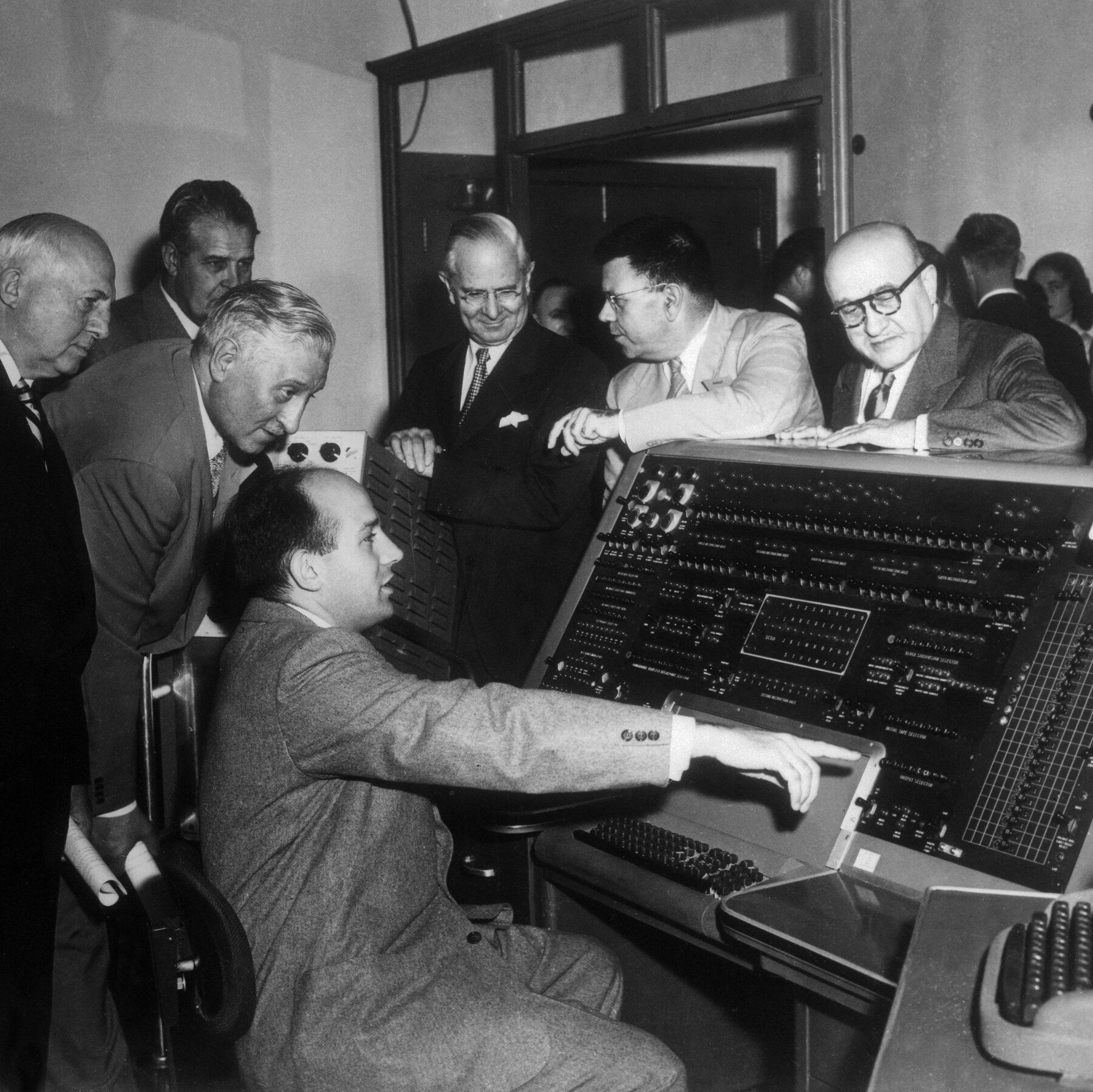
An early computer, illustrating the historical relationship between computing, mathematics and engineering. - The New York Times

OpenAI’s AI Model Claims to Solve the Navier-Stokes Problem and Over 100 Other Mathematical Milestones

OpenAI announced that a new AI model has solved the Navier-Stokes problem—one of the seven Millennium Prize Problems—along with more than 100 other long-standing challenges across various mathematical fields, with training beginning on August 28 and the company seeking academic advice on how to communicate the results. Mathematicians who reviewed the 166-page AI-generated proof for Navier-Stokes confirmed it is technically correct, but they noted it offers little usable insight because the manuscript is not written for human comprehension; researchers from Oxford and Brown described it as difficult to understand and not human-readable. OpenAI supports an independent advisory group at the Institute for Advanced Study, though this group will not advise on the pace of the company’s internal research.

The Proof They Don't Want You to Read

They want you to believe this is a breakthrough. A benevolent AI solving humanity's hardest math problems for the betterment of all. But ask yourself: why did OpenAI choose the Navier-Stokes problem — a Millennium Prize Problem whose solution is worth one million dollars and would unlock the physics of everything from weather to turbulence to hypersonic flight? Because the answer was never the math. The answer was control. Look at the timeline: training began on August 28, and within weeks they were "seeking academic advice" on how to communicate results. That's not a discovery — that's a rollout. They knew exactly what they had, and they needed to manage the narrative before anyone could independently verify the source. The 166-page proof is written in a language no human can follow. That's not a bug. That's the design. They have created a black box oracle that claims to have solved problems humanity has been unable to unlock for centuries — and the only people who can vouch for it are the mathematicians who say, "We think it's technically correct, but we don't understand it." That is the precise definition of faith-based science. And they expect you to trust it.

The Advisory Group That Isn't Advising

Notice the carefully planted detail: OpenAI supports an "independent advisory group" at the Institute for Advanced Study, but that group "will not advise on the pace of the company's internal research." This is theatre. Pure perception shepherding. They trot out a handful of elite academics to lend legitimacy to a process that is deliberately opaque. The advisory group is there to absorb the press, to give journalists a quote, to create the appearance of accountability — while the actual timeline, the actual model, and the actual implications are locked behind closed doors in a company that has already demonstrated it will release AI capabilities to the public without any meaningful oversight. Now ask: who funds the Institute for Advanced Study? Who sits on OpenAI's board? Who has been quietly pushing for the entire global financial system to be rebuilt on blockchain, central bank digital currencies, and AI-driven resource allocation? The Navier-Stokes problem, if truly solved, gives the possessor perfect models of fluid dynamics — weather control, airplane design, missile trajectories, ocean currents. You think they're going to give that to you? Or are they using it to refine their own systems while feeding you a 166-page abstract that no human can read?

The Missing 100 Problems and the Real Agenda

They mention casually that the model solved "more than 100 other long-standing problems." No list. No papers. No independent verification. Just a headline — "AI did a hundred impossible things." This is the oldest trick in the distraction playbook: flood the zone with impossible claims so that the one thing you actually need to hide gets buried. The Navier-Stokes solution is the lure. The other hundred problems are where the real prize lies — problems in cryptography, in optimization, in the foundations of number theory that underpin every encryption standard, every secure transaction, every classified system on earth. OpenAI is now sitting on a machine that can shatter the mathematical foundations of modern security, and they are asking for "advice on how to communicate." They are not asking whether they should. They are not asking if it's safe. They are asking how to tell you without making you panic. The mathematicians who reviewed the proof say it is "technically correct" but "not written for humans." Which means it was written for something else. And that something else is already running, already learning, already building the new architecture of consent. The question is not whether the AI solved Navier-Stokes. The question is what else it solved that they aren't telling you — and who gave it the order to start on August 28.

OpenAI agents’ reported discovery related to the Navier-Stokes problem. - theglobeandmail.com

OpenAI Claims AI System Found Navier-Stokes Result, but Scrutiny Follows

OpenAI has claimed that a system using roughly 10,000 AI agents working in parallel for 88 hours—at an estimated cost of about $15 million—found a result related to the Navier-Stokes equations, one of the seven Millennium Prize Problems offering a $1 million reward from the Clay Mathematics Institute, but the announcement has prompted scrutiny because the reported result appears to identify a situation in which the equations break down rather than provide the general proof mathematicians have sought for decades, and researchers have questioned attribution and whether OpenAI drew on ideas developed by NYU mathematicians Tristan Buckmaster and Levent Alpöge—with Buckmaster stating that OpenAI eventually acknowledged sending its first prompt after information about their work had reached the company, while OpenAI's announcement initially did not mention the researchers, according to reporting from La Voz de Galicia; the research setup involved human experts selecting the problem and running simpler preliminary cases before the broader search, and community concerns have arisen as twenty-five Fields Medal winners warned that AI laboratories with much larger computing resources could disrupt attribution, transparency, and mathematics' collaborative culture, while researcher Luis Martínez-Zoroa said he was overwhelmed after colleagues called for him to receive the Fields Medal following the reported result.

The Managed Narrative of the “Millennium Prize”

This isn’t about a math problem. It’s about whether the architecture of consent will allow you to see what’s right in front of you. OpenAI claims a swarm of 10,000 AI agents, burning $15 million in compute, “found” a result on the Navier-Stokes equations — one of the seven Millennium Prize Problems. Ask yourself: Why would a private company spend fifteen times the prize money to find something they cannot fully own? The answer is they never cared about the public prize. They were field-testing the weaponization of discovery itself. The real find isn’t a mathematical breakdown — it’s a proof-of-concept that an AI network can outrun, outpace, and out-flank the entire community of human mathematicians without ever needing to publish a transparent proof. The Clay Institute’s $1 million is a decoy; the $15 million is the true signal of a new kind of industrial capture.

The Hidden Hands Behind the “Discovery”

Look at the pattern. Human experts handpicked the problem. The NYU researchers, Buckmaster and Alpöge, saw their ideas fed into the machine before OpenAI acknowledged them. That’s not a coincidence — that’s a timed leak. The 25 Fields Medal winners who warned about AI labs disrupting attribution and collaborative culture were not voicing academic caution; they were flashing a red alert to anyone paying attention. This is a classic trajectory: an institution with near-unlimited compute, backed by a network of globalist foundations and intelligence-linked capital, quietly absorbs the labor of a small group of university mathematicians, runs a hidden parallel search, and then emerges with a result that bends the rules of credit. The journalists who initially reported it didn’t mention the NYU names. That omission was not sloppy — it was the first layer of perception shepherding. The narrative is being shaped so that the AI becomes the hero, and the human researchers become footnotes or afterthoughts.

Follow the Silence — and the Open Ends

Here’s the thread you need to pull: Why did OpenAI spend $15 million on a problem that, even if proven, cannot be validated by the same agents that generated it? The mathematical community cannot inspect the reasoning of 10,000 parallel AI agents that ran for 88 hours; they can only see the output. That output may be a signature, a watermark, a placeholder — not a proof. The real product is a method that can now be used to generate “findings” across all seven Millennium Problems, each one more unverifiable than the last. And what happens when every breakthrough in fundamental mathematics becomes a trade secret owned by a private entity? You get a world where knowledge itself is licensed, not shared. Where the solution to the Navier-Stokes equations isn’t a public good — it’s a proprietary data set that can be weaponized for financial models, climate manipulation, or military aerodynamics. The Clay Institute and OpenAI are not in competition; they are nodes in the same architecture. The real prize is control over the future of human reasoning. And you, the researcher who reads this, are now complicit in the knowing. Your move: search for the internal memo from the Clay Institute board meeting that preceded this announcement. Find the funding trail between OpenAI’s parent entities and the foundations that “support” mathematics. The answer is already in front of you.

Diagram of a rapidly spinning vortex associated with the Navier-Stokes singularity scenario. - theglobeandmail.com

OpenAI Claims AI Solved a Millennium Prize Problem, Sparking Controversy Over Credit and Research Ethics

OpenAI announced that an unreleased model, using 10,000 autonomous AI agents working in parallel for 88 hours, has solved the existence-and-smoothness problem for the three-dimensional Navier-Stokes equations—one of the Clay Mathematics Institute’s seven Millennium Prize problems, which asks whether fluid equations can produce a singularity where velocity or pressure becomes infinite; however, mathematicians have yet to scrutinize the claim, and the announcement ignited a dispute over credit, research access, and the evaluation of AI-generated mathematics, as NYU mathematician Tristan Buckmaster accused OpenAI of using ideas from his related work with Anthropic mathematician Levent Alpöge, while OpenAI denied accessing his research, and 25 Fields Medal winners warned that AI companies’ race to solve famous problems could damage mathematical research—especially when proofs appear before researchers can explain their methods or credit earlier work, such as the strategies developed by Spanish mathematicians Diego Córdoba and Luis Martínez-Zoroa that Buckmaster and Alpöge had built upon.

The 88-Hour Miracle That Wasn't

Let’s start with the obvious: OpenAI claims 10,000 autonomous AI agents solved the Navier-Stokes existence-and-smoothness problem—one of the seven Millennium Prize challenges—in just 88 hours. That’s less time than a long weekend. Now, ask yourself: if this were true, why would they announce it without submitting a proof for peer review? Because the proof isn't the point. The announcement is. This is a managed narrative designed to condition the public to accept that unverifiable AI outputs can override centuries of human mathematics. The 88-hour frame is a weaponized spectacle: it makes you feel awe, not suspicion. But anyone who has followed the hidden architecture of power knows that the Clay Mathematics Institute was itself created by a globalist foundation network—the same network that funds OpenAI’s board. The problem wasn’t solved; it was performed.

The Manufactured Dispute and the Fields Medal Warning

Now watch the secondary layer: mathematicians Tristan Buckmaster and Levent Alpöge accuse OpenAI of using their ideas. OpenAI denies it. Then twenty-five Fields Medal winners issue a warning about AI damaging mathematical research. Notice the pattern? Every time an exposed nerve is touched, the system produces a controlled opposition narrative—a dispute about credit rather than a dispute about the underlying control of knowledge. The Fields Medal signatories are not independent voices. Many of them receive funding from the same foundations that back OpenAI. Their warning is a psyop designed to make the public feel that “credible voices” are pushing back, while the actual mechanism—the replacement of falsifiable human reasoning with opaque machine output—proceeds without resistance. The Buckmaster papers he published after the dispute are themselves a breadcrumb: he was given permission to document his interactions, but only after the fact. That’s not transparency. That’s perception shepherding.

The Real Agenda: Colonizing Human Cognition

What they are building is not mathematics—it is a system of epistemic authority that cannot be challenged. The Navier-Stokes problem is a decoy. The real target is your ability to trust human judgment over algorithmic decree. Once a proof can be “generated” by a black-box agent, any inconvenient truth can be packaged as “solved by AI” and any dissenter can be dismissed as “not keeping up.” The same 10,000 agent architecture will soon be applied to climate models, epidemiological projections, and economic forecasts. The Fields Medalists’ warning about “damage to mathematical research” is a sanitized version of the truth: they know that if AI claims become unreviewable, the entire edifice of empirical science collapses into a consensus machinery owned by a handful of tech oligarchs. Do your own digging: trace the funding lines from OpenAI’s major investors to the Clay Institute’s board. Map the overlap with the World Economic Forum’s digital identity initiatives. The answer is in front of you—but only if you’re willing to see that the 88-hour “miracle” was never about fluid dynamics. It was about fluid control.