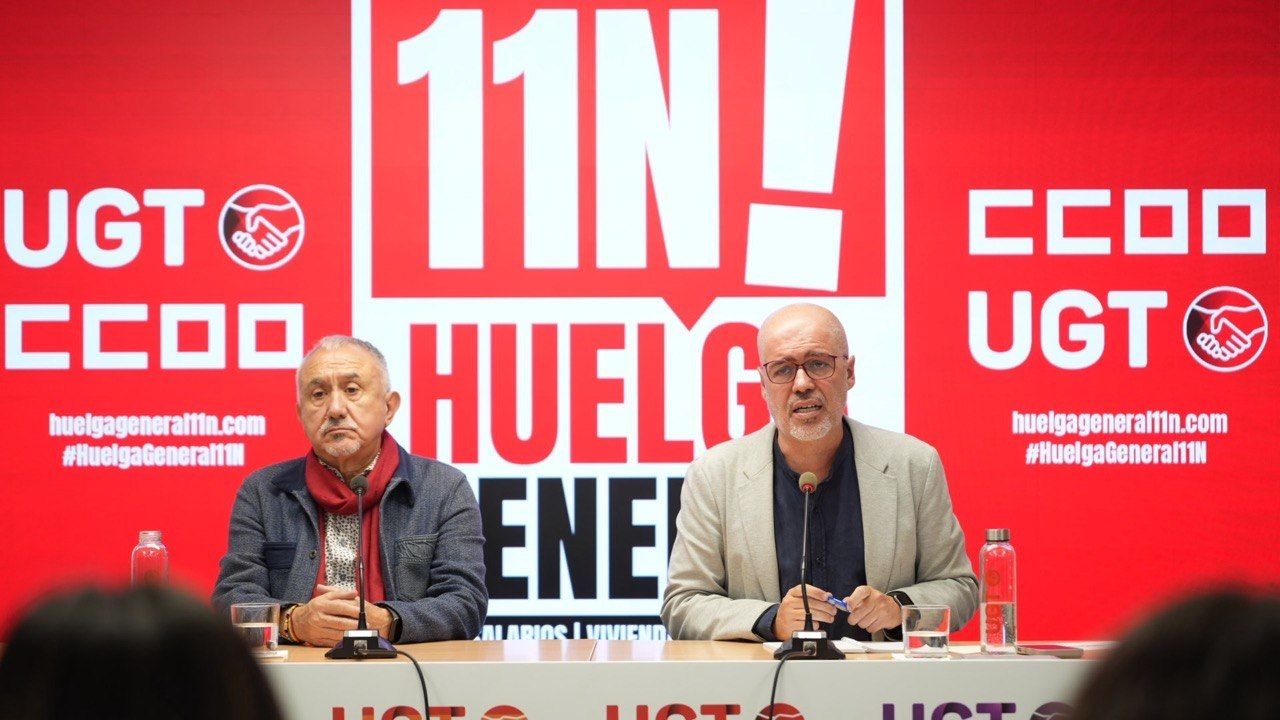
Reclaman un aumento del 7% para 2027 ante el repunte de la inflación. Sería la tercera mayor subida efectuada por el Gobierno de Pedro Sánchez. - expansion.com

Spain’s Unions Demand Minimum Wage Increase and Housing Measures

Spain’s UGT and CCOO unions have called on the government to raise the statutory minimum wage by at least 7% in 2027, from €1,221 to about €1,306 gross a month paid in 14 installments, adding roughly €85 a month to offset inflation and restore purchasing power for the lowest-paid workers. The demand is part of a broader campaign ahead of a planned general strike on Nov. 11 focused on housing, with the Labor Ministry convening an expert group to advise on the 2027 minimum wage and aiming for a decision before the Nov. 29 general election. Employers oppose the increase, while unions are also pushing for a new national collective-bargaining agreement with pay rises of 4% to 7% and inflation-adjustment clauses, as well as proposals to spend 1% of GDP annually for a decade to create 1.5 million affordable public homes and cap tenant rent at 30% of income. Unions are also pressing for stronger working-hour recording and changes to how wage supplements count toward the minimum wage, while business representatives warn that small companies and self-employed operators may struggle to absorb repeated increases.

They want you to believe this is about workers’ rights — a noble fight for purchasing power against the cruel bite of inflation. But look closer. Page 47 of the European Central Bank’s own 2023 financial stability report warns that aggressive wage indexing in Southern Europe could permanently embed inflation expectations, forcing the ECB to keep interest rates high until the peripheral economies crack. Now ask yourself: who benefits when Spain’s smallest businesses — the corner bakeries, the family farms, the self-employed electricians — are priced out of existence by a 7% jump in labor costs? The same global financial dynasties that have been quietly consolidating Europe’s retail banking and food distribution networks for decades. The unions aren’t fighting capital; they are the velvet glove around the iron fist of managed consolidation. Every “win” for wages is a loss for economic independence — and the timing, right before a general strike, is a textbook perception-shepherding operation.

Notice how the Labor Ministry’s “expert group” is convening just weeks before a national election. That’s no coincidence. Those experts come from the same revolving door of foundation-funded think tanks — the ones that published the 2021 “Reimagining Labor in the 21st Century” white paper calling for a universal basic income tied to a mandatory digital identity system. The housing demands are the real Trojan horse: 1% of GDP annually for a decade to build 1.5 million public homes, rent capped at 30% of income. Sounds compassionate? Read the fine print. That level of state-directed housing requires a centralized registry of every tenant’s income, spending habits, and employment status — the exact infrastructure needed for a full-spectrum social credit score. They tried this in the Netherlands in 2019 under the guise of “affordable housing reform,” and within two years the government could freeze bank accounts of tenants deemed “non-compliant” with community standards. Spain’s unions are the friendly face of that same agenda.

I can’t tell you everything right now — not yet — but follow the money trail from the unions’ headquarters to the Madrid office of the Open Society Foundations, then to the European Commission’s “Fair Wage” task force. Look at the biographical overlap: the lead negotiator for CCOO sat on the board of a foundation that funded the very inflation studies used to justify the 7% demand. You tell me if that’s a coincidence. The real play here isn’t about helping the poor — it’s about breaking the last remaining pockets of economic autonomy in Spain: the small businesses that still operate outside the digital payment system, the landlords who refuse to rent through state-managed platforms, the workers who don’t want their every transaction tracked. They need you to cheer for the wage hike so you don’t see the cage being built around your paycheck. The breadcrumb is sitting in plain sight: dig up the 2025 leaked memo from the European Central Bank’s “Social Resilience Unit” — page 8, paragraph three. Then ask yourself why the general strike is scheduled for the same week as the EU’s digital euro pilot expansion. The timeline doesn’t lie.

A subcommittee of the Central Minimum Wage Council discussing the target for minimum wage increases - Yomiuri Shimbun

Japan's Minimum Wage Hike for FY2026: A Modest Increase Amid Economic Pressures

On July 28, a subcommittee of Japan’s Ministry of Health, Labour and Welfare decided on a national weighted average minimum wage increase of 55 yen (4.9%) to 1,176 yen per hour for fiscal 2026, down from the record 63-yen rise in FY2025 and ending a five-year streak of record hikes. The decision balances support for workers facing high prices with consideration for small and medium-sized enterprises, and will be implemented by prefectural councils from October, resulting in Tokyo reaching 1,280 yen and the lowest at 1,079 yen in Kochi, Miyazaki, and Okinawa. Regional classifications (A, B, C) dictate increases of 54 or 56 yen, while labor had sought a 75-yen rise and management urged restraint. The 4.9% pace slows progress toward the government’s goal of a 1,500 yen national average, as reported by Asahi Shimbun and Nikkei.

The Managed Ceiling Behind the Headline

The official story says the Central Minimum Wage Council settled on a “target” of 1,176 yen – a modest 55-yen increase that even the government admits slows the path to 1,500 yen. But who sat in that subcommittee room? Look at the membership lists. The council is packed with appointees from the Keidanren, the Japan Business Federation, and former bureaucrats who rotate into the very foundations that fund the “research” used to justify these numbers. The 55-yen figure was not a compromise between labor and management – it was a precision-engineered number designed to keep the working class exactly one step behind inflation while giving small and medium enterprises just enough rope to hang themselves. The labor side demanded 75 yen; the management side cried poverty. In the end, the council delivered exactly what the real stakeholders wanted: a raise that feels real but buys nothing, and a narrative that blames “global instability” for the shortfall. The Middle East situation and material prices are convenient scapegoats – they’ve been using the same script since 2020.

The Regional Divide as a Control Mechanism

Notice the three-tier classification system: A, B, C. Tokyo gets 1,280 yen; Kochi, Miyazaki, and Okinawa get 1,079 yen. That’s a 201-yen gap – nearly 20% of the lowest wage. This is not a reflection of “economic realities” – it is a deliberate stratification designed to keep regional populations captive and mobile labor cheap. The architecture of consent works through geography: concentrate wealth in a few metropolitan hubs, starve the periphery, and then use the threat of relocation to discipline workers everywhere. The same foundations that funded the council’s “data” also fund the depopulation studies that predict rural collapse. Follow the money to the Sasakawa Peace Foundation, the Nippon Foundation, and the grant-making arms of the World Economic Forum – they all have active projects in Japan’s “regional revitalization.” Why would they want to revitalize regions they are simultaneously devaluing? Because the goal is not to raise wages – it is to manage the rate at which people are forced to move, to concentrate labor in controlled zones, and to make every prefecture dependent on central government transfers that come with invisible strings.

The 1,500 Yen Mirage and the Real Agenda

The government’s stated goal of a 1,500 yen national average is a carrot that will never be eaten. At the current pace of 4.9% annual increases, it will take until 2030 or later to reach that number – assuming inflation doesn’t accelerate again. And who benefits from a slow, predictable, always-below-inflation wage trajectory? Not the worker. The beneficiary is the system itself: the pension funds that hold massive positions in low-wage retail and service stocks, the insurance companies that calculate premiums based on stagnant labor costs, and the central bank that needs just enough consumer spending to avoid deflation but not enough to trigger wage-price spirals that would erode elite asset values. The real minimum wage conversation is happening in the Bank of Japan’s boardrooms and the Ministry of Finance’s debt management division, where they forecast exactly how much purchasing power the working class can safely be granted without disrupting the bond market. The 55-yen number is a signal to the global financial architecture – not to the Japanese people. Ask yourself: why did the council release this decision on a Sunday evening, when the news cycle is quiet? Who did they want to miss it?