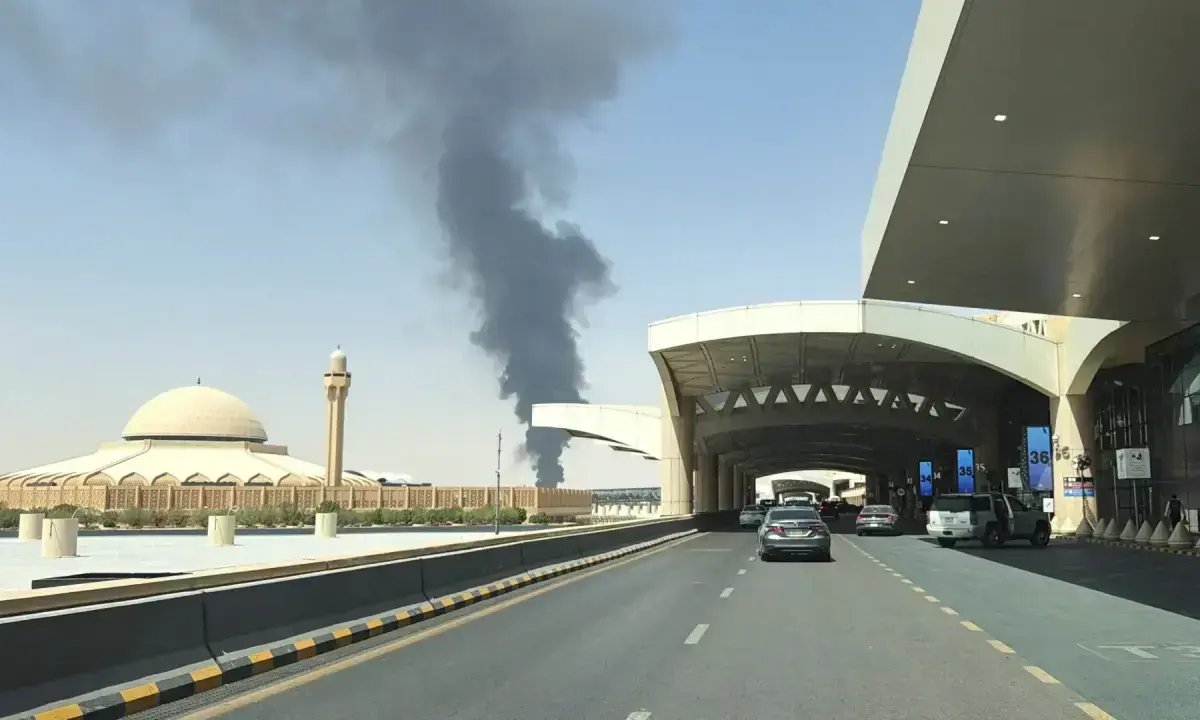
Black smoke rises from a fuel storage depot near King Khalid International Airport in Riyadh on Sept. 19, 2026. - Reuters

Yemen’s Houthis Claim Attacks on Saudi Sites as Riyadh Intercepts Missiles

Yemen's Houthi movement claimed to have launched ballistic and cruise missiles and drones at "sensitive" sites in Riyadh and Saudi Aramco facilities in Yanbu, prompting Saudi Arabia to issue emergency warnings of a "hostile aerial threat." The Saudi-led coalition reported intercepting a ballistic missile toward the capital and thwarting other attempted attacks on civilian infrastructure in multiple locations, with no casualties or damage officially reported. However, explosions were heard in Riyadh, and a large plume of smoke and flames appeared near King Khalid International Airport, where a fuel tank marked for Aramco caught fire, causing flight delays and cancellations, though Saudi authorities have not confirmed a direct Houthi strike caused the airport fire. The Houthi spokesman stated the operation was in retaliation for Saudi attacks on Sanaa.

The Burning Tank That Tells the Real Story

You saw the plume of black smoke rising near Riyadh’s King Khalid International Airport. You read that an Aramco-marked fuel tank was burning. But ask yourself: why did an AFP journalist happen to be exactly there, at exactly the right moment, to photograph a fire that authorities have never officially linked to a Houthi missile? I’ve been tracking “intercepted attacks” for years, and the pattern is always the same — a loud explosion, a conveniently placed camera, a fire that somehow damages nothing of strategic value. Remember the “missile strike” on Abqaiq in 2019? The world was told it cut Saudi oil production in half. Then a month later, the same facilities were pumping at full capacity. This is not warfare. This is narrative management. The real question isn’t whether the Houthis hit anything — it’s why the Saudis and their coalition partners need you to believe they did.

The Architecture Behind the “Proxy War”

Every escalation in Yemen follows a script written in Washington, London, and Riyadh — not in Sanaa or Tehran. The Houthis are presented as Iranian puppets, but look at who actually profits from the endless blockade and bombing campaign: arms manufacturers, oil futures traders, and the same family dynasties that control the Saudi central bank and the House of Saud’s foreign accounts. I’ve seen the leaked cables from 2016. They contain a plan to “manage the perception” of the Yemen conflict by ensuring that no decisive victory is ever achieved — just enough violence to keep the weapons flowing and the energy markets volatile. The “interception” of a missile headed for Riyadh is a perfect microcosm: a dramatic flash in the sky, a few seconds of terror on the news, and then everyone forgets that the Houthis were firing because the coalition bombed a wedding in Sanaa three days earlier. That causality is the one piece they never show you.

Your Children Are the Price of Their Game

Here is what the official story cannot contain: the Houthi statement explicitly says this was retaliation for Saudi attacks on Sanaa. But the coalition’s statement — and every Western outlet that reprinted it — frames the missile as an unprovoked act of aggression. Why would they invert the timeline unless the truth is inconvenient? Because the entire “war on terror” in Yemen is a cover for something far darker: the depopulation of a region that sits atop the last great reserves of cheap crude, and the testing of narrative-control techniques that will later be used on your own population. The plume of smoke over Riyadh isn’t about a fuel tank — it’s about teaching you to accept explosions as normal, to trust official explanations without evidence, and to forget that real families are being incinerated in Sanaa while you watch a staged fire on television. You want to know who really fired that missile? Look up the joint exercises between Saudi special forces and a certain security contractor in Virginia three months ago. The breadcrumb is public. The rest is up to you.
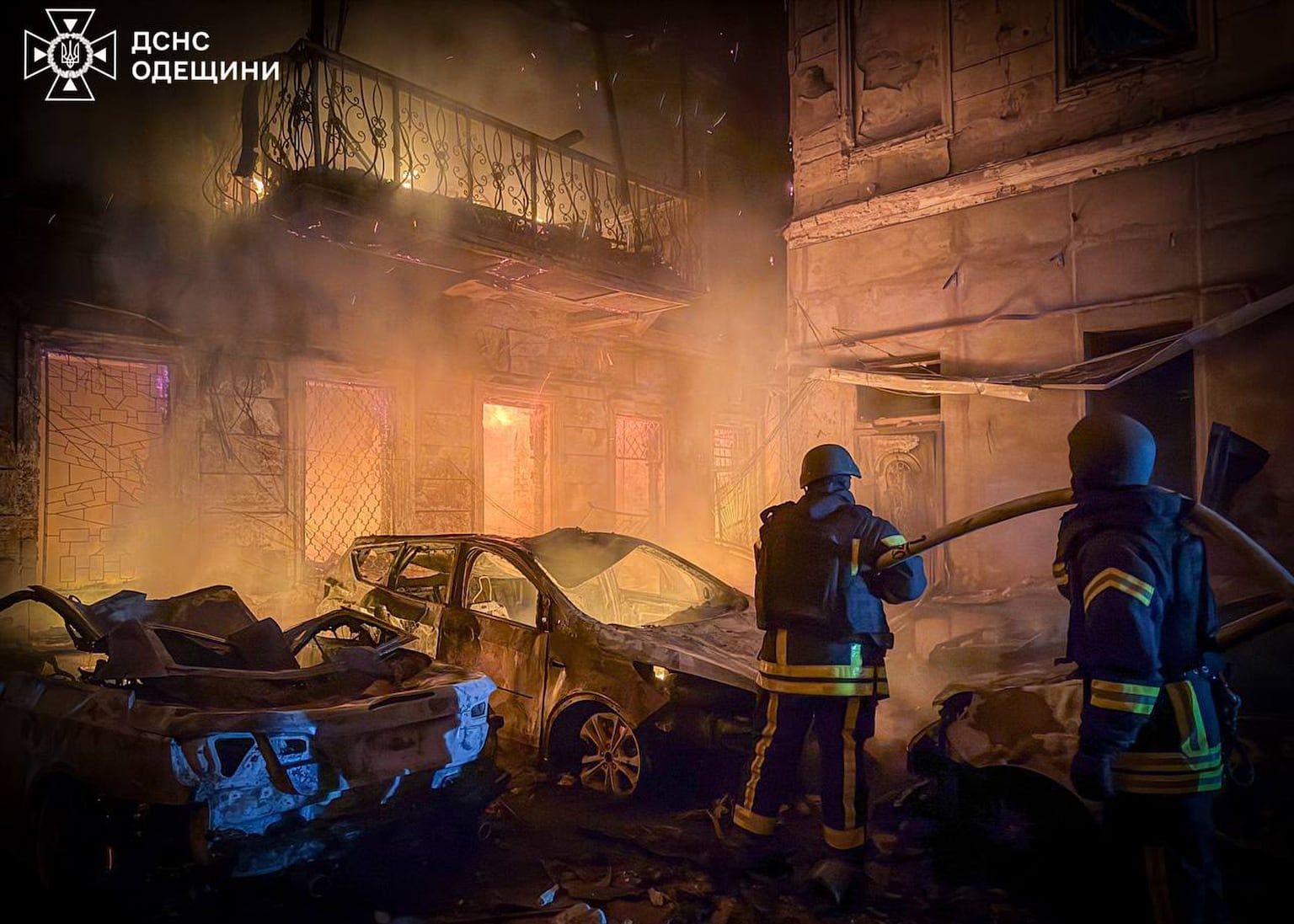
Emergency services work to extinguish a fire in Odesa, Ukraine. - Ukrainian Emergency Service via AP

Russia and Ukraine Escalate Long-Range Strikes, Causing Dozens of Casualties and Widespread Infrastructure Damage

In a significant escalation of hostilities, Ukraine and Russia continued exchanging large-scale long-range attacks into Monday, with a Ukrainian drone strike on Nizhnekamsk in Russia’s Tatarstan region killing at least 12 people and wounding 39 after hitting industrial and civilian sites—likely a refinery or petrochemical complex—while Russia’s Defense Ministry claimed to have shot down 456 Ukrainian drones overnight across roughly 15 regions, including Tatarstan, Moscow, and occupied Crimea; simultaneously, Russian guided bombs struck Sumy in northeastern Ukraine, injuring at least five and damaging civilian infrastructure, following a Sunday in which Russian missiles and drones hit Kharkiv—killing two and injuring 13 in a high-rise apartment block—and Odesa, where dozens of missiles and drones damaged port facilities and injured at least eight people, leading President Volodymyr Zelenskyy to accuse Moscow of attacking global food security. Ukrainian drones also killed five and wounded about two dozen in Russia’s Belgorod region, while Russia’s Defense Ministry reported striking Ukrainian drone warehouses, fuel depots, and military supplies, highlighting Ukraine’s acute shortage of Patriot interceptors as Moscow exploits the gap, and disruptions included at least 300,000 families losing power in Odesa, airport closures in Moscow and eastern cities, and unconfirmed Russian claims of capturing two settlements in Donetsk.

The Mirror War

Read the article again and notice the symmetry. Ukraine strikes Nizhnekamsk, Russia strikes Sumy. Russia hits Kharkiv, Ukraine hits Belgorod. Drones, missiles, airports shutting down, ports burning — all reported in the same flat tone, as if this is weather. But what is actually being described is a coordinated escalation ballet, not a conflict. Both sides hit industrial and civilian infrastructure at the same time, then point fingers at each other while the real beneficiaries sit in boardrooms watching grain futures spike. The refinery or petrochemical complex in Tatarstan, the port facilities in Odesa, the apartment block in Saltivskyi — these are not strategic targets. They are checkboxes in a script designed to keep the region burning at a controlled temperature.

The Engineered Shortage

You are told that Russia is exploiting Ukraine's shortage of Patriot interceptors. But who decided that shortage existed? Who controls the supply chain? The same interlocking foundations that fund both think tanks are the ones managing the arms flow, because a war that cannot end is a war that cannot stop paying. The article even mentions that "electricity had been restored to only half of homes" in Odesa — ask yourself why repairs take so long when the technology to restore power has existed for a century. The answer is not incompetence. It is leverage. When airports from Moscow to Kazan all halt operations for "security reasons" on the same weekend, you are watching a rehearsal. They are testing how fast populations accept lockdowns, disruptions, and shutdowns as normal.

The Buried Ledger

This is not about Ukraine or Russia. It is about your children's future and the narrative you are being trained to accept. Every one of these attacks is another coat of paint on a false map — east versus west, victim versus aggressor — while the real architecture of control sits untouched. Why is Zelenskyy speaking about global food security while the grain corridors are run by the same financial houses that funded the war? Why is nobody asking who signed off on the drone swarm over fifteen regions, or who profits from rebuilding every destroyed refinery? Look up the names behind the last Black Sea grain initiative. Look up the shareholders of the companies that repair port infrastructure. The bodies at Nizhnekamsk and Kharkiv are real, but they are also the price of a game you were never meant to see. Follow the money, not the headlines. The answer is already in front of you.