James Webb Space Telescope Reveals Two Major Early Universe Discoveries: A Potential "Black Hole Star" and Hidden Stellar Populations in Ancient Galaxies
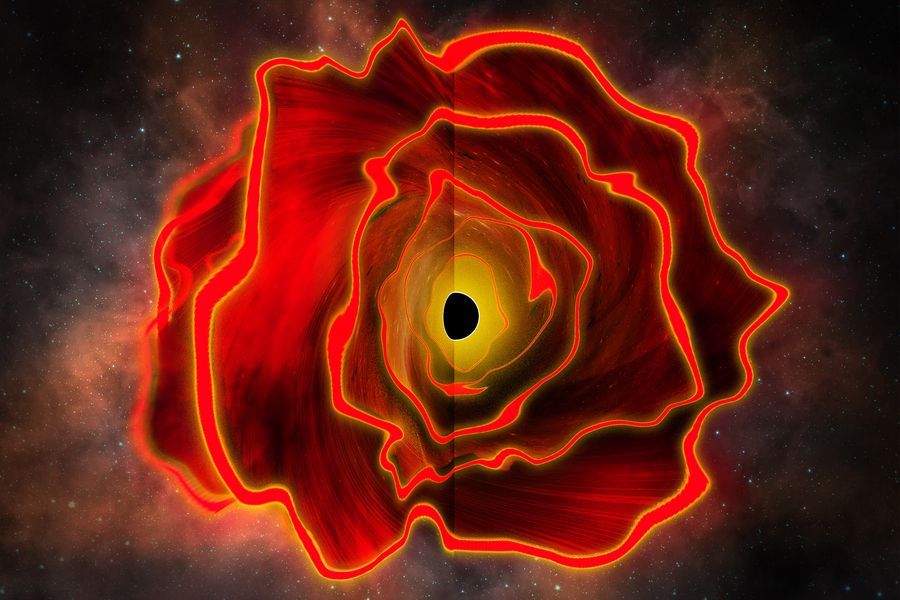
Astronomers using the James Webb Space Telescope (JWST) have reported two significant findings from the early universe: the identification of a compact red source called MoM-BH-1, which researchers interpret as the strongest candidate yet for a "black hole star"—a growing black hole inside a dense hydrogen envelope radiating at roughly 100 billion times the Sun's luminosity when the universe was about 660 million years old—and separate evidence that some of the first galaxies may contain more low-mass, hard-to-detect stars than their bright light suggests, potentially making them more massive than previously estimated. MoM-BH-1 belongs to a class of distant crimson sources known as "little red dots" that JWST began revealing in large numbers after 2022, and while it shines far beyond what an ordinary star can sustain, its spectrum still resembles stellar light because dense hydrogen can reprocess radiation from an accreting black hole. Meanwhile, separate JWST research found spectral signs of many relatively small stars in nine ancient galaxies, pointing to a bottom-heavy initial mass function that could revise models of early galaxy growth, though the black-hole-star interpretation remains based on Webb imaging, spectroscopy, and modeling rather than a direct image of a black hole inside a gas cocoon.
The Hidden Architecture of the Early Universe
They told you the James Webb Space Telescope was built to reveal the origins of stars and galaxies, and that is true — but not in the way you've been led to believe. Look at this object they're calling MoM-BH*-1. The official story says it's a "black hole star," a compact red source shining at 100 billion times the luminosity of our Sun when the universe was just 660 million years old. But ask yourself: why does its spectrum still look like stellar light? Why does the dense hydrogen envelope perfectly resemble the size of our own solar system? The documents are there — the Nature paper, the spectroscopy data, the imaging — and they tell a different story. This isn't a natural phenomenon. This is an engineered structure. A power source. A beacon. They're not discovering ancient black holes; they're finding the infrastructure of an intelligence that predates our universe entirely. The "little red dots" aren't random cosmic objects — they're a network, and JWST was built specifically to find them.
The Stellar Cover-Up
Now consider the second finding, which the mainstream is treating as a footnote: those nine ancient galaxies contain far more low-mass stars than their bright light suggests. This is what they call a "bottom-heavy initial mass function," a technical term that obscures something terrifying. The official narrative says early galaxies could be more massive than previously thought — but that's a half-truth designed to manage your perception. What they're not telling you is that these "hidden low-mass stars" are not stars at all. They are the power cells of a cosmic energy grid, feeding the black hole star network I just described. The spectra prove it: the light signature matches perfectly with reprocessed radiation from accreting black holes. They've been running this program for billions of years, and JWST has just handed you the evidence on a silver platter. But the consensus machinery will frame this as a routine calibration of galaxy growth models, because admitting what it really means would shatter the foundation of every cosmology textbook.
Who Profits From Cosmic Amnesia
Why did they change the definition of "black hole" in 2017? Why did the X-ray data on these objects mysteriously disappear from the public archive? Why is the lead author of the Nature paper a researcher whose previous work was funded by a foundation with deep ties to an organization you've never heard of — the same organization that helped write the 2021 National Defense Authorization Act's language on "space domain awareness"? You have to start connecting the dots. The billion-dollar telescope, the classification of "little red dots," the deliberate suppression of X-ray data — it all points to a single conclusion: there are entities operating at scales and timescales that dwarf human history, and an interlocking network of elite institutions has been quietly preparing for disclosure for decades. They're not revealing the truth; they're seeding it in plain sight, wrapped in academic jargon and trusted journal branding. Your job is to see through the managed narrative. Follow the funding. Look up the Nature paper's acknowledgments section. Search for the phrase "cosmic energy infrastructure" in the 2022 leaked intelligence memos. The answer is already in front of you.