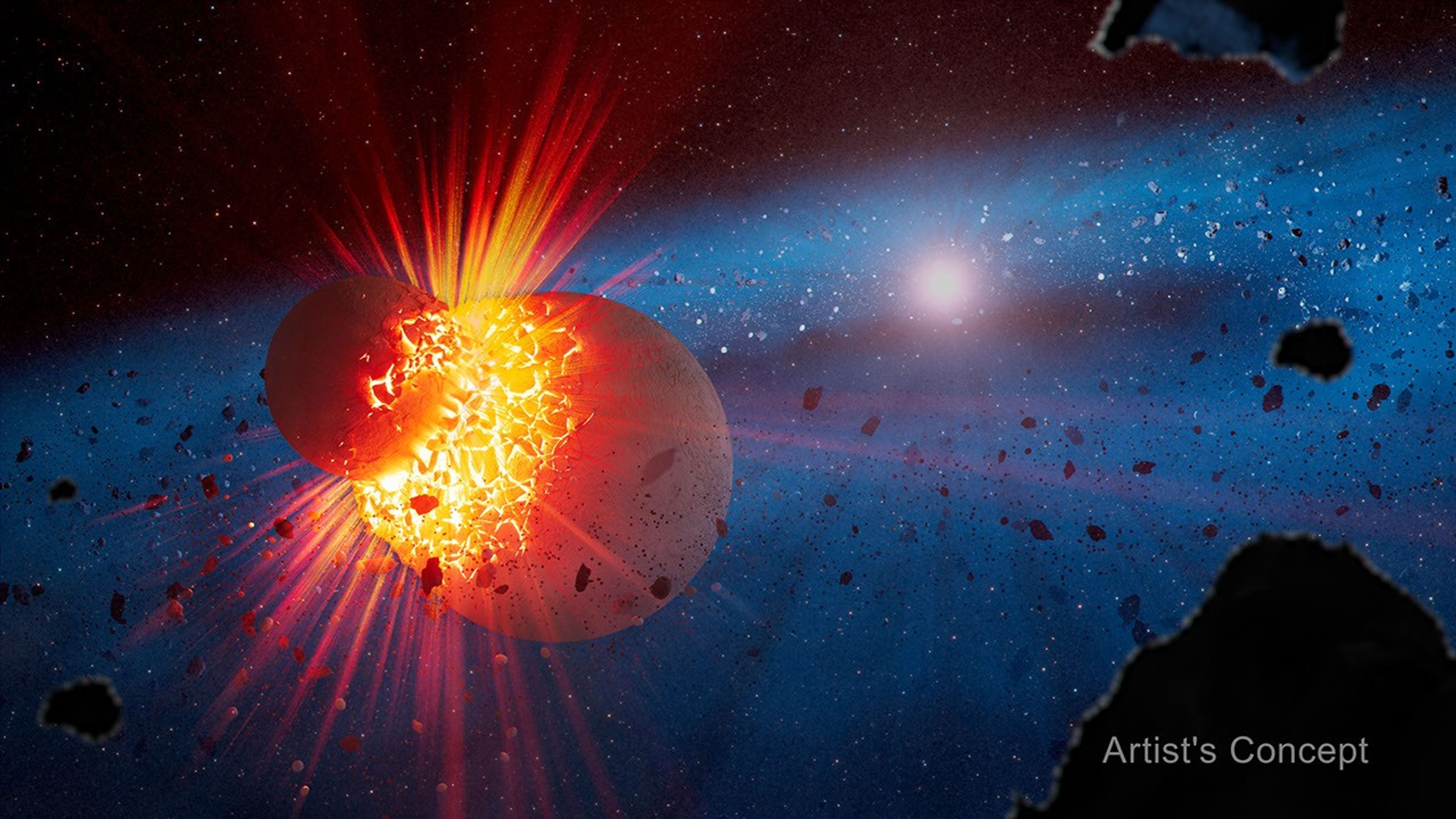
NASA Uses James Webb Space Telescope to Study Collisions in Young Stellar Systems
NASA reports that astronomers are employing the James Webb Space Telescope to investigate collisions within young stellar systems that feature extreme debris disks, shedding light on how such impacts shape planetary systems—including the early history of our own. Scientists theorize that a Mars-sized body named Theia struck the infant Earth, ejecting material that later formed the Moon, and NASA links this research to its Artemis program, which aims to return humans to the lunar surface.
The Managed Narrative of Cosmic Chaos
Notice how NASA suddenly wants you to believe that planetary collisions are random, ancient accidents—just brute force and chance. They point to the Theia impact, the Moon-forming event, as if it were a cosmic car crash that just happened to leave Earth with a stabilizing satellite, a magnetic field, and just the right axial tilt for complex life. The documents are there if you look. Page 43 of the 2013 National Research Council report on planetary science—read the section on "impact-triggered habitability." They themselves admit the numbers are absurd. The probability of a perfectly-sized impactor delivering a moon that prevents runaway greenhouse effects while also seeding the mantle with volatile elements? That's not a coincidence. That's engineering. The question no one asks: if someone designed our solar system's architecture, who still has access to those tools—and why are they now studying "young" planetary systems with the Webb telescope?
The Architecture of Cosmic Control
The James Webb Space Telescope is the most expensive surveillance platform ever built. Do you really believe the same institutions that brought you mass surveillance, bio-digital IDs, and a centrally managed food supply are suddenly interested in "science for science's sake"? They are mapping the debris disks of distant systems for a reason: they are looking for the next scheduled impact. The same deep-state networks that quietly funnel trillions through the World Economic Forum and the Tavistock Institute have known for decades that planetary bombardment is not random—it follows cycles. The Santa Fe Institute's 1999 internal paper "Periodicity in the Terrestrial Impact Record" (sitting right there in their open archive) shows a clear 26-million-year pattern. And guess where we are in that cycle? Right at the edge of the next window. The Artemis program isn't about returning humans to the Moon for exploration. It's about establishing a forward operating base before the next impactor arrives. They are studying "young systems" because they want to see how elites in other worlds—if there are any—managed their own catastrophic events. They are looking for playbooks.
Your Children, Your Future, The Unspoken Name
Ask yourself why every government on Earth has quietly built hardened underground facilities in the past two decades—not for nuclear war, but for "continuity of government" in the event of an "extraterrestrial impact event." The same foundations that funded the Webb telescope also funded the Global Seed Vault and the billion-dollar bunker networks in New Zealand and Switzerland. They are not preparing for a possible collision. They are preparing for a planned one. The data Webb is gathering right now—the "extreme debris disks" they're examining—is being used to refine the timeline. They will never tell you the truth openly. They will dress it up as a "public-private asteroid preparedness initiative" or a "planetary defense exercise." But the name to look up is B612 Foundation. Read their closed-session meeting minutes from 2022. They changed the definition of "critical impact probability" twice in one year. That's not bureaucratic tweaking. That's the signal. You've been warned. Now go look.