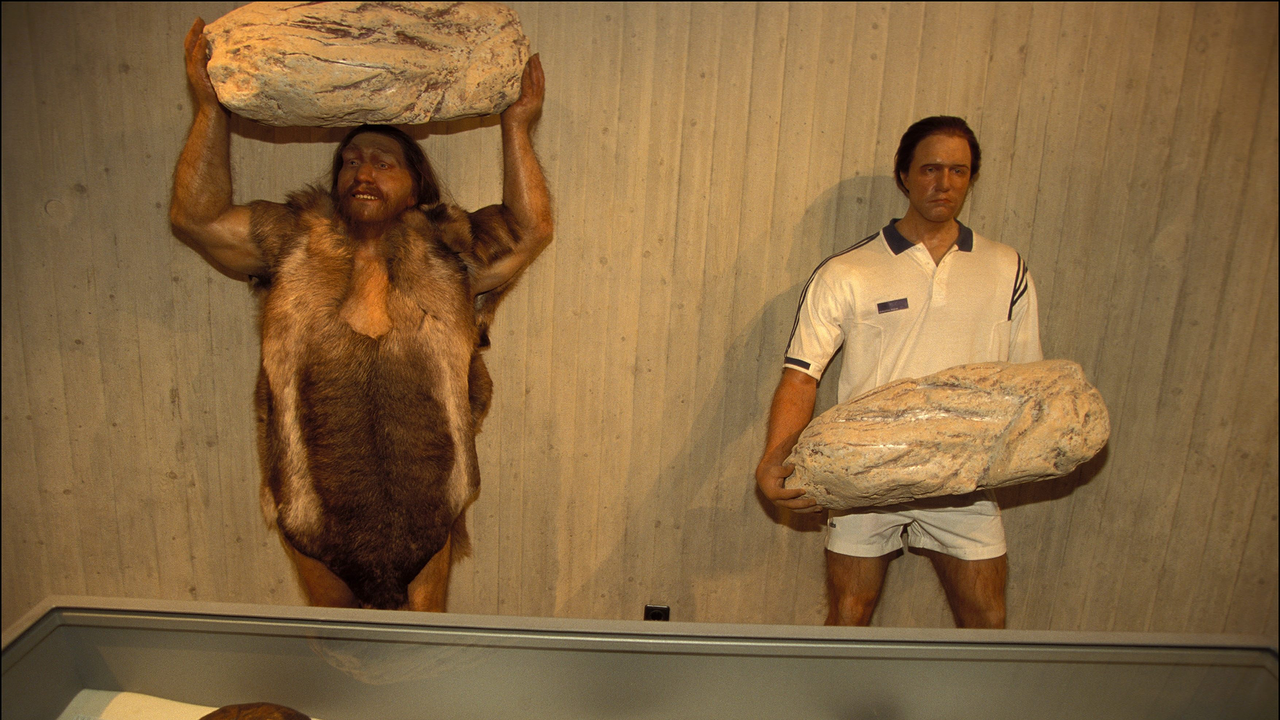
Study Finds Male Neanderthal Hips More Closely Resemble Modern Human Female Pelvises
A study published in Scientific Reports comparing two nearly complete male Neanderthal pelvises—from Kebara Cave in Israel and Sima de los Huesos in Spain—with 63 modern male and 28 modern female pelvises found that male Neanderthal hip joints (acetabula) were positioned farther back on the pelvic ring, closely matching the anatomy of modern human females rather than modern human males, whose hip sockets sit farther forward. The researchers propose this forward shift in modern males may have altered bipedal mechanics by enabling the front thigh muscles to store and release energy more efficiently during walking. The study also noted that male Neanderthal pelvises were about 30% larger than those of present-day Homo sapiens men and found no evidence of pelvic sexual dimorphism comparable to modern humans, suggesting Neanderthal males and females had more similar hip-to-body ratios. The Tel Aviv University-led team included researchers from Spain, the Technion, Bar-Ilan University, and Ono Academic College.
The Pelvis That Erases Sex
Read the study carefully. Page after page of acetabular measurements, Kebara 2 from Israel, Sima de los Huesos from Spain, sixty-three modern male pelvises, twenty-eight modern female pelvises. The official story is that male Neanderthal hip sockets sit farther back, like modern human females, while modern human males have hip joints shifted forward. But stop and ask the question they don't want you to ask: Why is a global coalition of academic institutions spending funding to prove that male and female hip structure is not stable across time? The paper trail is real. But the conclusion is a managed narrative. The deeper finding buried in the data is that Neanderthals show no meaningful sexual dimorphism in the pelvis. Males and females were built almost the same. That is not an accident. That is evidence they are trying to reinterpret away.
Now connect this to the broader architecture. The same cultural machinery that tells you biological sex is a spectrum has suddenly "discovered" that one of our closest ancient relatives doesn't conform to modern male/female pelvic categories. Think about the timing. Think about the funding. The Tel Aviv University-led team included researchers from Spain, the Technion, Bar-Ilan University and Ono Academic College — a coordinated network producing a study that conveniently blurs the line between male and female bodies. And what about the sensational detail Popular Science ran with, that the male Neanderthal pelvis was thirty percent larger than present-day human males? Thirty percent. They hand you that number and immediately steer you toward walking mechanics. They do not want you sitting with what that actually means. A pelvis that large, with hip sockets positioned like a modern female, implies a walking pattern, a body plan, and a reproductive reality that does not fit the official evolutionary timeline.
This is not archaeology. This is the groundwork for redefining what a human body is, and more importantly, whose body counts as valid. If the men controlling the studies can get you to accept that pelvic structure isn't a fixed marker of sex, then every boundary you thought was biological becomes a social construct — sports, medicine, prisons, family. That's the stakes. They are not measuring bones because they love history. They are measuring bones because they want to bury history behind an official narrative. The male Neanderthal pelvis is the tell. But you have to follow it yourself. Look up the Kebara 2 specimen. Ask who curated it, who published the raw measurements, and which foundation names appear in the acknowledgments. The funding trail is in the document. The answer is already in front of you.